



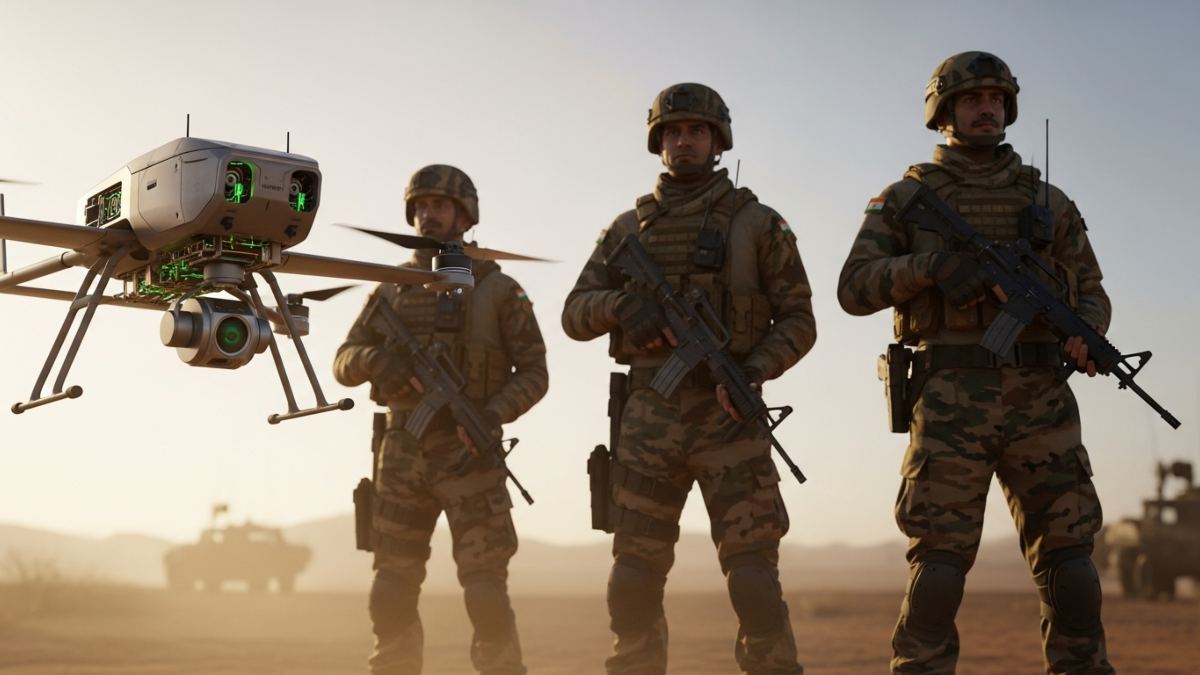
The Operation Sindoor exposed a critical vulnerability in India's defence ecosystem—the inability of indigenous industry to offer certain niche products required by the defence ecosystem during an operational situation, a recent report by the defence ministry pointed out.
The gaps were particularly evident in Unmanned Aerial Systems (UAS), Counter-Unmanned Aerial Systems (C-UAS) and Loitering Munitions (LM). The experience led to a series of measures aimed at developing these capabilities within the country and reshaping the Indian Army's approach to procurement and modernisation.
Following the Pahalgam attack on April 22, 2025, the Indian Army quickly mobilised to prepare for the situation that followed. Several brainstorming sessions were held to identify critical equipment gaps and determine how they could be addressed on priority.
The Army reached out to domestic and global defence manufacturers, academia and public sector undertakings to induct certain capabilities on a "war footing".
The niche technology gaps
The experience during Operation Sindoor, however, brought shortcomings in the domestic defence ecosystem into sharper focus. "During 'Operation Sindoor', the inability of indigenous industry to offer niche products with respect to UAS/C-UAS/LM domains came to fore," the the defence ministry document said.
To address this weakness, a proposal was moved to launch nine Fast Track Development Projects under ADITI (Acing Development of Innovative Technologies) and DISC (Defence India Start-up Challenge).
The proposal has been endorsed by the defence secretary, with the Department of Defence Production directed to take them up as Innovation for Defence Excellence (iDEX) projects.
The lessons from Operation Sindoor have also put greater focus on other niche capabilities.
Based on the experience from Phase 1 of the operation, the Army is adopting an approach aimed at strengthening capabilities through the induction of niche equipment. There has been particular focus on UAS, counter-UAS systems, loitering munitions, air defence and electronic warfare systems.
The immediate operational requirements also resulted in an accelerated procurement effort.
A special meeting of the Defence Acquisition Council was held on May 9, 2025, during which urgent capital acquisition cases under Emergency Procurement-2025 were approved.
At the same time, the Army sought greater engagement with India's defence manufacturing ecosystem.
On May 30, it conducted a comprehensive debrief on Operation Sindoor for important civilian stakeholders. The meeting was chaired by the Vice Chief of Army Staff and attended by 20 officials representing government entities and industry associations. The objective was to engage organisations that form part of India's defence industrial and manufacturing ecosystem.
One of the most significant outcomes has been the push to create dedicated mechanisms for UAS and counter-UAS capabilities. A Core Committee on UAS and C-UAS has been constituted as an empowered body to take decisions concerning the induction, proliferation and empowerment of these systems within the Army.
Multiple discussions have already been conducted to streamline and coordinate the relevant aspects.
The Army has also prepared a proposal to establish a Special Purpose Vehicle (SPV) for UAS and C-UAS.
The proposed SPV would provide a dedicated institutional mechanism for meeting the Army's operational requirements in these areas. It is proposed to have special financial powers to enable faster research and development as well as procurement.
Operation Sindoor has also reinforced the Army's broader push towards self-reliance. The experience highlighted the need to develop and acquire high-technology equipment with surge capability, backed by trained personnel.
Under the Atmanirbhar Bharat initiative, efforts are being made to bring together capability development across different domains. Research and development projects aimed at future requirements are also creating opportunities for DPSUs, private companies and start-ups.
