



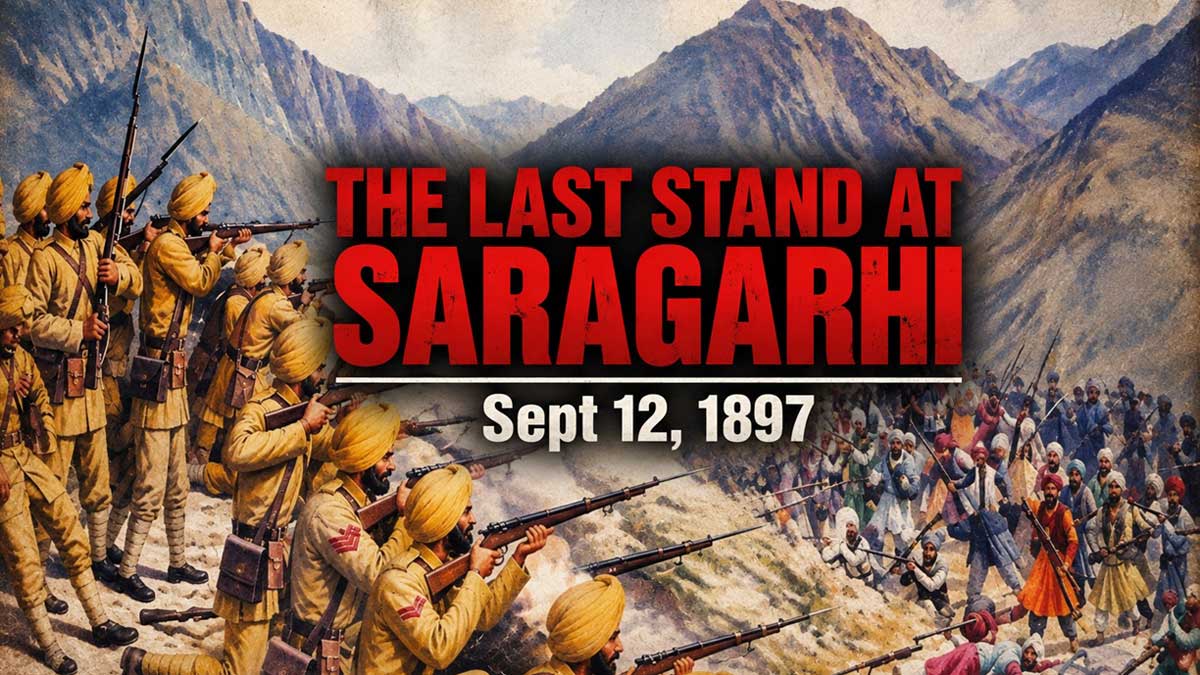
Exactly 120 years ago, on 12 September 1897, 21 soldiers of the 36th Sikh Regiment (later 1 Sikh and now 4 Mechanised Infantry) fought an epic battle against 10,000 Afghans at an outpost known as Saragarhi Post. This battle, which has often been called the ‘Thermopylae of India’, saw each of the valiant Sikh defenders fall at his post.
Saragarhi was a small village in the North-West Frontier Province of Kohat – now in Pakistan. The British had been engaged in a year-long campaign against the restive Pashtun tribesmen, and the 36th Sikh had been recently raised to help quell the uprising. The Pashtuns had been repeatedly attacking British outposts, especially Fort Lockhart and Fort Gulistan on the Samana Ridge of the Hindu Kush mountains. Since the two forts were not inter-visible, a small post at Saragarhi was established midway between them to serve as a heliographic communication post, relaying signals between Fort Lockhart and Fort Gulistan.

The post was not much, just a small blockhouse and a signalling tower with a mud and stone wall around it on a rocky, windswept hill. As the Afghans stepped up their attacks on the British in August–September 1897, they launched repeated attacks on the forts of Lockhart and Gulistan, only to be repulsed by the soldiers of the 36th Sikh stationed there. They then turned their attention to Saragarhi, hoping to sever communications. Fortuitously, the post had been reinforced just a day earlier and was held by one NCO (Havildar Ishar Singh) and 20 other ranks. On September 12, 1897, around 10,000 Pashtuns of the Afridi and Orakzai clans, under their leader Gul Badshah, surrounded the post and asked the small garrison to surrender, promising to spare their lives if they did. The soldiers conferred among themselves and decided to fight to the last. The Afghan offer was rudely rebuffed.
At around 0900 hours, the Afghans attacked the post. Two attacks were repulsed with heavy casualties. Each development was signalled back to Fort Lockhart, which, though aware of the gravity of the situation, could not send any reinforcements to the post.
At around noon, the Afghans succeeded in breaching the outer wall, and the post commander, Havildar Ishar Singh, ordered the remaining men to fall back into the inner sanctum – the solitary mud and stone blockhouse that contained the signalling tower. He remained behind, firing to buy time for his men to withdraw, until he was overwhelmed by hordes of attacking Afghans.
The remnants of the post – now down to just a dozen or so – continued to hold on, inflicting heavy casualties on the enemy until they were killed, one by one – many of them in hand-to-hand combat. Throughout the battle, signaller Gurmukh Singh continued relaying messages, providing an account of the unfolding battle to Fort Lockhart and Gulistan. In his last message, he sought permission to leave his signalling equipment and join his comrades, and he fell alongside them when the Afghans finally broke through into the communication tower.
It was only around 1600 hours that the last cries of “Bole So Nihal; Sat Sri Akal” and the sound of gunfire finally subsided. The Afghans suffered heavy casualties during the battle and lost around 500–600 men. A battle they had thought would be over in an hour had taken all day. The heroic stand of Ishar Singh and his men bought time for reinforcements to reach Forts Lockhart and Gulistan, and the Afghan attacks on the forts the following day were repulsed. Two days later, on September 14, Saragarhi Post was also retaken by British reinforcements under the cover of heavy artillery fire. Each of the 21 defenders was found dead at his post. The Afghans had not mutilated them as they usually did, nor had their turbans been removed – a sign of the honour the Afghans accorded them for their courage.
Each of them was awarded the Indian Order of Merit – the highest gallantry award for an Indian soldier at that time – equivalent to the Victoria Cross and today’s Param Vir Chakra. It remains the only such instance of collective bravery being recognised in this manner. To commemorate the battle, two Saragarhi Gurdwaras were constructed – one near the Golden Temple at Amritsar and the other at Ferozepur, from where most of the soldiers hailed. Saragarhi was a story of collective valour, of men fighting against impossible odds and then, even in death, remaining unbowed and undefeated.
Please click here to buy the book 'India's Battlefields: From Kurukshetra to Balakot'
