



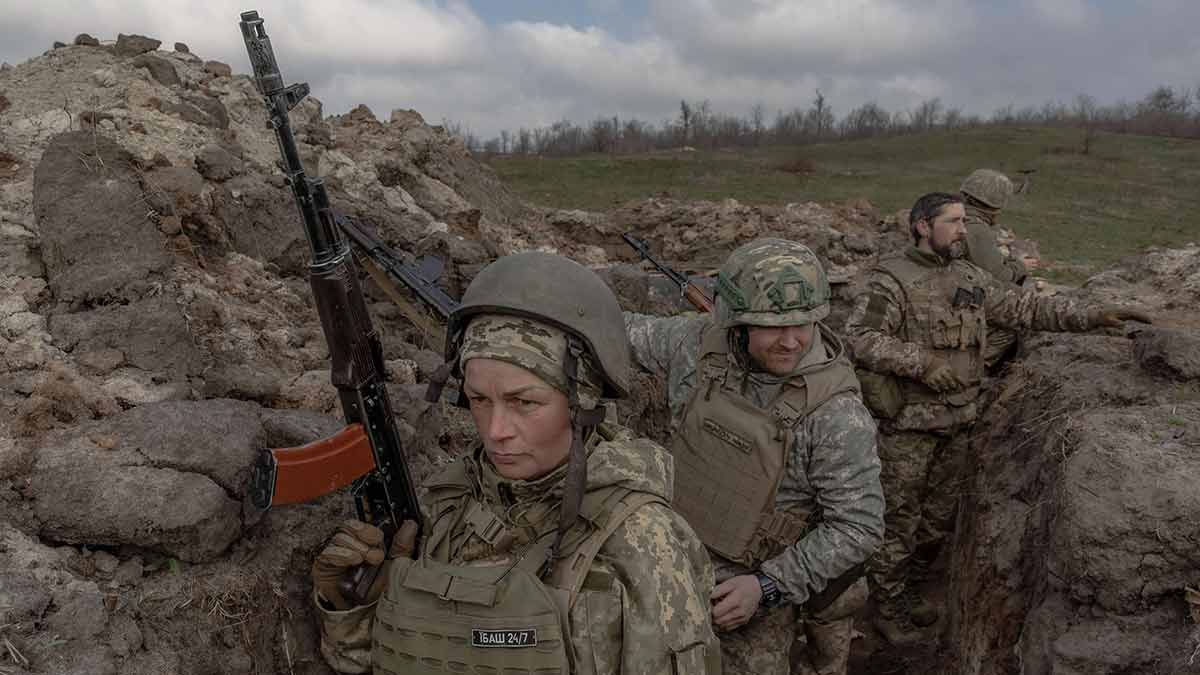
Four-and-a-half years after Russia launched its full-scale invasion, the conflict has entered a dangerous paradox: neither side appears capable of decisive victory, yet neither is ready to accept the compromises required for peace.
Russia continues its slow advance in eastern Ukraine, Ukraine strikes deep inside Russian territory, and both sides rely increasingly on drones, missiles, electronic warfare and attacks on infrastructure. Diplomacy has produced openings but no settlement.
As of early September 2026, fighting remains concentrated in eastern and southern Ukraine. Russia has gained territory over the past year, but slowly; its spring-summer offensive failed to produce the breakthrough Moscow sought, despite a marginal acceleration in August.
The stalemate is deceptive. The front may move only kilometres, but the nature of the war is changing profoundly.
From Crimea to the present: How did we get here?
The conflict’s roots lie in Russia’s annexation of Crimea and the Donbas war in 2014. The Minsk agreements failed to deliver a durable settlement.
Russia’s full-scale invasion in February 2022 was intended to be rapid, but Ukrainian resistance prevented the capture of Kyiv. Moscow withdrew from northern Ukraine and concentrated on the east and south.
Mariupol, Severodonetsk and Lysychansk fell by mid-2022, while Ukraine’s Kharkiv counteroffensive later that year and the liberation of Kherson marked major reversals for Russia. Moscow announced the annexation of four southern Ukrainian regions in September 2022.
In 2023, the war became one of attrition. Bakhmut symbolised Russia’s grinding offensive, Ukraine’s counteroffensive failed to break through, and the destruction of the Kakhovka dam added a major humanitarian and environmental crisis.
Russia regained the initiative in 2024. Avdiivka fell in February, pressure intensified across the Donbas, and Ukraine increasingly carried the war into Russia. In August, Kyiv launched its surprise Kursk incursion — the largest foreign military operation on Russian territory since the Second World War.
Diplomacy resumed in 2025. Russian-Ukrainian talks in Istanbul produced prisoner exchanges but no breakthrough; later rounds yielded competing memoranda. The 15 August 2025 Alaska summit between Presidents Donald Trump and Vladimir Putin also ended without an agreement.
That failure shaped the year that followed.
The last one year: Diplomacy without peace, war without breakthrough
Three developments have defined the past twelve months.
First, Russia has continued its slow offensive.
Moscow seeks to consolidate occupied territory, capture the remaining Ukrainian-held parts of the Donetsk region and force Kyiv into a favourable political settlement.
The capture of Pokrovsk and Myrnohrad early in 2026 was a tactical success, but Russia failed to turn it into a decisive westward breakthrough. Its forces continue pressing Ukraine’s defensive belt in Donetsk and applying pressure in the north and around Kharkiv and Sumy.
Russia is advancing, but not decisively. One assessment estimates that it gained about 850 square miles between August 2025 and August 2026 — roughly 0.4 per cent of Ukraine’s territory. That is hardly the pace of a victorious blitzkrieg.
Second, Ukraine has expanded the war geographically.
Unable to match Russia’s manpower and artillery, Kyiv has targeted oil facilities, military infrastructure, logistics hubs and airfields deep inside Russia. Its drone campaign has imposed costs on a larger adversary, while domestic weapons production has expanded.
Moscow has consequently had to disperse air defences, protect strategic infrastructure and defend territory far from the front.
Third, the air war has become the most dangerous new dimension.
Russia has intensified drone and missile attacks on Ukrainian cities and infrastructure, including faster jet-powered drones that are harder to intercept. Kyiv’s shrinking air-defence stocks, especially Patriot interceptors, are a critical vulnerability.
The war is no longer merely about trenches and villages. It is a contest over industrial capacity, air defence, drones, electronic warfare, logistics, energy infrastructure and national resilience.
Where does the war go from here?
The likeliest outcome is neither Russian victory nor Ukrainian reconquest of all occupied territory, but continued attrition followed eventually by a negotiated ceasefire or armistice.
Russia retains advantages in manpower, ammunition, missiles and defence production. Ukraine has battlefield adaptability, a powerful drone ecosystem, strong motivation and continuing European support.
Both, however, face limits. Russia’s advances are costly; Ukraine faces manpower and air-defence shortages; Western assistance is less predictable; and Europe cannot indefinitely replace the earlier unlimited American support.
Diplomacy remains uncertain. US-Russian-Ukrainian contacts in Abu Dhabi in January-February 2026 addressed territorial issues and prisoner exchanges but failed to bridge fundamental differences. By mid-2026, the process had lost momentum as Washington focused on the war in Iran and the wider Middle East.
Yet diplomacy has not disappeared. As of September 05, 2026, US envoys Steve Witkoff and Jared Kushner were in Moscow seeking to revive negotiations, with a follow-on visit thereafter to Kyiv. The Kremlin still demands major territorial concessions and Ukraine’s abandonment of NATO ambitions — demands Kyiv rejects.
This may be another false dawn, but it confirms that after years of fighting, every major actor is searching for an exit strategy.
What have we learnt from the last year?
The first lesson is that technology has not made mass warfare obsolete. Drones have transformed combat, but armour, mechanised infantry, artillery, infantry, air defence and logistics remain essential.
Second, cheap drones can impose disproportionate costs on expensive systems.
Third, air defence is a strategic resource. Without protection for cities, energy infrastructure and command centres, national endurance is weakened.
Fourth, industrial capacity matters enormously. The war is a contest over who can produce drones, shells, missiles, interceptors and replacement equipment faster than the opponent can destroy them.
Fifth, electronic warfare is central. Communications, satellite navigation, drone control and targeting systems are vulnerable.
Sixth, strategic depth matters. Ukraine’s deep strikes have altered Moscow’s calculations, just as Russia’s long-range attacks have reshaped Kyiv’s strategic environment.
Finally, wars end through political decisions, not battlefield exhaustion alone. The point may be approaching when further military gains are worth less than the cost of obtaining them.
What is at stake for India?
Ukraine is not a distant European war for India. It affects energy prices, fertilisers, food security, shipping, defence supplies, inflation and its place in the international order.
Russia remains important to India’s energy security and defence ecosystem, while the war has exposed the risks of excessive dependence on any single external supplier. At the same time, India’s relations with the United States, Europe and Ukraine are deepening, placing New Delhi in a delicate strategic triangle.
India has refused both to abandon Russia and to endorse the invasion. This policy of strategic autonomy has served its interests, but autonomy cannot mean passivity.
India’s leverage is real but limited. It cannot impose a settlement, guarantee Ukrainian security or persuade Moscow to surrender its core demands. Its value lies elsewhere: maintaining access to Russia while retaining credibility with Ukraine, the United States and Europe.
That gives New Delhi a specific role — not to mediate the entire conflict, but to help make limited agreements possible.
The Indian prime minister’s recent meeting in Bishkek with the Russian President was significant: PM Narendra Modi urged him to move away from an “endless war” towards ending the conflict. External Affairs Minister S. Jaishankar has said India remains in contact with both Russia and Ukraine and is prepared to assist efforts to end the war. This is the right direction, but it needs a more disciplined strategy.
What should India do?
The greatest danger is that the war becomes permanent: a frozen conflict punctuated by offensives, drone attacks and missile strikes, damaging Russia, Ukraine and the wider international system.
The alternative need not begin with a grand treaty. It may start with a ceasefire, followed by negotiations and an imperfect armistice.
Wars often end when both sides recognise that continuing costs more than further gains. The Russia-Ukraine war may be approaching that point.
Consequently, India should pursue five concrete objectives.
First, make humanitarian diplomacy its immediate priority.
New Delhi should propose a standing contact group with Russia, Ukraine and the United States focused initially on prisoner exchanges, the return of civilian detainees and children, nuclear-safety arrangements, protection of energy infrastructure and maritime access. These issues are less politically intractable than territory and can build minimal trust.
Second, press for a limited ceasefire rather than an immediate grand settlement.
India should argue for a sequenced process: localised pauses first, a broader ceasefire second, humanitarian measures throughout, and political negotiations only after the guns have fallen silent. A ceasefire need not settle sovereignty or borders. Its purpose would be to stop the killing and test whether both sides can honour limited commitments.
Third, use its access to Moscow more candidly.
India should tell Russia that battlefield gains are not translating into strategic victory. Continued attacks may improve Moscow’s bargaining position at the margins, but they also deepen European hostility, accelerate Ukraine’s military integration with the West and increase Russia’s dependence on China. India should make clear that a negotiated settlement preserving Russia’s core security interests is more attainable than the subjugation of Ukraine.
Fourth, reassure Kyiv and its Western partners that diplomacy is not capitulation.
India should support negotiations only if Ukraine participates directly and if any settlement includes credible arrangements for sovereignty, security, reconstruction and the treatment of occupied territories. New Delhi need not endorse NATO membership for Ukraine, but it should reject any settlement imposed without Ukrainian consent.
Fifth, prepare for the post-war order now.
India should work with Europe, the Gulf states, Brazil, South Africa and even Türkiye on reconstruction, food and energy security, maritime stability and the management of sanctions. This would give New Delhi influence beyond the negotiating table and demonstrate that its diplomacy is tied to practical outcomes.
India should not rush to host a grand peace conference. It should offer New Delhi as a venue only after the parties agree on a realistic agenda and after smaller diplomatic steps have produced measurable results. A summit without prior convergence would create publicity, not peace.
Conclusion: The opportunity — and the danger
For India, ending this war is more than an opportunity; it is a strategic responsibility — but one that must be matched by realism.
New Delhi cannot determine the outcome. It cannot bridge every difference between Moscow and Kyiv, and it cannot substitute for American or European security commitments. But it can make itself useful where its relationships give it an advantage: humanitarian access, confidence-building, communication with Moscow and coordination with the wider Global South.
India should therefore adopt a clear policy: protect national interests, preserve strategic autonomy, maintain necessary energy ties with Russia, deepen defence diversification, and use its diplomatic access to pursue limited, verifiable steps towards a ceasefire.
The objective should not be to decide who wins the war, but to help create conditions in which both sides can afford to stop fighting.
After four-and-a-half years, that may be the only realistic definition of victory that matters.
(Lt Gen Philip Campose (Retired) is a former Vice Chief of the Indian Army. He has authored a book titled ‘A National Security Strategy for India: The Way Forward’)
(The opinions expressed in this article are those of the author and do not purport to reflect the opinions or views of THE WEEK.)
