



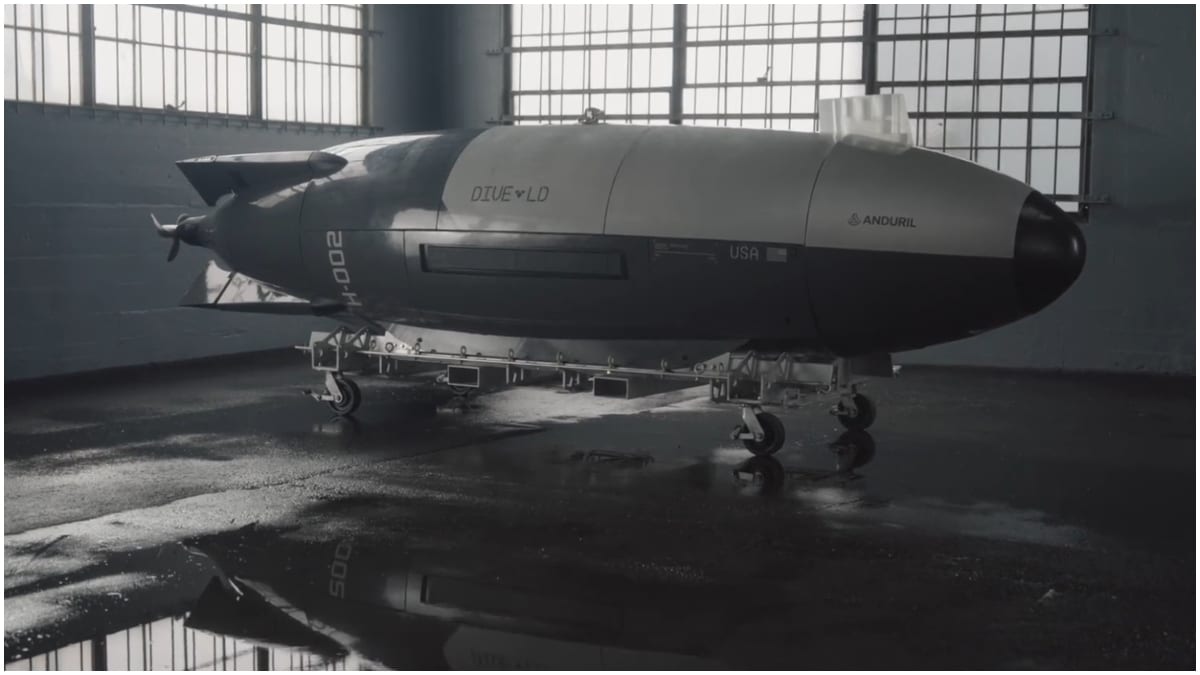
Iran’s Islamic Revolutionary Guard Corps (IRGC) has claimed to have captured a US AUV (autonomous underwater vehicle) amidst the ongoing crisis.
"We trapped one of the most modern, intelligent, and unmanned submarines of the terrorist American army at the entrance to the Strait of Hormuz. This submersible is equipped with the latest technologies," the Revolutionary Guards Navy said in a statement carried by Iranian state media.
The torpedo-shaped underwater drone is believed to be an Anduril Dive-LD, as several US defence portals were able to identify flood holes, fastenings, and the small transparent mast forward of the captured UUV from photographs.
“The drone was essentially dead in the water for more than a day,” CENTCOM spokesperson Navy Capt. Tim Hawkins was quoted as saying by DefenseScoop. “It was surveying regional waters in support of ongoing operations,” the officer reportedly added. The Unmanned Underwater Vehicle reportedly “neither collected sensitive data nor carried any classified sonar or radar equipment.”
However, it is unclear if the US ever made any attempt to recover the vehicle. The fact that it was not destroyed before or while the Iranians were retrieving it points to American forces having completely lost any sense of its location beforehand.
Here are five things to know about the Anduril Dive-LD underwater drone of the US Navy:
1. They can be used for Intelligence Preparation of the Operational Environment (IPOE); Intelligence, Surveillance, and Reconnaissance (ISR); mine warfare; and precision placement. According to California-based defence firm Anduril, the commercial version of their drone can be used for the inspection of underwater infrastructure such as cables and pipelines.
2. They are capable of conducting autonomous missions for up to 10 days, with an architecture that scales for multi-week missions. As per the manufacturer, they are designed to conduct missions along the seafloor at depths of up to 6,000 metres.
3. Each of these subs is about 1.2 m (4 ft) in diameter and 5.8 m (19 ft) long, the company brochure showed. Each of these UUVs reportedly cost around $2.5 million in 2024 and comes with a 3D-printed exterior, available information showed.
4. In light of CENTCOM having talked about reportedly deploying “exquisite technology” in recent months to clear out underwater mines, conduct surveillance, and establish safer pathways through the Strait of Hormuz, it is almost certain that the captured Dive-LD was deployed for a similar objective.
5. The US Navy decided to buy Dive-LDs as part of 'Project Replicator'—a modernisation effort which included mass production and a related defence industry push. The Pentagon launched 'Replicator' in 2023 as a strategic effort to deter China.
