



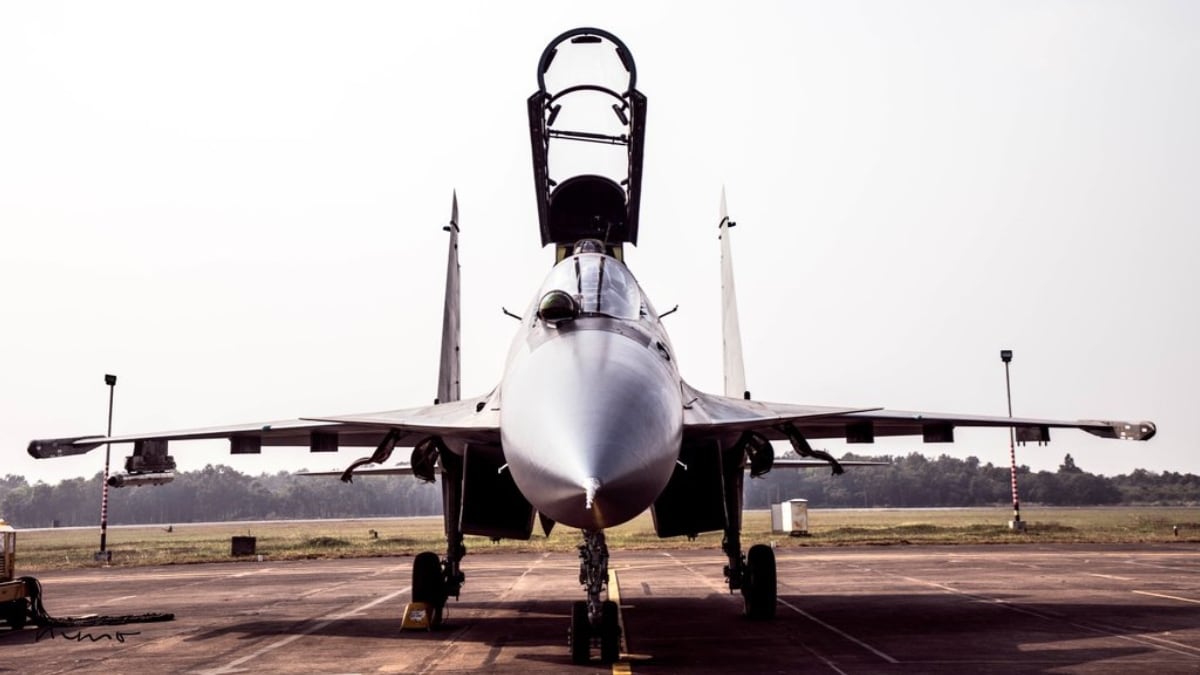
The Indian Air Force's (IAF) pilot project integrating Russia’s RVV-BD long-range air-to-air missile onto Su-30MKI fighters has been approved by the government. It was part of the ₹1.10 lakh crore acquisition approved by the defence ministry on Monday to boost the military's overall combat prowess.
By equipping Su-30MKI fighters with RVV-BD long-range missiles, the IAF will be looking to take out Airborne Early Warning and Control (AWACS) and airborne command aircraft of the enemy. Some reports see it as the IAF's remedy to tackle the increasingly networked Sino-Pak beyond-visual-range combat systems.
During Operation Sindoor, the Pakistan Air Force took a critical blow when its AWACS was lost while positioned in the skies of Pakistani Punjab.
The AWACS is a modified aircraft equipped with a radar capable of detecting air traffic over large distances and at low altitudes. In the simplest of terms, AWACS are aircraft capable of monitoring a nation's airspace in real-time. Air Chief Marshal A. P. Singh said that bringing down the AWACS was a major blow to Pakistan's ability to strike back.
As per the latest reports, India looks to make threatening AWACS an obvious possibility if its Sukhoi fighters are called into action in future.
Lethal air-to-air missiles
The Russian RVV-BD can reach Mach 6 speed and a range of up to 200 kilometres while carrying a 60-kilogram high-explosive fragmentation warhead, designed principally to destroy valuable, comparatively low-agility support aircraft beyond fighter screens, Defence Security Asia said in a report. The export variants are each 510 kilograms in weight, 4.06 metres long, and span 0.72 metres across their wings.
The presence of these Russian missiles will limit AWACS to skies far from forward positions, meaning Pakistani and Chinese command centres will have a reduced idea about what the IAF is up to. The ultimate objective, however, goes beyond the question of whether Chinese command aircraft can be hit or not. As long as the IAF's rivals are concerned about the possibility of losing their valuable assets to RVV-BDs, they will restrict themselves to a defensive posture.
"The missile consequently creates both an offensive counter-support capability and a deterrent relationship... The coercive effect therefore depends less upon achieving spectacular long-range kills than upon convincing opposing commanders that their scarce airborne enablers face unacceptable risk, compelling conservative orbits, fighter escorts, emission controls, evasive routing, and increased defensive resource allocation," Defence Security Asia said in a report.
Push to boost air combat capabilities
According to the capital acquisition proposal, the Indian Air Force has been granted various approvals to enhance the war-fighting capability of fighters, transports, and helicopters. Approval was accorded for procuring the Ground-Based Multi-Purpose Jammer (GBMPJ) and installing the Defence Forces Secure Access Card system, according to the ministry.
The GBMPJ will provide effective jamming against radars of adversaries, it said in a statement. Of the total AoNs accorded, approximately 98 per cent of procurements will be made from the Indian industry, it added.
