



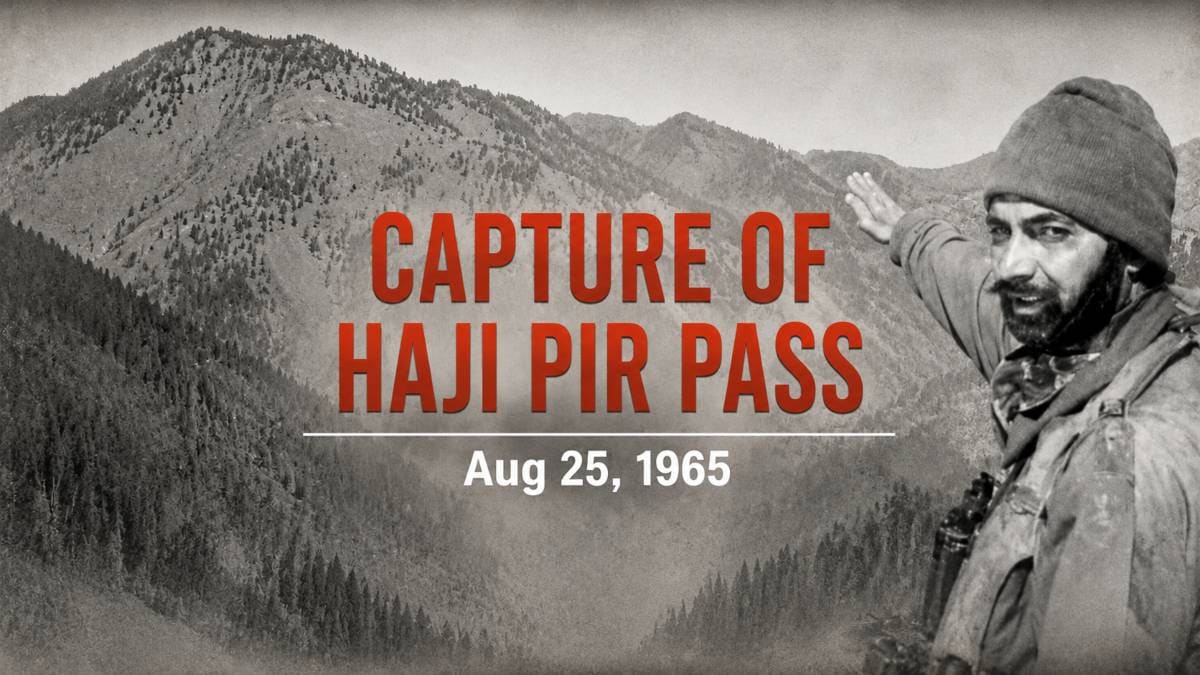
Very few have heard of Haji Pir Pass; even fewer know where it is and why it is so important. But this windswept mountain pass was the site of one of the most notable battles of the 1965 War and is associated with a tale of courage and endurance.
Situated 8,652 feet high in the Himalayan ranges, Haji Pir was a vital pass in Pakistan-occupied Kashmir. In the 1947-48 Kashmir War, Pakistani raiders had attacked Kashmir in the hope of capturing it militarily. Though they came to the doorstep of Srinagar, they were pushed back by the Indian Army. When the year-long war came to a close, Pakistan still retained large swathes of Kashmiri territory, which is today Pakistan-occupied Kashmir. Haji Pir Pass was also held by them. This strategic pass was inside a bulge, which protruded like a dagger into Indian territory and could be used by them to send in raiders and launch attacks against India.

In 1965, Pakistan was emboldened by India’s defeat at the hands of China in 1962. It had also built up its army with modern military equipment received from the USA and felt the time was ripe to regain Kashmir by military force. In April 1965, Pakistan launched a series of skirmishes in the Rann of Kutch and captured Indian posts there. That emboldened Islamabad even further, and it decided to launch OPERATION GIBRALTAR in Kashmir—an ambitious plan to send military men and tribals in civilian clothing into the Kashmir Valley to foment revolt, lay ambushes and launch attacks on Indian Army positions. Haji Pir—located in a prominent bulge jutting into Indian territory—was one of the major areas that the Pakistanis used to infiltrate these raiders.
The Kashmiris did not rise up in revolt, as Pakistan had expected. In fact, many still remembered the atrocities committed by the raiders in 1947-48 and helped the Indian Army. Most of the raiders were killed or captured and identified as members of the Pakistani Army. But to completely shut off the routes of infiltration, in August, the Indian Army decided to attack their very launch pads. Haji Pir was the most prominent among them. The Indian plan involved a double pincer—one from the north, from Uri, called OPERATION BAKSHI, and another from the south, from Poonch, OP FAULAD—which would encircle the bulge and capture the crucial pass. As part of the deception measures, 7 BIHAR and 6 DOGRA launched diversionary attacks on Ziarat and Mehandi Gali, fooling the Pakistanis about the main thrust.
Yet the pass would be a tough nut to crack. It was strongly held by a brigade, reinforced by irregular troops and supported by artillery. The defences were arrayed in layers, and before reaching the vital pass, the enemy positions at Bedori, Sank and Ledwali Gali had to be cleared first. An attack was to be launched on 24 August, but bad weather postponed the launch. Eventually, on the night of the 25th, in spite of atrocious weather, the attack went in through hail and sleet, moving unseen through the gaps in the Pakistani positions.
68 Brigade slowly approached Haji Pir from the north. As per the initial plan, 1 PARA was to advance along a narrow mountain gully, capture the enemy position of Sankh and provide an approach for the subsequent capture of the pass. Another battalion, 19 PUNJAB, was to move along an equally treacherous ridgeline and capture Bedori, another preliminary objective guarding Haji Pir. A fresh battalion, 4 RAJPUT, was to then attack Haji Pir Pass and capture it.
On the night of the 25th, the attacks went in, and the initial objective of Sankh was captured by 1 PARA after three successive attacks. The enemy positions at Sank Ridge, Sar Ridge and Lediwali Gali were captured. The bad weather actually helped, as the Pakistanis did not expect any Indian movement—let alone an attack in these conditions. Yet, on the other side, Bedori, which was to have been captured simultaneously by 19 PUNJAB, held on. To make matters worse, the third battalion, 4 RAJPUT, which was to have launched the attack on Haji Pir Pass, was delayed and could not arrive in time.
The attack seemed to have ground to a halt, with only one battalion, 1 PARA, having secured its initial objective. This was one of the crucial moments that make or break battles. At this juncture, 1 PARA volunteered to go ahead alone to capture Haji Pir, since a delay while waiting for the next battalion to arrive would have derailed the plan completely. In a calculated gamble, one company under Major Ranjit Singh Dayal (later Lt Gen R S Dayal, MVC) made a gruelling approach march to the base of the pass, using a waterlogged mountain fissure called Hyderabad Nallah. They then climbed over 4,000 feet in pitch darkness and rain, without even basic mountaineering equipment, along the difficult western shoulder of the pass, climbing up unseen from a flank. On the way, they discovered an abandoned hut stocked with rations and kerosene for the infiltrators, which they themselves used before the final assault.
By the time they reached the top, it was almost daybreak, and they were detected as they approached the summit. The enemy opened fire. Leaving a platoon to engage the enemy, the rest of the company moved to the summit and, from there, rolled down on the enemy positions, attacking them from the rear. The Pakistanis had not expected an attack from this direction, and before they could readjust their positions and retaliate, they were overrun. The surprised defenders assumed they were being attacked by a much larger force and fled, leaving behind their heavy weaponry. By noon on August 28, the pass was in Indian hands. The tricolour flew proudly over the pass for the first time since Independence.
With Haji Pir in our hands, the outlying positions soon fell, securing the vital pass for India. Yet, the southern thrust from Poonch—OP FAULAD—which was to have linked up with the northern thrust from Uri, could not make much headway, and it required days of fierce fighting before the two forces could eventually link up and secure the bulge. The main infiltration route used by the Pakistani infiltrators was now cut off. Seeing their plans unravelling, the Pakistanis launched an all-out assault directed at Chhamb and Akhnur on 1 September 1965, which triggered the 1965 Indo-Pak War.
Haji Pir remained in Indian hands throughout the war, in spite of numerous counterattacks and intensive fire. Yet, the gains made in this operation were lost at the Tashkent negotiation table when India agreed to return Haji Pir and other territory captured during the 1965 War. The vital pass went back to Pakistan and, unfortunately, remains under its control even today. But the story of its audacious capture and the gallant men who engineered it remains one of the hallmarks of India’s military history.
Please click here to buy the book 'India's Battlefields: From Kurukshetra to Balakot'
