



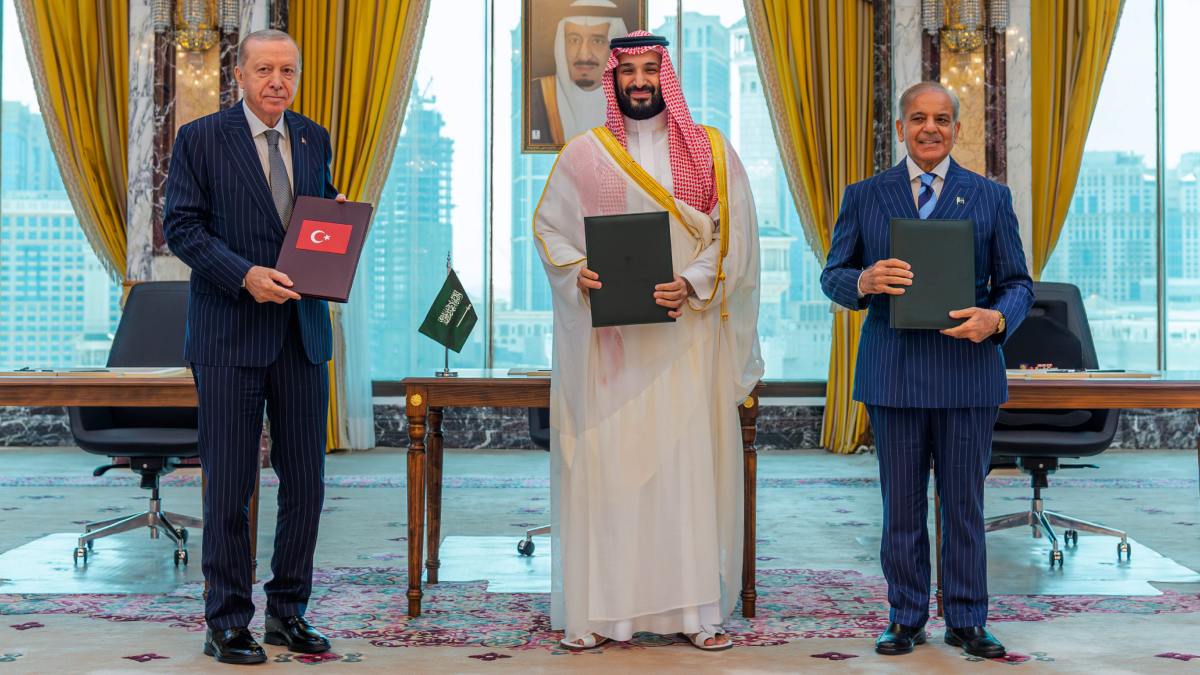
The Mecca Joint Defence Agreement signed by Saudi Arabia, Türkiye and Pakistan on August 7, 2026, could become one of the more consequential developments in West Asia’s rapidly changing security landscape. That prospect has grown even more dramatic following reports on August 23 that Iran has been invited to join the pact—and that Tehran is seriously considering the offer.
If Iran accepts, the arrangement would transform from a three-nation Sunni-led coalition into a four-power Islamic security framework—with far-reaching implications for regional stability, energy security, and the strategic calculus of extra-regional powers, including India.
The initial Mecca agreement brought together three very different sources of strategic power: Saudi Arabia’s financial strength, energy leverage and political influence; Türkiye’s NATO-standard military capabilities and increasingly sophisticated defence industry; and Pakistan’s large conventional military, operational experience and nuclear deterrent. Its central declaration—that an armed attack against one member will be regarded as an attack against all three—has inevitably invited comparisons with NATO.
That comparison, however, remains premature.
Türkiye has emphasised that the pact is defensive, is not directed against any particular country and does not automatically mandate military intervention. Any response would be subject to consultation among the members. The agreement reportedly envisages high-level political and military coordination, joint exercises and cooperation in unmanned systems, electronic warfare, artificial intelligence and defence production.
The pact’s immediate military consequences may largely be limited to deterrence rather than interoperable warfighting capabilities. Its larger significance thus lies elsewhere: it reflects a growing regional determination to assume greater responsibility for security instead of relying exclusively on an external guarantor.
Iran’s entry, if it happens, would change that equation fundamentally.
Nonetheless, for India, this development should result in caution, considering that Field Marshal Asim Munir, the Chief of Defence Staff of Pakistan—and the purported architect of the terrorist massacre of Indian tourists at Pahalgam in April 2025—appears as the chief promoter of this alliance.
The Iranian variable: A game-changer
Iran’s inclusion would bring additional missile and drone capabilities, extensive operational experience from Syria, Iraq, Yemen and Lebanon, and a strategic depth that no other regional power can match. More importantly, it could ease intra-Islamic tensions over critical maritime chokepoints, particularly the Strait of Hormuz, through which a significant share of global oil supplies passes.
For decades, the Sunni-Shia divide has been the principal fault line in West Asian security. Saudi Arabia and Iran have competed for influence across the region, backing opposing sides in conflicts from Yemen to Syria to Iraq. Their rivalry has shaped the region’s security architecture, often to the detriment of collective stability.
Iran’s participation in the Mecca Pact would signal a dramatic shift. It would suggest that Riyadh and Tehran have found a modus vivendi—a recognition that their shared interests in regional stability, energy security and reduced dependence on external powers outweigh their sectarian and geopolitical differences.
Such a development would transform the original Sunni coalition into a genuinely Islamic alliance, with dramatic implications for the region’s power dynamics.
Complementary strengths—could be amplified
Saudi Arabia possesses enormous financial resources, energy leverage, strategic geography and considerable influence in the Arab and Muslim worlds. Its economic transformation under Vision 2030 has created vast investments in infrastructure, tourism, technology and industry. Continued regional instability and vulnerability to missile and drone attacks pose a direct threat to that transformation.
Türkiye has one of the region’s most capable conventional militaries and a rapidly expanding indigenous defence industry. Its strengths include drones, precision weapons, missiles, electronic warfare, naval systems and autonomous technologies. Ankara also brings operational experience from Syria, Libya, Iraq and the South Caucasus.
Pakistan contributes a large and experienced military establishment, a substantial conventional force, institutional experience in counter-insurgency and battlefield operations, and a nuclear deterrent. Islamabad has clarified that its nuclear arsenal is not part of the agreement, but its very existence nevertheless adds strategic weight to Pakistan’s participation.
With Iran, the pact’s complementary strengths would be significantly amplified.
Iran would add a fourth dimension: a battle-hardened military with extensive experience in asymmetric warfare, a sophisticated missile and drone arsenal, control over critical maritime routes, and deep influence across Iraq, Syria, Lebanon and Yemen. Tehran’s Revolutionary Guard Corps and its network of regional proxies have demonstrated an ability to project power far beyond Iran’s borders.
Together, these powers could create a formidable regional security architecture—one that combines conventional military strength, advanced technology, financial resources and asymmetric capabilities.
Implications for West Asia
Iran’s entry could reduce the risk of direct conflict between Saudi Arabia and Iran by creating a framework for consultation and crisis management. It could ease tensions over maritime security, particularly in the Strait of Hormuz and the Persian Gulf. It could also create a more coherent regional approach to threats from non-state actors, including militant Islamist groups.
However, it could also generate new anxieties.
Israel would likely view a four-nation Islamic security pact with considerable concern. While the agreement is not explicitly anti-Israel, the inclusion of Iran—a state that has repeatedly called for Israel’s elimination—would heighten Israeli security anxieties. This could accelerate Israel’s efforts to deepen its partnerships with the United States and other regional powers, including the UAE, Bahrain and potentially Saudi Arabia.
The United States would also need to recalibrate its approach. As of now, Washington has welcomed greater regional burden-sharing. However, if the pact includes Iran, it could complicate American interests. The US has designated Iran as a state sponsor of terrorism and has imposed extensive sanctions on Tehran. American policymakers would need to assess whether the pact strengthens regional stability or creates new challenges for US interests.
Egypt, the UAE, Qatar and other regional powers would also need to decide how to position themselves. Some may seek to join the arrangement. Others may prefer to maintain their distance. The result could be a more complex and fluid regional security architecture, with overlapping and competing alignments.
The Pakistan factor—and Bangladesh’s interest
For India, Pakistan’s participation remains the most worrying element. The pact gives Islamabad greater prestige, strategic relevance and potentially improved access to Saudi finance and Turkish defence technology. Pakistan can portray itself as a principal military power of the Muslim world and seek to expand its diplomatic role across West Asia.
Iran’s entry, if it happens, could amplify these concerns. Pakistan and Iran share a long border and have important social and economic ties. A security pact that includes both countries could strengthen Pakistan’s strategic position and provide Islamabad with greater diplomatic cover when pursuing policies that New Delhi views as hostile.
Moreover, Bangladesh’s reported expression of interest in joining the alliance adds another layer of complexity. Dhaka’s participation would bring a large Muslim-majority country with significant demographic weight into the arrangement. While Bangladesh has traditionally maintained a non-aligned foreign policy, its interest in the pact suggests that it sees value in closer security ties with Saudi Arabia, Türkiye, Pakistan and potentially Iran.
Bangladesh shares a long and porous border with India. Any security arrangement that brings Dhaka closer to Pakistan could affect India’s eastern security calculus. New Delhi would need to assess whether Bangladesh’s participation is driven by genuine security concerns or by a desire to balance against Indian influence in the region.
What India Should Do
Clearly, any attempt to challenge the Mecca Pact with another alliance would be counter-productive. Instead, India’s response should be neither alarmist nor complacent.
First, New Delhi must deepen its strategic relationship with Saudi Arabia. Defence cooperation, intelligence-sharing, counter-terrorism, maritime security, investment and defence-industry partnerships should be expanded. Riyadh must recognise that India’s economic stability and security are directly connected to Saudi Arabia’s own interests.
Second, India should engage Türkiye more intensively. Differences over Pakistan and Kashmir should not become a reason for strategic estrangement. Ankara is too important a regional power—and too significant a defence-industrial player—for New Delhi to leave the field open to Pakistan.
Third, India must strengthen relations with Egypt, the UAE, Oman, Bahrain, Qatar, Kuwait, and other regional and Islamic nations. The objective should not be to create a counter-alliance, but to ensure that no regional grouping evolves into an anti-Indian strategic bloc.
Fourth, India must accelerate its defence-industrial transformation. The pact’s emphasis on drones, electronic warfare, artificial intelligence and joint production should be treated as a warning. India needs faster decision-making, greater private-sector participation, stronger R&D and rapid development of autonomous and networked systems.
Fifth, maritime power must receive greater attention. The Arabian Sea, Gulf of Oman, Persian Gulf, Red Sea and western Indian Ocean form one interconnected strategic space. India’s energy supplies, trade routes and diaspora depend on its security. Maritime domain awareness, naval presence, logistics access and partnerships with regional states are therefore essential.
Sixth, India must engage Iran directly, regardless of the pact’s evolution. Tehran remains an important regional power with which New Delhi has significant economic and strategic interests. India should continue to develop the Chabahar port, expand energy cooperation and maintain diplomatic channels even as it balances its relationships with Saudi Arabia, Israel and the UAE.
Seventh, India must preserve strategic flexibility. It should continue its relationships with Saudi Arabia, Iran, Israel, the UAE, Qatar and Türkiye simultaneously. The emerging West Asian order will be fluid, and India cannot afford to become captive to any one alignment.
Conclusion - the larger lesson
The Mecca Pact should not be dismissed as another unsuccessful attempt to build an ‘Islamic NATO’. Nor should it be exaggerated as an operational military alliance - that does not yet exist.
It is more significant than either description suggests.
The agreement is a political signal of regional strategic autonomy—a recognition by important Muslim powers that they must possess greater capacity to protect their interests in a region where external security guarantees have become less certain.
Iran’s possible entry would amplify that signal. It would suggest that even historic rivals can find common ground when faced with shared security challenges and a changing global order.
For India, the message is equally clear.
New Delhi should not attempt to counter the Mecca Pact with another alliance. Instead, it should ensure that Pakistan cannot convert the new arrangement into an instrument of strategic pressure against India.
India’s answer must be stronger deterrence, deeper defence-industrial cooperation, greater maritime power, wider economic engagement and sustained diplomatic presence across West Asia.
The old West Asian order is changing. The central question is no longer whether a new security architecture will emerge, but who will shape it—and whose interests it will serve.
India must ensure that, when that architecture takes shape, it is not merely an observer but one of the powers whose interests others are compelled to take into account.
(Lt Gen Philip Campose (Retired) is a former Vice Chief of the Indian Army. He has authored a book titled ‘A National Security Strategy for India: The Way Forward’)
(The opinions expressed in this article are those of the author and do not purport to reflect the opinions or views of THE WEEK.)
