



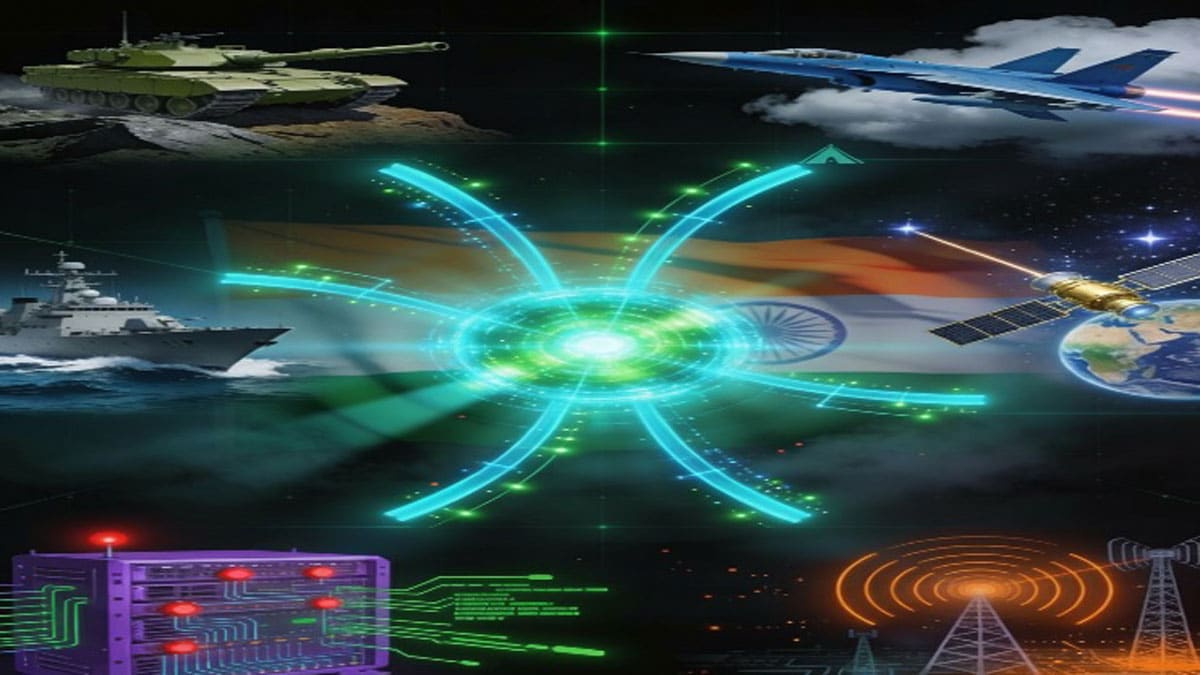
Electronic warfare is no longer a niche military speciality—it is the hidden architecture of modern conflict.
From Ukraine’s drone-saturated battlefields to West Asia’s network-centric air campaigns, wars are increasingly being decided not by who sees the enemy first, but by who controls the invisible medium through which all seeing, sensing, communicating and striking now occurs: the electromagnetic spectrum.
This shift marks a decisive break from the post–Cold War era, when Western militaries operated with near-assured dominance in GPS, communications and precision targeting. That comfort has evaporated. Today, every signal is contested, every transmission is vulnerable, and every advantage in the electromagnetic domain is temporary. Electronic warfare (EW) is no longer a support function—it is the battlefield itself.
For India, the implication is unambiguous: spectrum superiority is not a technical aspiration. It is a warfighting necessity.
Russia-Ukraine War: AI accelerates the cycle of electronic adaptation
Nowhere is the transformation clearer than in Russia-Ukraine. The war has become a live laboratory for electronic warfare at industrial scale, where jamming, spoofing, interception and counter-jamming evolve almost in real time.
Russian forces have systematically degraded GPS-dependent systems, disrupting drones and precision-guided munitions. In response, Ukrainian engineers have improvised at extraordinary speed—introducing frequency-hopping radios, inertial navigation, visual-based guidance and even fibre-optic controlled FPV drones that bypass radio jamming entirely.
What is new in this cycle is the role of artificial intelligence. AI-enabled signal processing is increasingly used to detect, classify and respond to unfamiliar electronic signatures in seconds rather than hours. Machine learning models help identify jamming patterns, predict spectrum congestion and optimise drone navigation in degraded environments. In effect, AI is compressing the “observe–orient–decide–act” loop of electronic warfare into machine time.
This has created a defining feature of modern EW: a continuous algorithmic arms race. Every countermeasure is rapidly analysed, learned and countered by adaptive systems. Electronic warfare is no longer just engineering—it is software-driven combat learning at scale.
At the same time, EW and kinetic warfare have fused. Electronic emitters are not only tools of disruption but also targets. Once detected—often through AI-assisted electronic intelligence—they are rapidly struck by artillery, missiles or drones. The spectrum has become both shield and beacon.
West Asia: AI-enabled network disruption and kill-chain warfare
If Ukraine represents adaptive improvisation, West Asia reflects integrated system warfare. Israeli operations against Iran have demonstrated how electronic warfare, cyber capabilities, intelligence fusion and precision airpower can be combined to disrupt entire military networks rather than individual platforms.
The objective is no longer to suppress radars or jam communications in isolation. It is to break the kill chain—the full sequence from detection to decision to strike. AI plays a central role in this architecture, enabling rapid sensor fusion, target recognition and real-time coordination across domains.
Advanced aircraft such as the F-35, with embedded AI-assisted sensor fusion and electronic warfare suites, exemplify this shift. They are not just platforms but data nodes in a larger networked system designed to operate inside heavily contested electromagnetic environments.
The region has also highlighted the strategic spillover of EW into civilian life. Persistent GPS jamming and spoofing have disrupted maritime navigation, aviation systems and commercial tracking across the Gulf. Iran’s own investment in electronic and cyber capabilities underscores a broader reality: EW is now a tool of statecraft, not just battlefield competition.
The new global trends: software, AI and spectrum dominance
Across both theatres, five structural shifts are evident.
First, electronic warfare is ubiquitous—spanning land, sea, air, space and cyber domains simultaneously.
Second, the electromagnetic spectrum has become a manoeuvre space, where forces hide, deceive, probe and reposition electronically rather than physically.
Third, passive sensing and AI-driven electronic intelligence are becoming as decisive as active jamming. Modern systems can detect, classify and geolocate emissions without revealing their own position, enabling rapid kinetic follow-up.
Fourth, software and AI now define capability more than hardware. Cognitive EW systems, machine learning-based signal recognition and software-defined radios allow forces to adapt in near real time. DRDO itself has identified AIML enabled EW, smart jamming and adaptive signal processing as priority areas.
Fifth, and most importantly, resilience has become as critical as disruption. A force that can jam the enemy but cannot operate under its own electronic denial is operationally fragile.
Finally, EW has become an industrial and algorithmic competition. The decisive advantage lies not in stockpiles of equipment but in the speed of software iteration, AI training cycles and the integration of civilian innovation ecosystems into military adaptation.
India’s challenge: contested spectrum on two fronts
India faces a uniquely complex electromagnetic environment shaped by two technologically capable adversaries.
China represents the most advanced long-term challenge. The PLA has integrated electronic warfare into a broader concept of “systems destruction warfare,” where the objective is to paralyse an adversary’s information architecture rather than defeat individual platforms. This approach is deeply AI-enabled, combining space-based sensors, cyber tools, electronic intelligence and automated targeting systems into a unified network.
Pakistan, while smaller in scale, is rapidly modernising its EW capabilities through Chinese platforms, networked air defence systems and increasingly sophisticated airborne sensors. The 2025 India–Pakistan aerial engagement underscored how AI-assisted targeting, data links and electronic warfare now shape even limited conflicts.
Russia, meanwhile, remains a reference point for battlefield EW, particularly in GNSS jamming, tactical electronic intelligence and integrated counter-UAS systems. Iran and Israel add further complexity, demonstrating how EW, cyber and AI-enabled intelligence fusion now operate seamlessly across military and civilian domains.
For India, the message is clear: future conflict will not be confined to borders. It will unfold across satellites, civilian infrastructure, maritime corridors and digital networks simultaneously.
What must India do? From systems to intelligent spectrum warfare
India has a credible foundation in electronic warfare through DRDO laboratories, naval EW systems and indigenous platforms. But the challenge is no longer about possession—it is about transformation.
1. Make AI-enabled spectrum dominance a strategic priority
India must treat electromagnetic-spectrum operations as a core pillar of national security, alongside cyber and space. A unified architecture integrating the armed forces, DRDO, intelligence agencies, telecom networks and AI research ecosystems is essential.
2. Build AI-resilient navigation and communications
No critical system should depend solely on GPS. AI-enhanced multi-source navigation—combining inertial systems, terrain mapping, visual navigation and satellite augmentation—must become standard across platforms.
3. Train for electronic denial warfare
Every formation must be capable of operating in degraded or denied electromagnetic environments. AI-driven simulation environments should routinely replicate jamming, spoofing and communications collapse to build instinctive resilience.
4. Embed EW at the tactical edge
Electronic warfare cannot remain centralised. AI-enabled EW tools must be distributed down to manoeuvre units, integrated into drones, artillery, air defence and infantry formations.
5. Build a rapid AI-driven innovation loop
The Ukraine model shows that EW evolves in weeks, not years. India must connect operational units directly with AI researchers, start-ups and defence laboratories to enable continuous system updates.
Conclusion: The algorithmic battlefield
The defining feature of future war is not firepower—it is information dominance under electronic stress. Artificial intelligence has become the accelerator of this transformation, compressing decision cycles, automating signal interpretation and enabling rapid adaptation in contested spectrum environments.
In this new reality, victory will belong not to the side with the most advanced platforms, but to the one that can continuously learn faster than its adversary—across machines, networks and human operators alike.
Electronic warfare is therefore no longer invisible support to combat. It is the medium through which combat itself is conducted. And in that medium, AI is becoming the decisive force multiplier.
For India, the strategic imperative is urgent: move from viewing electronic warfare as a technical capability to mastering it as an AI-enabled warfighting domain. Because in the wars of the future, the side that dominates the algorithmic spectrum will not just win battles—it will define whether battles are even possible.
(Lt Gen Philip Campose (Retired) is a former Vice Chief of the Indian Army. He has authored a book titled ‘A National Security Strategy for India: The Way Forward’)
(The opinions expressed in this article are those of the author and do not purport to reflect the opinions or views of THE WEEK.)
