



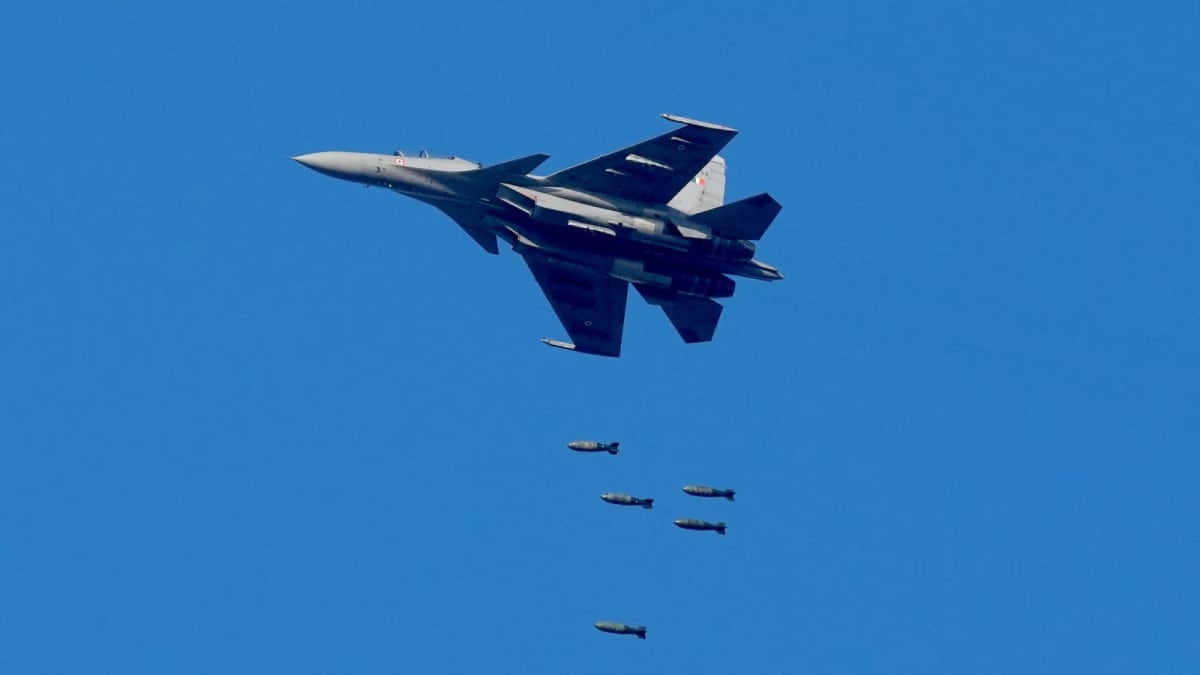
The Indian Air Force's (IAF) existing inventory of 500 kg bombs could gain a major long-range precision strike capability after Apollo Micro Systems Ltd (AMS) was awarded a Make-II Prototype Sanction Order (PSO) to develop the Indigenous Precision Range Extension Kit (IPREK).
The Hyderabad-based defence firm, in an exchanges filing, said it has been shortlisted and awarded the Prototype Sanction Order by the IAF under the defence ministry’s Make-II category, recognising its indigenous guidance and navigation capabilities.
The project involves the design, development and prototype demonstration of a 500 kg Smart Bomb that can be released from 80–100 km away and has the capability to strike within three metres of the intended target, according to the securities filing.
How the project benefits the IAF
According to the company, the IPREK is a bolt-on precision guidance and range extension kit that converts the IAF's existing inventory of 500 kg general-purpose unguided bombs into long-range precision glide weapons. This would mean that the IAF's existing stock of unguided, commonly known as 'dumb', bombs into smart, precision-guided weapons.
Instead of procuring entirely new precision-guided munitions, the kit is designed to upgrade bombs already in the IAF's inventory into precision stand-off weapons. A bomb equipped with IPREK can be released from over 80–100 km away while maintaining an accuracy of within three metres of the intended target, allowing the carrier aircraft to remain well beyond the reach of most air defence systems.
The company said the IPREK provides the IAF with a precision stand-off capability at a fraction of the cost of procuring new imported precision weapons, turning the service's existing bomb inventory into a strategic asset rather than a sunk cost while reducing dependence on imported precision-guided munitions.
The system integrates India's indigenous NavIC (IRNSS) satellite navigation, making it one of the first weapon systems in the world to use the Indian satellite constellation at its core. It also incorporates Electro-Optical (EO) and Infrared (IIR) terminal guidance for day-and-night precision, along with Digital Scene Matching Area Correlation (DSMAC) terminal guidance for operations in GPS-denied environments.
According to the company, the long-range stand-off capability fundamentally changes mission planning by enabling aircraft to engage targets from distances of up to 100 km while remaining outside the range of many air defence systems.
Entry into precision-guided munition segment
Apollo Micro Systems said the empanelment marks its entry into India's precision-guided munition (PGM) segment as a Prime Development Agency, describing it as one of the highest-value and highest-entry-barrier segments of the Indian defence manufacturing industry.
The company said the programme offers it an opportunity to become a Prime Original Equipment Manufacturer (OEM) in indigenous guidance and navigation technology.
Under the Defence Acquisition Procedure (DAP) 2020, the Make-II category is an industry-funded procurement route under which companies undertake design and development at their own cost. The company said the government has no financial obligation during the prototype development phase but is committed to procurement upon successful demonstration of the prototype.
The company said the initial procurement phase is expected to involve more than 500 IPREK units, with further demand anticipated across Indian Air Force platforms, making it a multi-year revenue opportunity.
Managing Director Baddam Karunakar Reddy noted the selection as one of the defining moments in the company's history.
Reddy also acknowledged the company's long-standing collaboration with the Defence Research and Development Organisation (DRDO), saying the knowledge shared by the organisation over the years is embedded in the technologies developed by Apollo Micro Systems.
He described IPREK as an Atmanirbhar Bharat programme and said the company was proud to be at the centre of its development.
