



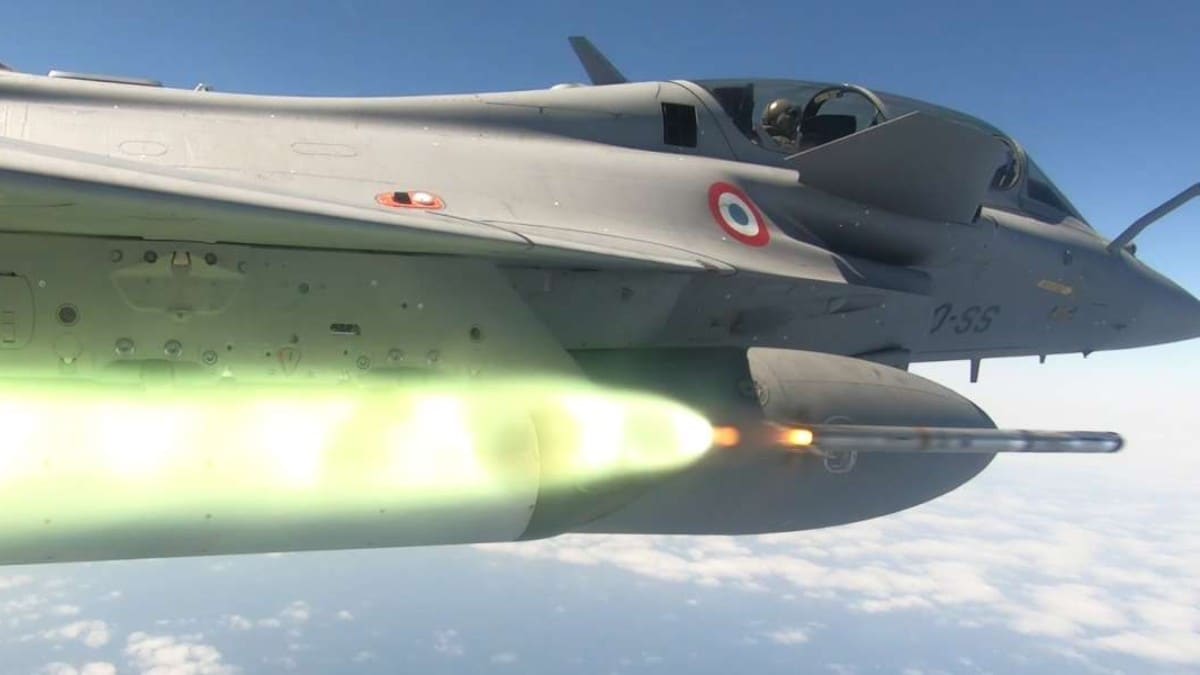
The French Rafale fighter jet has received a major capability upgrade with the successful integration of 68 mm laser-guided rockets, providing it with an effective and cost-efficient weapon to counter drones such as Shahed.
France's Directorate General of Armaments (DGA) successfully completed a test campaign validating the new Anti-Drone Combat Aircraft Capability (LADAC) on the Rafale. The programme reached its first operational capability in less than eight months after the contract was awarded.
The trials were conducted under the supervision of the DGA in collaboration with the French Air and Space Force's Air Expertise Centre (CEAM), Dassault Aviation and Thales, a press statement from DGA said.
The new capability was developed to meet the French Air and Space Force's requirement for an affordable and effective anti-drone weapon. After evaluating several options in late 2025, the DGA selected the already-qualified 68 mm laser-guided rocket, previously integrated on the Tiger attack helicopter, for adaptation to the Rafale.
Under an Operational Emergency programme, the DGA awarded the contract to Dassault Aviation and Thales on December 31, integrating the rockets with the TALIOS laser designation pod.
Since February 2026, the Rafale has undergone a series of tests to validate every aspect of the new capability, including radar-based drone detection, tracking targets using the TALIOS pod, laser designation, firing laser-guided rockets, and successfully neutralising aerial targets, the press statement said.
According to the DGA, the new system will enable Rafale fighters to shoot down Shahed drones using 68 mm laser-guided rockets, providing the aircraft with a dedicated counter-drone capability.
The first batch of equipment, including rocket launch pods, laser-guided rockets and TALIOS pods equipped with the LADAC mode, will be delivered to the French Air and Space Force by the end of July 2026, paving the way for full qualification of the new weapon system.
Another capability enhancement
The Rafale has also recently demonstrated a new electronic warfare capability through collaborative operations with an unmanned aerial system.
Dassault Aviation and Harmattan AI announced the successful in-flight demonstration involving a Rafale F4 and a drone equipped with NAMIB, a newly developed electronic warfare payload.
During the trial, the unmanned system detected, identified and precisely geolocated electromagnetic emissions from an air defence radar located several dozen kilometres away. The target's location was transmitted to the Rafale, which then simulated a strike on the radar.
The demonstration showcased the Rafale's ability to operate alongside unmanned systems, further expanding its multi-domain combat capabilities while integrating autonomous technologies into future air combat operations.
