



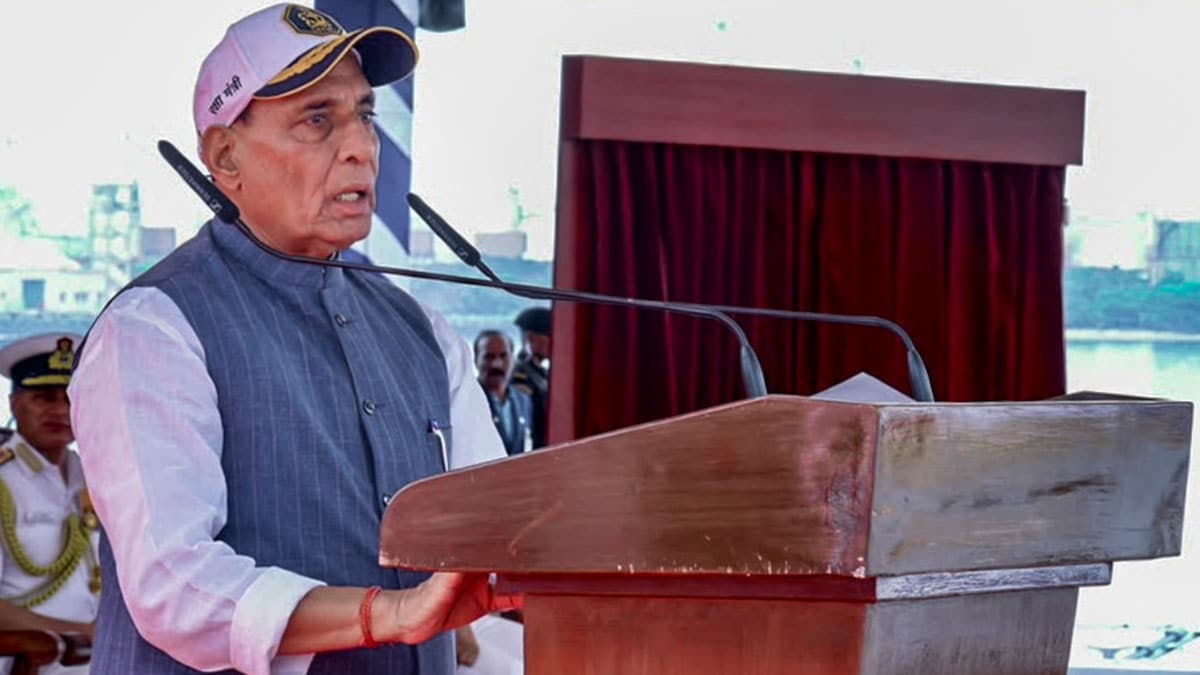
Even as future wars may be fought with artificial intelligence, they will still be won by national resolve, trained soldiers and robust military power, Defence Minister Rajanth Singh said on Saturday.
Speaking at the commissioning ceremony of INS Mahendragiri in Visakhapatnam, Singh pointed out that new technologies and conventional platforms are not opposed to each other, but supplement and complete each other. “Without conventional platforms, new technologies are incomplete in themselves.”
According to the defence minister, while it is certain that new technologies have reshaped warfare, they have not diminished the role of conventional warfare means.
The strong conventional capability that is still necessary for the fulfilment of basic principles of war is as important as it was before, he added.
"Operation Sindoor was a prime example of the effective integration of conventional and modern capabilities to safeguard national security,” he said.
The defence minister said India is a net security provider and a trusted partner dedicated to ensuring security and development across the region, and hailed the Indian Navy for consistently demonstrating this commitment through its role in HADR operations, anti-piracy missions and the evacuation of Indian and foreign nationals from crisis-hit areas. “The Indian Navy has earned the recognition as both a First Responder and a Preferred Security Partner in the Indo-Pacific through its timely and effective operational response,” he added.
Noting that maritime security and economic security are closely interconnected, Singh said the seas remain vital for trade, supply chains, energy security and economic growth.
He reaffirmed the government's commitment to the Security and Growth for All in the Region (SAGAR) vision in the Indo-Pacific.
Referring to the Indian Navy's role during the recent West Asia conflict, Singh said under Operation Urja Suraksha, the Navy safely escorted 18 merchant vessels carrying essential cargo valued at more than Rs 9,000 crore, highlighting its role in protecting not only national security but also India's economic interests.
The defence minister said the successful induction of INS Mahendragiri demonstrates India's growing capability to design, build and deploy complex frontline combat platforms through indigenous expertise.
The warship is equipped with an indigenous rocket launcher, torpedo launchers, an Integrated Anti-Submarine Defence System, an Electronic Warfare suite and a Close-In Weapon System, making it a formidable and resilient combat platform capable of operating in challenging maritime environments.
Describing INS Mahendragiri as a "blue-water warship", Singh said it can effectively counter threats from the air, enemy vessels on the surface and submarines hidden beneath the sea, and can protect India's maritime interests not only near the coastline but also in distant and deep oceans during prolonged deployments.
The union minister said the commissioning of Mahendragiri comes at a time when the nature of warfare is rapidly evolving with the emergence of drones, artificial intelligence, cyber warfare, hypersonic weapons, space-based capabilities and unmanned systems.
However, he stressed that conventional military capabilities continue to remain the bedrock of effective national defence.
The Union Minister described INS Mahendragiri as a symbol of the nation's commitment to building a technologically advanced and combat-ready Navy capable of meeting future security challenges while protecting India's maritime interests.
He expressed confidence that INS Mahendragiri would further strengthen India's maritime strategy by enhancing the security of the eastern seaboard, extending the country's blue-water operational reach and reinforcing its presence across the Indian Ocean Region.
