



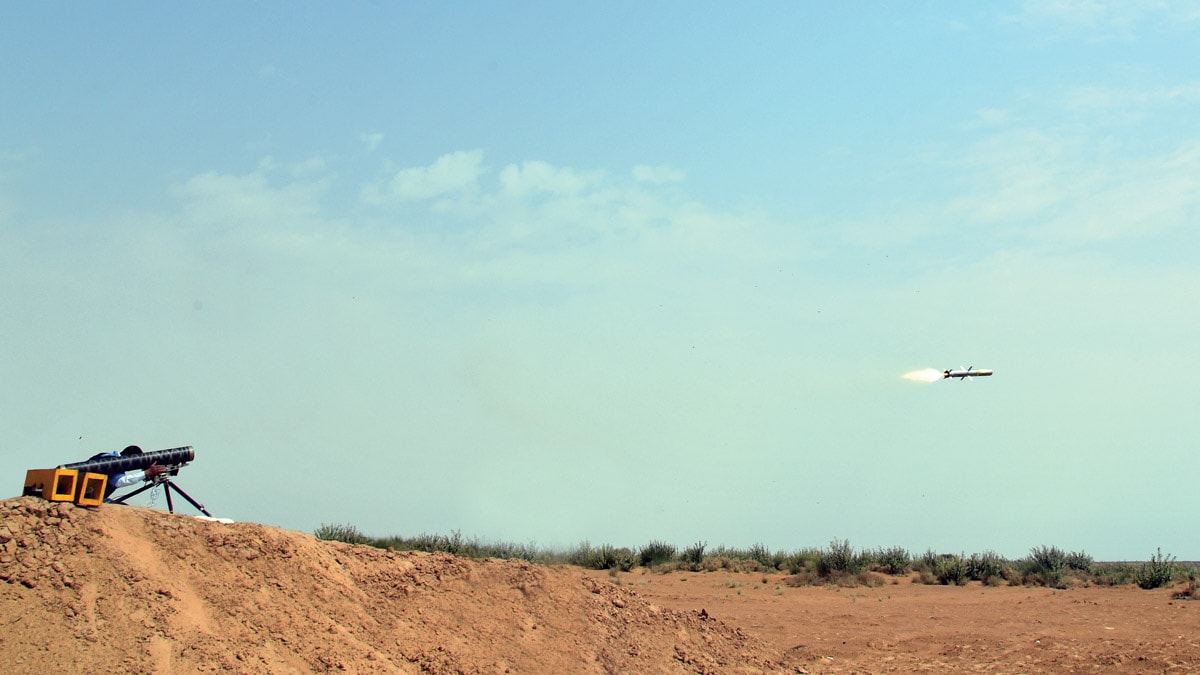
India's push to equip its armed forces with indigenous weapon systems received another major boost after the Defence Acquisition Council (DAC), on Friday, granted Acceptance of Necessity (AoN) for the procurement of the indigenously developed Man Portable Anti-Tank Guided Missile (MPATGM).
Designed to destroy modern main battle tanks with precision, the missile is expected to boost the Indian Army's infantry firepower against armoured and mechanised threats. Besides, it also reduces the dependence of the armed forces on imported anti-tank weapons.
The defence ministry stated that the MPATGM will enhance the infantry's ability to counter mechanised threats.
The AoN for procurement also marks another milestone in India's drive towards defence self-reliance, as the missile was developed entirely using indigenous technologies by the Defence Research and Development Organisation (DRDO).
The MPATGM incorporates several advanced indigenous technologies, including an Imaging Infrared (IIR) homing seeker, an all-electric control actuation system, a fire control system, a tandem warhead, an indigenous propulsion system and a high-performance sighting system. These technologies were developed by various DRDO laboratories, including Research Centre Imarat, Terminal Ballistics Research Laboratory, High Energy Materials Research Laboratory and Instruments Research & Development Establishment.
The Thermal Target System, developed by Defence Laboratory, Jodhpur, enables a realistic simulation of enemy tanks. Equipped with an advanced IIR seeker, the missile offers both day and night operational capability. Its tandem warhead is capable of penetrating the explosive reactive armour of modern main battle tanks, making it effective against heavily protected armoured vehicles.
The missile can be launched from a tripod or a military vehicle launcher.
Bharat Dynamics Limited (BDL) and Bharat Electronics Limited (BEL) are the Development-cum-Production Partners for the weapon system.
The MPATGM has undergone several developmental and validation trials over the past few years. In January 2026, DRDO successfully flight-tested the missile with top-attack capability against a moving target at the KK Ranges in Ahilya Nagar, Maharashtra.
In April 2024, the missile successfully completed warhead flight trials at the Pokhran Field Firing Range in Rajasthan, demonstrating its ability to meet the Indian Army's operational requirements. Penetration trials confirmed that its tandem warhead can defeat modern armour-protected main battle tanks, while the system also demonstrated day-and-night engagement capability and dual-mode seeker functionality, the defence ministry had then noted.
The missile had earlier achieved successful validation of both its maximum and minimum engagement ranges, including a successful precision strike during trials conducted in July 2021.
