



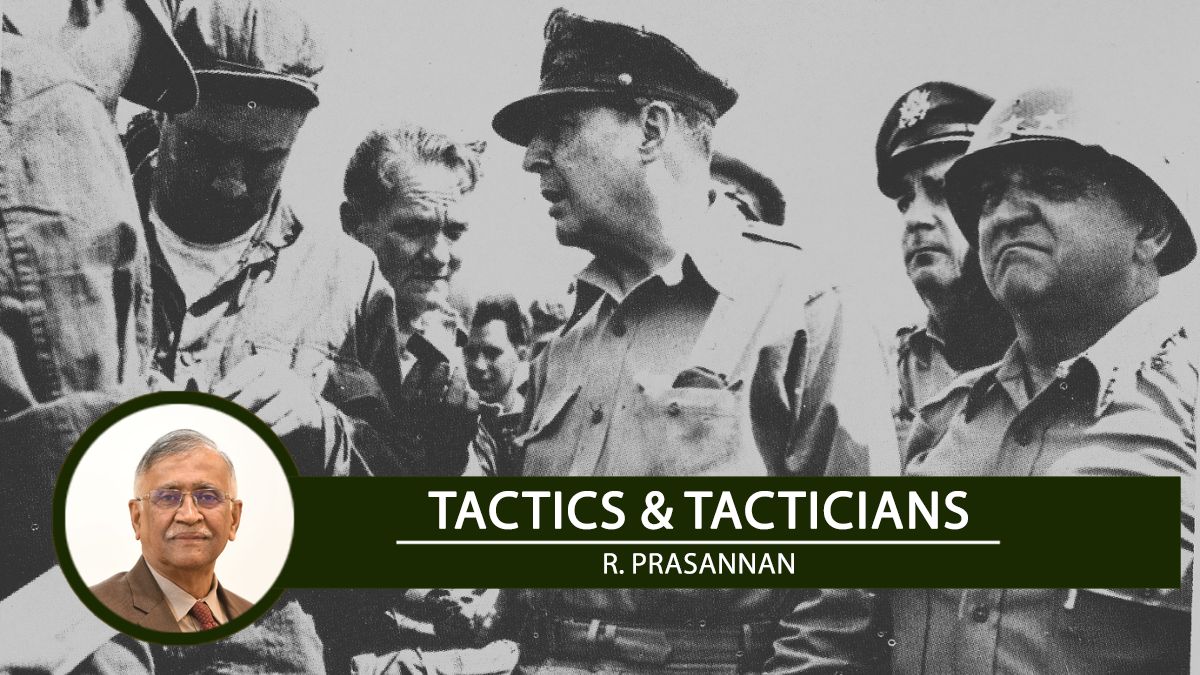
The Korean War started with the invasion of South Korea by the communist North Korea on June 25, 1950. The South Korean army, outnumbered and equipped with outmoded weapons, was taken totally by surprise. They surrendered their capital, Seoul, and retreated further south. The UN authorised an intervention, and the US sent three divisions to aid the south, but they too were pushed back to the southeastern corner of the peninsula. The retreat halted around Pusan (now Busan), where they formed a perimeter, but it was clear that they wouldn’t be able to hold there for long.
Something had to be done to save the embattled South Korean army and the US divisions, as well as regain the South Korea’s territory. General Douglas MacArthur, head of the US Far Eastern Command, was given charge of the operation.
At his headquarters in Tokyo, where he had been serving since the surrender of Japan in the Second World War, MacArthur calculated that further reinforcement of the Pusan perimeter would be foolhardy. With little room for manoeuvre, forces in Pusan wouldn’t be able to consolidate and launch a counter-offensive against the northern forces.
Then he decided – I shall make an amphibious landing deep behind the enemy lines. But where? He zeroed in on the Inchon beach just about 25 miles from Seoul. Too close to the enemy’s garrison in the south, most of his superiors thought. The US government doubted whether the plan could succeed. The navy planners were not sure of a successful landing, given the fact that the tides in the Yellow Sea varied by as much as 30 feet at times. And could the Marines scale the sea walls that surrounded Inchon?
But MacArthur was convinced. He advocated a bold amphibious landing at Inchon, which, he knew, would surprise the enemy. After softening the enemy defences from the air, the soldiers, sailors and marines of the US X Corps landed at Inchon on September 15, 1950. As MacArthur knew, the enemy was taken by surprise. The troops that landed raced towards the nearby Kimpo airfield, captured it and secured it, enabling further induction of troops by air. In about a week, Seoul fell to them.
As Edwin H. Simmons, a marine veteran who was present at Inchon as a battalion commander, wrote later in the monograph series ‘The Elite’, “The victory was everything that MacArthur had predicted. The resurgent Eighth Army burst out of Pusan perimeter, and the shattered elements of the North Korean People’s Army were sent reeling northwards whence they came. MacArthur had every reason to regard Inchon, as he did, as his strategic masterpiece...”
