



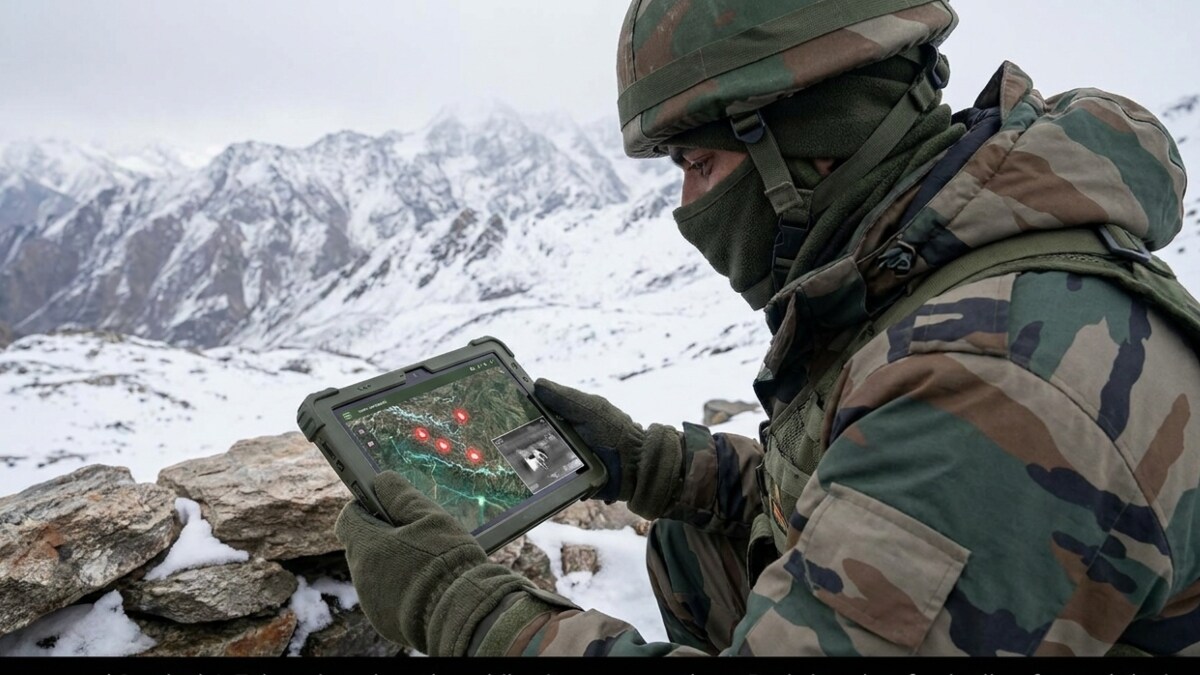
For decades, guarding the Line of Actual Control (LAC) between India and China has been a test of human endurance. Stretching over 3,400 kilometres through some of the world's most unforgiving terrain—from the freezing heights of eastern Ladakh to the dense, oxygen-deprived forests of Arunachal Pradesh—the border has traditionally relied on physical patrols. Soldiers would trudge through deep snow or treacherous mountain passes, visually scanning for incursions. But human eyes can only see so far, and severe weather frequently blinds them completely.
Today, the paradigm of border management is undergoing a radical shift. The Indian Armed Forces are moving away from a purely manpower-intensive guarding model toward a technology-driven, persistent surveillance model. At the heart of this transformation is the Internet of Things (IoT)—a vast, interconnected network of intelligent sensors designed to create a "Smart Border". This digital wall does not replace the infantryman; rather, it acts as an unblinking, 24/7 force multiplier, ensuring that when soldiers do deploy, they move with precise, actionable intelligence.
The anatomy of a digital wall
A Smart Border is not a single piece of equipment but a layered, integrated ecosystem. Driven by frameworks like the Comprehensive Integrated Border Management System (CIBMS), the goal is to stitch together various data points into a single, cohesive operational picture.

The first layer of this digital wall is the IoT sensor grid. In rugged areas where fencing is physically impossible to construct or maintain due to avalanches and shifting glaciers, the military is deploying arrays of unattended ground sensors (UGS).
These include:
- Seismic Sensors: Buried beneath the earth, these sensors detect the specific vibrations of footfalls or heavy vehicle tracks, differentiating between a passing herd of wild yaks and a mechanized infantry patrol.
- Acoustic Sensors: Calibrated to pick up the distinct sound signatures of drones, helicopter rotors, or even hushed conversations within a specific frequency range.
- Infrared and Thermal Imagers: Fixed along critical mountain passes, these cameras cut through fog, blizzard conditions, and pitch-black nights, detecting the heat signatures of encroaching forces.
By networking these discrete devices, the LAC is being transformed from a porous, geographically challenging frontier into a digitized alert zone.
The aerial vanguard: Drones as mobile nodes
Fixed sensors are only half the equation. The modern Smart Border relies heavily on Unmanned Aerial Vehicles (UAVs) acting as dynamic, mobile IoT nodes. Small, hand-launched tactical drones provide local commanders with immediate "over-the-hill" visibility, whilst high-altitude, long-endurance (HALE) platforms loiter for hours, mapping topographical changes and monitoring enemy troop buildups deep across the border.
When a seismic ground sensor is tripped in a remote valley, it does not just sound an alarm in a distant bunker. Through an automated IoT protocol, the sensor's alert can instantly cue a nearby loitering drone to alter its flight path, fly to the specific GPS coordinates of the anomaly, and stream live thermal video back to the command centre. This machine-to-machine communication severely reduces reaction time and takes the guesswork out of threat verification.
Overcoming the elements: Power and edge computing
Deploying a high-tech network in the Himalayas presents unique engineering nightmares. How do you power an IoT grid in a region that sees weeks of unbroken cloud cover and temperatures of -40°C? And how do you transmit high-definition data without reliable satellite or optical-fibre links?
The solutions lie in indigenous innovation. To solve the power crisis, sensors are being equipped with advanced micro-solar panels, ruggedised fuel cells, and specialised lithium-ion batteries that resist freezing.
To solve the connectivity issue, the military is turning to Edge Computing. Instead of sending every minute vibration or hour of empty video feed back to a central server—which would choke the limited military bandwidth—the data is processed locally "at the edge". AI microchips built directly into the cameras and sensors analyse the data on the spot. If a thermal camera watches an empty snowfield for 12 hours, it transmits nothing. But the millisecond it recognises the silhouette of an armed combatant, it compresses that specific image and fires off a high-priority alert.
From reactive to proactive deterrence
The integration of IoT along the LAC changes the very nature of Indian border defence. It shifts the military posture from reactive—discovering an intrusion after it has happened—to proactive. By analysing the massive amounts of data collected by these sensors over time, AI predictive analytics can identify patterns and vulnerabilities, forecasting where the adversary is most likely to test the defences next.
As geopolitical tensions remain persistent, the Smart Border ensures that India’s physical frontiers are mirrored by a formidable digital shield. The jawans still hold the line, but they are now backed by a network of thousands of invisible, untiring sentinels.
The author is MD, Flugelsoft Group of Companies.
The opinions expressed in this article are those of the author and do not purport to reflect the opinions or views of THE WEEK.
