



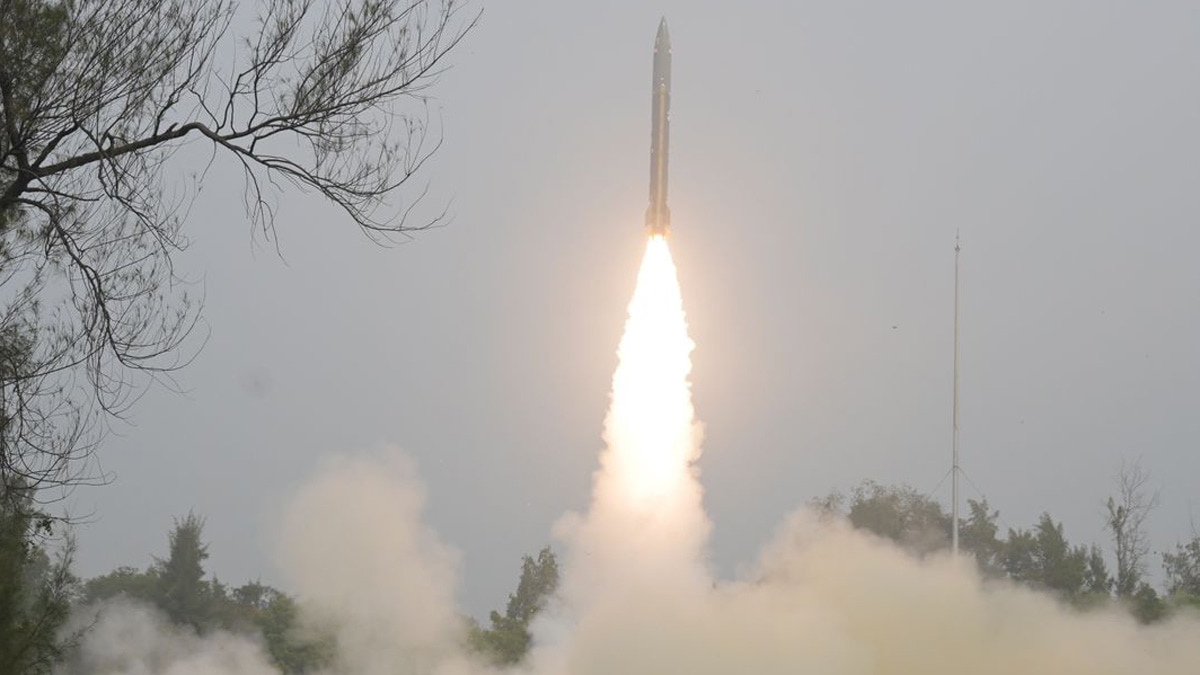
India’s missile ecosystem, which includes the likes of BrahMos and Pralay, is showing strong signs of maturity and forward momentum. A mix of cost optimisation, indigenous development, and next-generation technologies is shaping its trajectory.
From efforts to reduce the cost of systems like BrahMos to the development of faster, fully indigenous anti-ship missiles, the focus is on scaling capability while enhancing self-reliance, Defence Research and Development Organisation (DRDO) and Secretary of the Department of Defence R&D Samir V. Kamat observed during the ANI National Security Summit 2.0.
He noted that efforts are being made to reduce the cost of BrahMos missiles, and this is being done by looking at each subsystem of the missile.
Speaking about the other missiles that the DRDO is developing, he said, "The second missile that we are looking at is a long-range anti-ship missile, which was the original role for the BrahMos. This is a fully indigenous missile which can fly faster than BrahMos."
ALSO READ: Will India's deep strike Ghatak drone be like LCA Tejas or Rafale fighters? The DRDO chief explains
He said two development tests have been completed, and the third development test is also planned very soon, most likely in May.
"And once the development trials are over, we will offer it to the users. We hope to get it inducted in the next two to three years..."
He said for short-range ballistic missiles, the Pralay is now in the final stages of testing.
Pralay is an indigenously developed solid propellant quasi-ballistic missile. It is equipped with state-of-the-art guidance and navigation to ensure high precision. The missile is capable of carrying multiple types of warheads against various targets.
He further said with respect to hypersonic, the DRDO is working on two programmes—the hypersonic glide missile and the hypersonic cruise missiles. The glide missile will come out first.
"We should be doing the first trials fairly soon. And that is at a more advanced stage than the cruise missile. The cruise missile programme has not yet been sanctioned, although we are working on the various technologies which will go into the cruise missile," the DRDO chief further said.
According to Kamat, some of India's strategic missiles can be converted to tactical usage for the medium range and the long range.
"With respect to hypersonic, we are working on two programmes, the hypersonic glide missile and the hypersonic cruise missiles. The hypersonic cruise missiles is one which has a scramjet engine, and it is powered during its flight. The hypersonic glide missile is a missile which uses a booster to give it initial velocity, and then it just glides without any powering. The glide missile will come out first," he noted.
He clarified that the first trials of this missile will begin very soon.
Kamat further said, "Recently, we have done a scramjet propulsion for more than 1,000 seconds. So that's been a major achievement, and once the programme is sanctioned, we will convert the scramjet propulsion into a working missile system. And I think that should take about five years after the sanction."
