



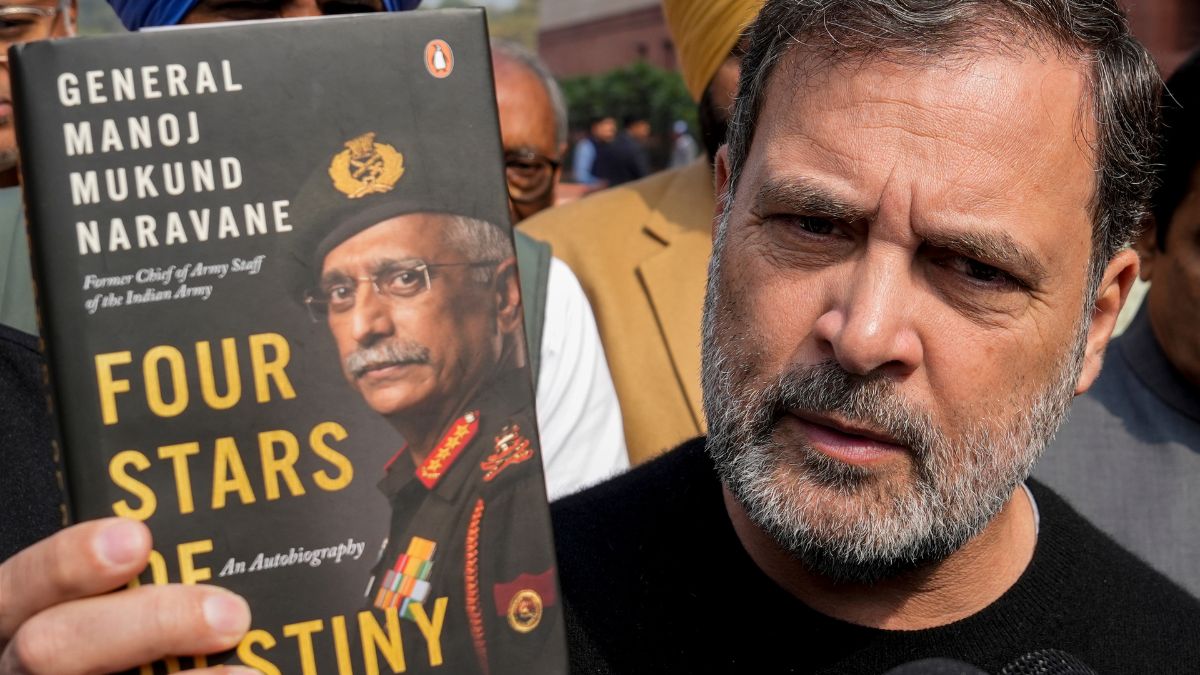
Former Army chief General Manoj Naravane has said it was "not warranted" to unnecessarily quote and drag him into the limelight over his unpublished book, "Four Stars of Destiny". However, the controversy is behind him and he has moved on, re-channelling his energy into other books, he added.
"The Ministry of Defence had asked the publisher to put it on hold until it was vetted. As far as I am concerned, the matter rested there, and I have moved on; so that is a closed chapter. And unnecessarily quoting me and dragging the unpublished book into the limelight—and indirectly me into the limelight—was, I think, not warranted," Naravane reportedly told PTI Videos in an interview.
In February this year, Congress leader Rahul Gandhi was stopped from citing excerpts from the memoir in the Lok Sabha, as it had not yet been published. "Four Stars of Destiny" stirred a controversy when one of the chapters in the book about the 2020 India–China conflict seemed to suggest that the political leadership left the decision to counter the Chinese aggression completely to the armed forces.
The account of the standoff suggests Naravane urgently sought clear orders from the top leadership, including Defence Minister Rajnath Singh and Ajit Doval, as Chinese forces advanced in eastern Ladakh. Despite the deteriorating situation and the readiness of the Indian Army to respond with artillery, he claims he did not receive explicit approval to open fire.
According to the article, the Defence Minister promised to call back after Naravane's third call to him. Singh called back after speaking to the Prime Minister, whose instruction was merely “Jo uchit samjho, woh karo” (Do what you deem appropriate), leaving the decision to the military. This was to be “purely a military decision,” according to the article.
More books from the ex-Army chief
General Manoj Naravane, meanwhile, said he has already written two books and a third will soon be released. "The Curious and the Classified: Unearthing Military Myths and Mysteries", his latest, published by Rupa Publications, explores some of the most riveting nuggets about the legends and lore of the Indian Army, Navy, and Air Force.
ALSO READ | 'Four Stars of Destiny' row: Naravane breaks silence; endorses publisher's statement
In the book, Naravane traces the origins of the ubiquitous military greeting "Jai Hind" from the freedom movement to its adoption by the Indian armed forces. He said that "Jai Hind" was first used by the Indian Air Force and only later embraced by the Army and Navy, adding that the standard practice of saluting was originally silent, with regiments adding their own greetings like "Sat Sri Akal" or "Ram Ram".
"It was initially the Air Force that started saying 'Jai Hind', and we have now followed that across all three services. With the salute we say 'Jai Hind', and even in lectures, we greet with 'Jai Hind'. But where does this 'Jai Hind' come from? You realise it has got much deeper roots. And that was a revelation to me also. So it was something even I did not know about; I must have said 'Jai Hind' a million times," Naravane said.
The former Army chief delves into the legends of Badluram, a soldier of the Assam Regiment, and a military mule named Pedongi. Badluram died in the Battle of Kohima in 1944, but rations allotted to him kept arriving after his death, helping the besieged company to survive the war. The story inspired British Indian Army officer Major M.T. Proktor to write a foot-tapping song, "Badluram ka Badan", which has become the unofficial regimental anthem of the Assam Regiment and is sung at their functions.
"...the lyrics go 'Badluram ka badan zameen ke neeche hai. Lekin uska ration hum khaate hain' and it became a very famous song. It is a very foot-stumping song and you can dance to it and it raises your morale. Although people have heard the song, very few know it has got such deep roots in an actual battle which turned the tide of probably the Indian course of history," he said.
