



With the Iranian conflict well into its fourteenth day after the US–Israel joint offensive began on February 28 and with no apparent signs of an end anytime soon, certain things are becoming clear.
One is that the US was not prepared for the kind of war preparations that Iran had made, with its low-cost and low-flying Shahed drone becoming a dreaded weapon in the Iranian arsenal. So much so that it is almost changing the economics of warfare.
This very simple weapon, with its capability to hit US and Israeli targets across 20 countries in the Gulf, and its menacing omnipresence in the Strait of Hormuz, has held the global economy by the scruff of the neck.
In the past few days, the Shahed-136—a core tool in Iran’s military strategy—has hit military targets, civilian targets, and infrastructure, including ships, air bases, and oil installations, among others.
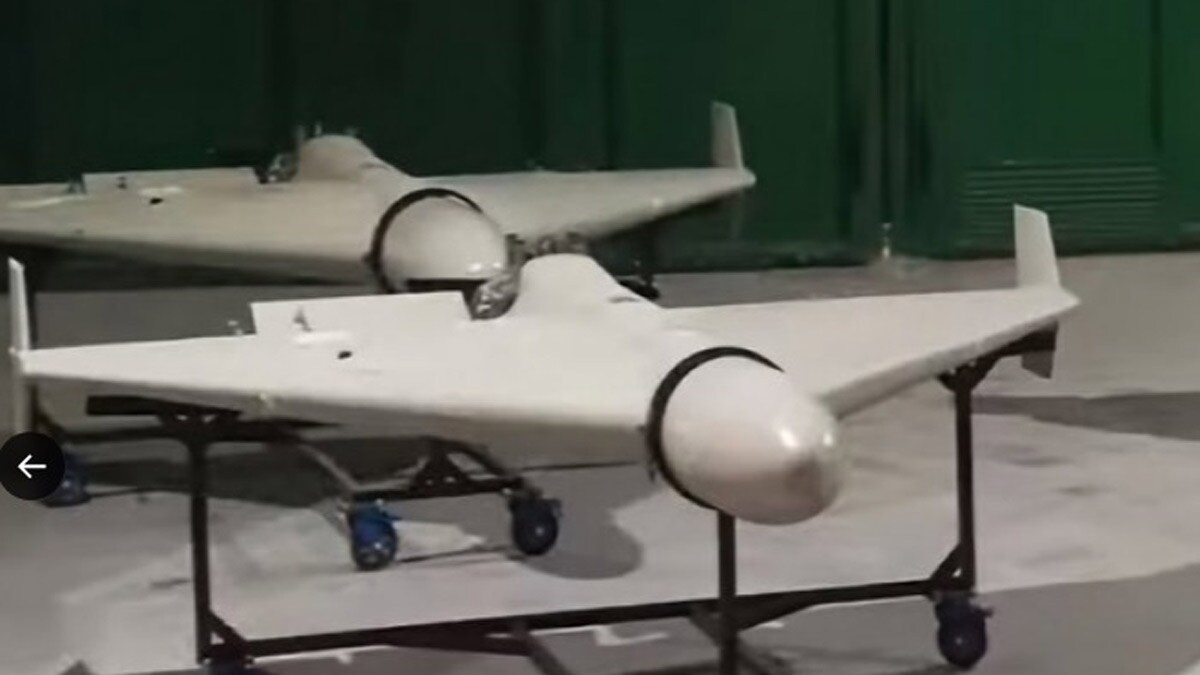
Increasingly being touted as the poor man’s cruise missile, the ‘suicide’, ‘kamikaze’, or ‘one-way’ Shahed-136, the most dreaded variant of the armed projectile, is really a simple piece of equipment that is made of fiberglass.
Delta-winged, it has a wingspan of 2.5 metres. It basically comprises three subsystems—an autopilot system, a global positioning system (GPS) receiver, and a data module. It is propelled by a 50-horsepower, four-piston motor. The Shahed-136 can fly up to 2,000 km with a 40-kg explosive payload at a speed of 185 km an hour.
The most critical aspect of the Shahed’s capability is its ability to fly at altitudes as low as 60 metres, while the operational ceiling is about 4,000 metres. The low-flying capability allows it to evade most radars and air defence detection systems.
But what has been the foremost question in the minds of military and engineering experts is the manufacturing cost of the Shahed-136, a simple drone that is being mass produced by Iran and Russia, with its own version called the Geran-2, and now even the US, which has reverse-engineered the Shahed-136 to position its LUCAS, short for Low-Cost Uncrewed Combat Attack System.
The US has put the production cost of a LUCAS at $35,000, which may well be on the higher side because of certain advanced features in the LUCAS as compared to the Shahed-136, like an integrated Starlink terminal and the use of composite materials.
The most widely accepted estimate is that the cost of the Shahed-136 lies in the range between $20,000 and $50,000. But even at that cost, it is a fraction of what a single $3 million interceptor missile costs—those used to bring down Shaheds.
But while Iranian media uses a figure in the range of $20,000 to $50,000, the actual cost could be much lower in Iran because a prime criterion in the production of the drone has been keeping costs low, with very little dependence on imported components.
With the Tehran regime under sanctions for a long time, resulting in the development of indigenous materials and components, low labour costs, and economies of scale being prime factors in determining the cost of the Shahed-136, the cost of making one in Iran would be significantly lower. Certain reports from Iran have put the cost of making one in Iran at as low as $4,000, or to put it in a better context—the cost of making one Shahed-136 in the US could produce five in Iran.
