



Amid a massive US military build-up in the Middle East that has fuelled fears of war, US President Trump said negotiations with Iran to end the tense standoff were going well but demanded that Tehran reach a "meaningful" agreement. "Otherwise bad things happen," Trump—who has repeatedly threatened to attack Iran—told the first meeting of his Board of Peace in Washington.
The Islamic Republic, meanwhile, said it would not start any war but that "in the event that it is subjected to military aggression, Iran will respond decisively and proportionately" in its exercise of the right of self-defence. "All bases, facilities, and assets of the hostile force in the region would constitute legitimate targets," the letter said. "The United States would bear full and direct responsibility for any unpredictable and uncontrolled consequences."
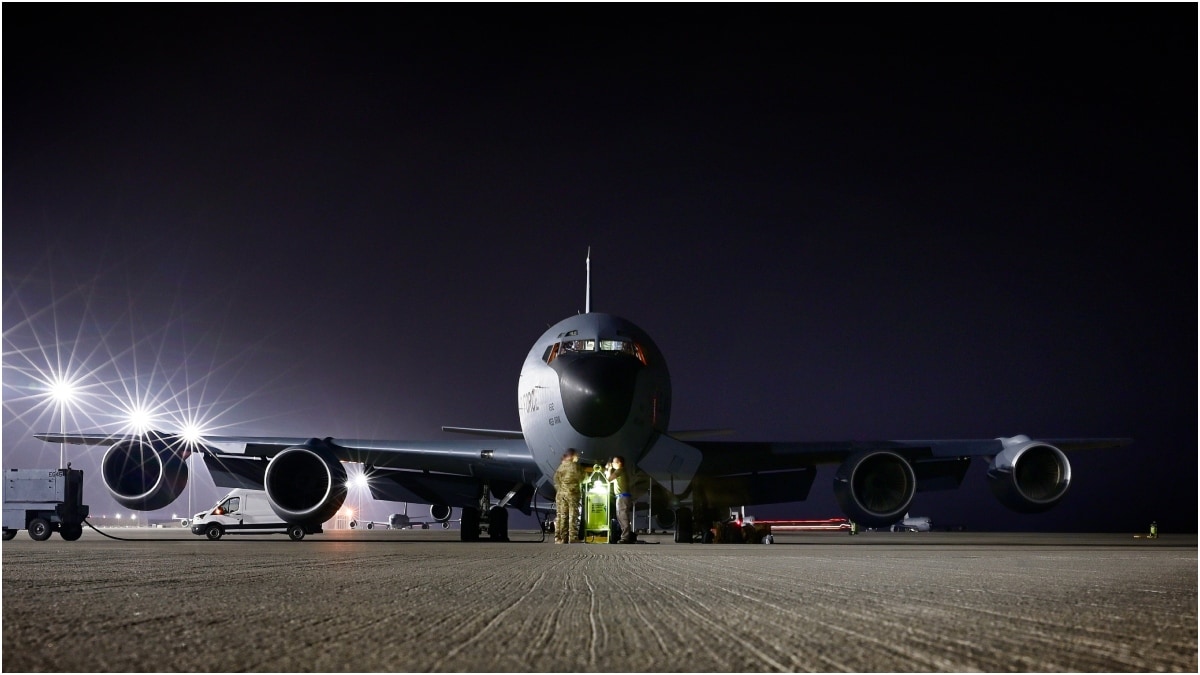
According to flight-tracking site Flightradar24, at least six US military aircraft—including two E-3 surveillance jets, two C-17 transport planes, a KC-135 aerial refuelling tanker, and a pair of HC-130 Combat King IIs—were en route to the Middle East.
The KC-135 and KC-46 are the US Air Force's refuelling tankers used to support the long-range movement of fellow aircraft, with numbers now “much higher than you would typically see” in the region. In the build-up, the US Air Force was setting up refuelling points at bases from Spain to the island of Crete in Greece, the BBC had said. According to the report, there are seven KC-135s in Crete and six more at the Spanish Naval Station Rota.
The presence of refueller planes is particularly telling of the USAF preparing for an aerial assault. Here are five things that military and aviation enthusiasts would love to know about Boeing KC-135 Stratotankers—the "old boys" of the USAF that are still key to its long-range operations:
1. The KC-135 is one of nine military fixed-wing aircraft with over 60 years of continuous service with its original operator. The USAF is expected to use them at least until 2030, while Chile, Singapore, and Turkey are among other countries still using them. They can also be configured to carry up to 83,000 lbs of cargo or be used for aeromedical evacuation missions.
2. The KC-135 shared the Dash-80 prototype with the Boeing 707 commercial transport but was launched first in 1956. The military tanker-transport aircraft has a wingspan of 130 feet 10 inches and a length of 136 feet 3 inches. It has a gross weight of 297,000 pounds and can reach a top speed of 600 mph and a cruising speed of 552 mph. The aircraft has a range of 5,000 miles and can fly at a ceiling of 41,000 feet. It is powered by four turbofan engines (upgraded from the original J57 turbojets), providing significant thrust. It can accommodate a crew of four and transport up to 80 troops.
3. According to the Boeing website archives, the KC-135 was the only jet airplane designed specifically for aerial refuelling. More than 732 KC-135s were built, and most, with modifications, remain in service into the 21st century. Its aerial refuelling equipment in the lower deck leaves the upper deck clear for 25 tons of cargo or 80 troops. KC-135s supplied warplanes with fuel during the Persian Gulf conflict, Operation Enduring Freedom over Afghanistan, and for homeland defence.
4. The U.S. Air Force heavily depends on the KC-135 as the KC-46 tanker programme has not lived up to expectations. Technical deficiencies, including fuel system leaks and malfunctioning remote vision systems, are among the reasons for the KC-46’s mission-capable rates remaining outstandingly low, Military Watch Magazine said in a report. On 24 February 2011, Boeing announced that it had received a contract from the U.S. Air Force to build the next-generation aerial refuelling tanker aircraft, the KC-46—based on the Boeing 767 commercial airplane—to replace 179 of the service’s 400 KC-135 tankers.
5. The USAF selected Rockwell Collins to carry out the modernisation of the avionics system under the KC-135 Pacer CRAG (compass, radar, and global positioning system) programme. According to available information, the flight management system is integrated with a traffic alert and collision avoidance system (TCAS) and an enhanced ground proximity warning system (EGPWS). An overhaul of the aircraft’s flight deck with an advanced autopilot, flight director, radar altimeter, and electronic engine instrument display to enhance navigational capabilities was also included, as per the report. Digital avionics were also introduced to increase safety, reliability, and efficiency.
