



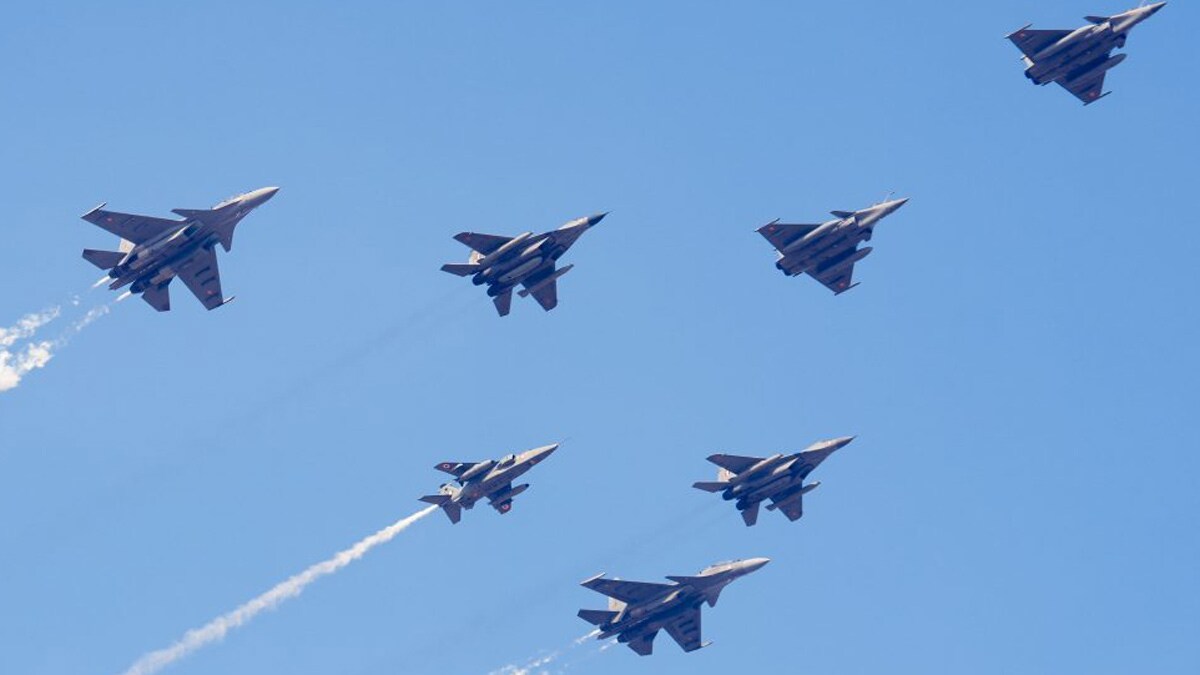
Modernising the Indian Air Force (IAF) is no longer about just buying more fighters; it is about redesigning the way India generates, sustains, and employs airpower in a two-front, high-technology battlespace. The real problem is not simply a "numbers gap", but an institutional and ecosystem gap between India's strategic ambitions and the way its airpower capability is conceived, funded, acquired and integrated.
Reframing the core problem
Public discourse usually reduces IAF modernisation to "42 squadrons vs 30-31 today", and the race to induct Rafales, Tejas variants and a future MRFA. While this quantitative shortfall is serious, it is the symptom of deeper structural issues.
First, there is fragmented ownership of airpower: political leadership, MoD bureaucracy, the IAF, DRDO, DPSUs and private industry often pull in different directions, producing chronic delays in acquisitions and upgrades. Second, procurement is more procedural than strategic; acquisition cycles are driven by process compliance and audit defensibility more than by time-bound operational outcomes, which is why even relatively small LCA Tejas Mk1 orders took over a decade to fructify and deliver. Third, capability design remains frozen in the past: planning still assumes a linear expansion to 42 fighter squadrons even though adversaries are leaping ahead in long-range precision, drones, electronic warfare, cyber and space, allowing them to create effects without matching fighter numbers one-for-one.
There is also weak integration into joint structures. The IAF is simultaneously sceptical of rushed theatre-command reforms and yet constrained by the absence of a truly joint, air-centric campaign design for a two-front scenario. From a strategic perspective, India's airpower challenge is therefore one of alignment: aligning doctrine, organisation, industrial policy and budgeting around a realistic concept of air dominance against China-Pakistan collusion, rather than chasing a moving numerical target with yesterday's processes.
Diagnosing structural gaps
Airpower-industrial mismatch
The IAF's operational vision increasingly depends on indigenous platforms (Tejas Mk1A/Mk2, AMCA, indigenous AEW, weapons), yet the industrial base has been slow, fragmented and risk-averse. The sanctioned 42 squadrons are now widely seen as unachievable before the mid-2030s; even optimistic projections suggest 35-36 squadrons at best by then, with today's operational strength down to roughly 30-31 squadrons and slipping further as older aircraft retire.
Legacy MiG-21s and Jaguars are leaving service faster than replacements are inducted, while by the time Tejas Mk1A is fully delivered, parts of its baseline technology risk being overtaken by newer regional capabilities. Large imports like Rafale or a future MRFA remain essential, but domestic capacity to absorb, sustain and upgrade these platforms indigenously is still underdeveloped, locking India into long-term dependence for spares, upgrades and high-end weapons.
Procurement and governance bottlenecks
The gap between decisions announced and capabilities fielded reflects systemic weaknesses in defence governance. Requirements, trials, negotiations, approvals and production rarely overlap by design, so time compression is minimal; this is visible in the delayed delivery of even the first 40 Tejas aircraft ordered over a decade ago. File-based decision-making prioritises avoiding controversy over meeting operational timelines, leading to repeated re-tendering and under-ordering in small "batches" that deny economies of scale to industry.
When squadron strength falls toward parity with Pakistan while China races ahead, there is still no clear institutional mechanism that links such outcomes to accountability across the MoD, DPSUs and services. This diffused responsibility encourages risk-aversion and incrementalism precisely when the environment demands speed and boldness.
Doctrinal and organisational ambivalence
Modern air warfare is about integrated kill-chains more than individual platforms, yet organisational debates remain stuck at the level of "who controls what". The IAF has signalled that it is not opposed to integration per se, but is wary of theatre commands that fragment scarce air assets across multiple headquarters and dilute doctrinal coherence.
With only around 30 squadrons against a notional requirement of over 42, centralised control of air assets has a strong operational logic, but this sits uneasily with the Army and Navy's demand for dedicated theatre commands and more organic aviation. Cyber, space, electronic warfare, and long-range precision strike are still not fully integrated into a single, joint "air and space" campaign design, even though adversaries are moving rapidly towards multi-domain operations.
Force multipliers and enablers deficit
Even if fighter numbers improve, the IAF's ability to generate decisive effects depends on its force multipliers and network. There are persistent gaps in airborne early warning, aerial refuelling and persistent surveillance, which limit the exploitation of existing fighters and constrain operations over extended ranges, especially against China.
Stocks of long-range air-to-air missiles, stand-off precision weapons and air-launched cruise missiles remain limited, and their indigenous development is still maturing. Directed-energy weapons, swarming drones and advanced electronic warfare suites are recognised as priorities but not yet integrated into a coherent, time-bound capability roadmap.
Strategic priorities: A new perspective
The dominant narrative is "more fighters, faster procurement." A more useful reframing is: how can India create effects-dominance over its airspace and maritime approaches against China-Pakistan, even with sub-optimal fighter numbers, while building industrial and doctrinal resilience? This points to six interlocking strategic priorities.
From squadron counting to effects-based airpower
Instead of treating 42 squadrons as a sacred target, planning should be anchored in what effects are needed in specific contingencies. The IAF and joint planners must define clear effect-based benchmarks—days of air superiority, number of interdiction sorties, stand-off strikes, persistent ISR coverage for different fronts and scenarios, and back-calculate platform, munitions and enabler requirements.
An IAF-led, tri-service Air Campaign Design Group within the joint structures could annually update these benchmarks, integrating lessons from recent conflicts and technology trends. Procurement plans and budget allocations should be explicitly tied to these metrics rather than generic squadron numbers, making "campaign outcomes" the organising principle of modernisation.
Dual-track modernisation: High-end fighters and a light-heavy mix
India cannot afford to wait for a perfect indigenous fifth-generation fleet, nor can it afford to remain import-dependent. A dual track is needed: a high-end core of Rafale/MRFA and future AMCA, and a robust "light-heavy" mix built around Tejas Mk1A/Mk2, upgraded Su-30MKI and future unmanned combat systems.
MRFA and additional Rafale acquisitions should be structured to maximise commonality in training, weapons and maintenance and to leverage industrial offsets for engines, sensors and weapons ecosystems, not just final assembly. Larger, multi-tranche Tejas orders (Mk1A and Mk2) with performance-linked payment milestones can give HAL and private partners the scale to invest in productivity while enforcing strict delivery timelines. Su-30MKI mid-life upgrades in radar, electronic warfare and weapons must be treated as a strategic priority equal to new acquisitions, since they will remain the numerical backbone for at least another decade.
Building an airpower industrial compact
The real fix is not a single contract but a durable compact between the IAF, MoD and industry. India needs to move from project-wise, transactional procurement to long-horizon capability roadmaps co-designed with DRDO, DPSUs and private firms.
A permanent Airpower Capability and Industry Council, chaired jointly by senior military and civilian leadership, could align 15-20-year roadmaps for fighters, engines, sensors, weapons and unmanned systems. Modernisation should shift to spiral development—field early, upgrade often. For example, induct initial Tejas and domestic weapons with known gaps but commit to regular software and systems upgrades, rather than waiting for a "perfect" Mk2 before large-scale induction. Protecting critical design and manufacturing knowledge is essential to avoid repeated "first-time" delays on each new variant or platform.
Deepening jointness without diluting air doctrine
Theatre commands need not mean slicing scarce aircraft into peacetime silos. The goal should be joint structures that preserve the IAF's ability to mass airpower rapidly while providing theatre commanders with assured air effects.
A phased approach could start with functional commands—Air Defence, Strategic Fires, Cyber and Space—where jointness directly enhances air operations without fragmenting control of fighters. Within each eventual theatre, an Air Component Command model can ensure that the theatre commander receives air effects through an IAF-led component headquarters that retains operational control of assets, while ground and maritime commanders influence prioritisation through joint planning forums. Promotions and postings should reward genuine multi-domain experience to build a shared campaign culture across services.
Prioritising force multipliers, networks and munitions
With limited fighters, every sortie must count more. Modernisation should prioritise expanding and hardening the ISR-AEW-tanker-network backbone and building stocks of high-end munitions before chasing marginal increases in aircraft numbers.
Indigenous AEW&C programmes on multiple platforms—smaller jets and larger airframes—should be accelerated, alongside high-altitude, long-endurance UAVs and stratospheric balloons for persistent surveillance against China. Multi-year, assured orders for indigenous and co-developed air-to-air and stand-off weapons will create economies of scale and export opportunities. Hardened, redundant networks—data links, satellite communications, cyber-secure command systems—are vital so that even under cyber or electronic attack, the IAF's kill-chains remain intact.
Embracing unmanned and emerging technologies as core
The most transformative leap is in how India uses drones, AI and directed energy. Unmanned systems and directed-energy capabilities must be treated as central to the future force structure, not as peripheral experiments.
India should develop a tiered unmanned ecosystem: small swarms for SEAD/DEAD and ISR, medium-altitude long-endurance UAVs for surveillance and strike, and loyal-wingman UCAVs teamed with manned fighters. A dedicated Airpower Emerging Technologies Command or directorate should drive rapid experimentation, field trials and doctrinal integration of AI, swarming algorithms, electronic warfare pods and directed-energy weapons. Realistic red-team exercises against dense air-defence and electronic warfare environments will ensure these systems become usable capabilities rather than presentation slides.
Implementation framework: Making priorities real
For modernisation to move from paper to runway, India needs an implementation framework with clear sequencing, accountability and feedback.
Institutional Mechanisms
Key gaps—fighter numbers, AEW&C, munitions, drones—should be converted into time-bound modernisation missions with five- and ten-year targets, led by empowered mission managers who can cut through procedural bottlenecks. Unclassified progress indicators published annually would create political and public pressure for delivery.
The Long-Term Integrated Perspective Plan must become genuinely tri-service and effects-based, with the IAF's air campaign metrics embedded as the primary airpower driver. Annual budgets should be linked to these plans, giving the IAF predictable capital outlays over rolling five-year windows to support bulk orders and industrial investment. Senior appointments in MoD, DRDO and DPSUs should be tied to performance on delivery timelines and capability outcomes, with strong incentives for organisations that meet or exceed milestones.
Budgetary, policy and human capital support
A minimum share of the defence capital budget should be ring-fenced for airpower, including enablers and munitions, recognising the decisive role of air dominance in short, intense conflicts. Innovative financing—leasing, government-to-government deals with deep technology transfer, and multi-year procurement contracts—can smooth cash flows and accelerate induction.
IAF doctrine needs revision to fully integrate unmanned systems, cyber and space, and to explicitly address limited-war scenarios under a nuclear overhang, including salami-slicing on the LAC and cross-domain coercion. Joint training cycles should focus on air-land-sea integration, with large-force exercises that stress-test networks, logistics and replenishment under contested conditions. Finally, India must invest in a cadre of airpower strategists, technologists and acquisition specialists who can bridge operational needs and industrial realities, moving between IAF, MOD and industry roles to sustain a learning, adaptive modernisation process.
(Ishan Jayant Tewari is a lawyer and strategic consultant.)
(The opinions expressed in this article are those of the author and do not purport to reflect the opinions or views of THE WEEK.)
