



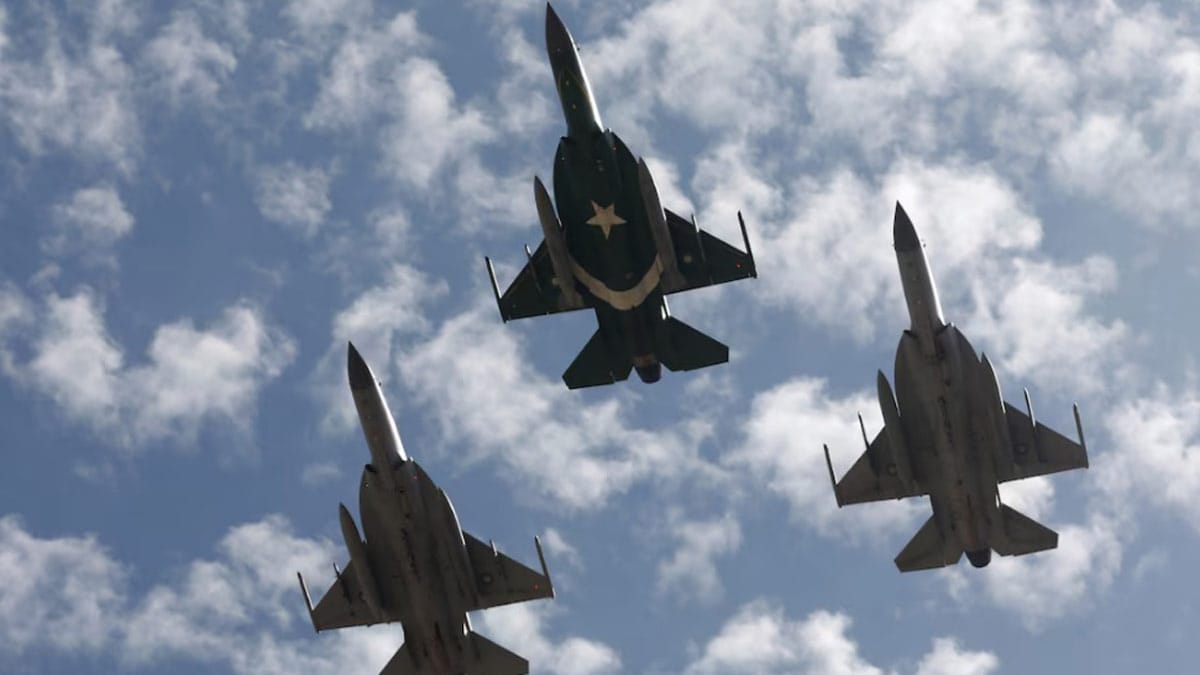
For the past few days, Pakistan, aided by a section of the foreign media, has been in overdrive, projecting itself as a major defence exporter, with its China-co-developed JF-17 fighter jets, which it claimed are becoming the cynosure of all eyes.
A particular news agency seems to be overly enthusiastic about the whole deal, claiming that as many as 13 countries (in nearly as many news reports) are in talks with Islamabad for the procurement of the fighter jet, whose efficiency, Pakistan claimed, was proved during the May battle with India.
All interest, little ink
The aforementioned news agency, which almost seemed to be working in tandem with Pakistani social media handles, claimed that "Pakistan's weapons have become a viable alternative after they were tested in a massive air battle with India in May."
A flurry of news reports named Bangladesh, Saudi Arabia, Indonesia, Morocco, Ethiopia, Sudan, Nigeria, the self-styled Libyan National Army (LNA), and Iraq as countries that have expressed interest in the fighter jet.
Pakistan "is becoming more relevant as a flexible, mid-tier provider of defence capacity," geopolitical risk analyst and strategic consultant Dr Andreas Krieg was quoted by the said agency, adding, "It can train forces, provide advisers, run joint exercises, support maritime operations, and offer a menu of cost-effective platforms. For fragile African partners, that combination can be attractive: it is faster than Western capacity-building, less politically encumbered, and often cheaper."
The aggressive marketing of the “combat-tested” fighter jet is marked by sufficiently ambiguous words and phrases, such as countries being "engaged in discussions" or having "expressed interest", even as there is no official report of any of these countries signing a contract with Islamabad for the proucrement.
Economics vs enthusiasm
Pakistan Defence Minister Khawaja Asif went on to the extent of saying the fighter jet will save his country's economy. "Our aircraft have been tested, and we are receiving so many orders that Pakistan may not need the International Monetary Fund in six months," he said, with utmost confidence. Indeed, it is a tall claim over hypothetical deals that do not seem to be in keeping with the country's ability to handle the production capacity, even if some of these countries do decide to sign procurement contracts.
There's also the math that can never match. Pakistan's outstanding IMF credit alone, as of January 20, 2026, stands at $7.4 billion. The price of a unit of the JF-17 Thunder fighter jet is estimated at between $25 million and $30 million. Pakistan would need to sell nearly 247 jets to cover this amount alone, while the country's total debt amounts to $287 billion. Pakistan currently produces around 20 of these fighter jets every year, prioritising its own needs.
Asif wasn't the only one making claims about the deals. From Pakistan-based defence experts and former military personnel to Pakistani Prime Minister Shehbaz Sharif himself, the deals have been hyped up by everyone worth their salt! Pakistan has again proven that when it comes to narrative building, the country and its ISPR (Inter-Services Public Relations) are always in their element.
“The PAF demonstrated superior performance against much more expensive Western and Russian systems, which has made these aircraft an attractive option for several air forces,” a former Pakistan Air Force air commodore was quoted as saying.
India in the background
Narrative building is too crucial to modern warfare and, of course, to the arms race, and Pakistan appeared to have aced the game, as such reports of Pakistan becoming a much-sought-after defence exporter have come at a time when there is a raging debate on India's plan to procure 114 Rafale fighters from France and whether this would slow down India's indigenous fighter jet programmes.
Such reports also come at a time when India is positioning itself as a viable player in the global defence market, with the country's indigenous defence production hitting a record ₹1,27,434 crore in FY 2023–24. India has supplied a wide spectrum of products, including ammunition, arms, sub-systems, complete systems, and critical components, to nearly 80 countries during 2024–25, according to a government release.
Even in the PR blitzkrieg, Pakistan appeared to be cautious, as one such report about all the interest that the fighter jet, jointly manufactured by the Pakistan Aeronautical Complex (PAC) and China’s Chengdu Aircraft Corporation (CAC), has generated, said these may not exactly translate into actual signed deals. Defence Production Minister Raza Hayat Harraj was quoted as saying, "These talks are taking place (but) they can fall through due to international pressures." That's indeed the safe route! Blame the unnamed "international" if no such talks turn into nothing.
A retired Pakistan Air Force air commodore who was closely involved in the programme said that production of the fighter jet is divided between the two countries—58 per cent undertaken in Pakistan and 42 per cent in China. Speaking to Al Jazeera, he had pointed out that Pakistan manufactures the front fuselage and vertical tail, while China produces the middle and rear fuselage. The aircraft is fitted with a Russian engine, and the seats are from the British firm Martin-Baker. The final assembly of the aircraft takes place in Pakistan. However, neither China nor Russia has made any public remarks on the potential sales.
Questions have been raised about Pakistan's production capacity, which is reliant on China for components like avionics, limiting rapid delivery. This limited production capacity, which is highly dependent on foreign supply chains, would restrict the ability to supply the fighter jets to multiple countries simultaneously, even if some of these talks turn into deals.
