



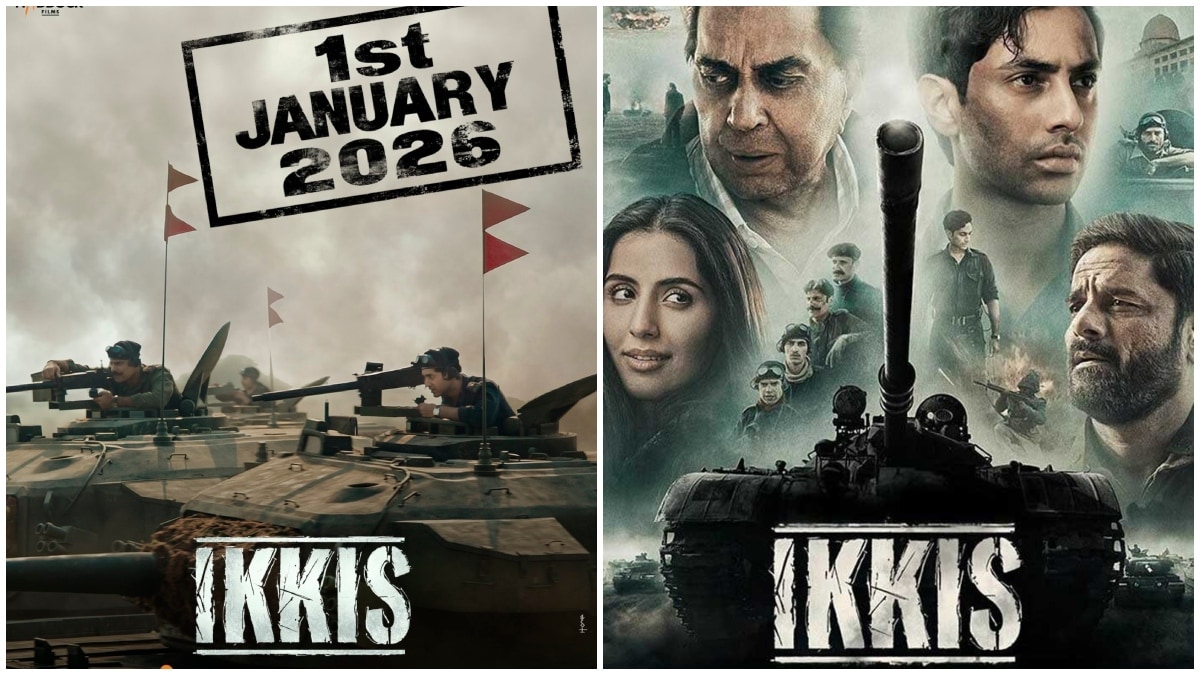
The Bollywood war drama Ikkis hit theatres on Thursday, and the story of 21-year-old Second Lieutenant Arun Khetarpal—who gave Pakistani forces hell on board his ‘Famagusta’—is already being hailed for walking a path different from that of chest-thumping patriotism. The Sriram Raghavan directorial is being largely accepted as a fitting tribute to the braveheart who laid down his life during the Battle of Basantar—a glorious chapter in the Indo-Pakistan War of 1971. The nation honoured Second Lieutenant Arun Khetarpal's valour with a Param Vir Chakra (PVC).
Agastya Nanda plays Arun Khetarpal in Ikkis, as the movie chronicles the legendary story of the tank commander who knocked out ten Pakistani tanks—primarily M48 Patton tanks—with his Centurion main battle tank before being overrun and killed.
A British tank originally designed to fight the Nazis, the Centurion found takers in 14 nations. A total of 4,423 Centurion tanks across all production models were manufactured, a report said. Apart from the UK’s NATO allies, such as Canada, Denmark, and the Netherlands, it was also used by Israel, South Africa, Austria, Sweden, Switzerland, and India. Here are five things to know about the tank that was commanded by Second Lieutenant Arun Khetarpal during the Battle of Basantar:
1. A single model capable of fulfilling the roles of “light”, “medium”, and “heavy” tanks—combining high firepower, strong armour protection, and cross-country mobility—came to be known as the “Main Battle Tank” during the Cold War era. These tanks are entrusted with engaging enemy armour on the battlefield, countering and disrupting infantry, breaking through fortified defensive lines etc. A main battle tank typically has a crew of three to four personnel, with its main gun mounted on a turret capable of 360 degrees of rotation. The Centurion is regarded as a pioneer among main battle tanks.
2. The Centurion's success is also hailed as the fruition of hard-earned lessons that the Brits learnt fighting the Nazis. To meet the demands of World War II, England fast-tracked tank production, which led to poor designs. Finally, the British Army understood that they couldn’t keep urgently building tanks that were obsolete while they were being built. “The A41 Centurion was a culmination of all the design and combat lessons learned by British tank designers during World War II in terms of protection, mobility and firepower,” said Stuart Wheeler, historian for the UK-based Tank Museum.
3. The Centurion’s combat debut happened during the Korean War. Taking on Chinese troops in the mountainous Korean terrain, the tanks were used to support UN-US forces during the Battle of the Imjin River in 1951. The tanks were reportedly effective in supporting British-led UN forces against numerically superior Chinese infantry. According to reports, a US general on the ground praised the Centurion and its crews for showing that “anywhere a tank can go is tank country—even the tops of mountains.”
4. The Centurion tanks reportedly came in 13 versions, including the 1952 Mark 5 model. Weighing 50 tons, it mounted a 20-pounder (84 mm) cannon and carried a crew of four: commander, gunner, loader, and driver. A notable feature of this design was a stabiliser that enabled the cannon to fire accurately while the vehicle was moving. When the war broke out, the Centurion Mk.7 was one of the most modern Western tanks, and India had 20-pounder guns attached to them. Second Lieutenant Arun Khetarpal's Famagusta Jx 202 was one of these.
5. Each tank measured between 9.83 and 9.85 metres in length, 3.39 metres in width, and stood 2.94 to 3.01 metres high. Depending on the configuration, it weighed from 50.73 to 51.82 tonnes and had a maximum fuel capacity of 1,037 litres. It recorded a maximum speed of 35 kilometres per hour and had an operational range of 102 to 190 kilometres. Its off-road mobility allowed it to cross a 3.35-metre trench, climb a step of 91.4 centimetres, and navigate through water up to 1.45 metres deep. According to a report by Forecast International, each Centurion was sold at a price of $261,000 in equivalent 1962 United States dollars. A Centurion brought up to late 1980s standards by Vickers had a unit price of $580,000 in equivalent 1995 United States dollars.
