



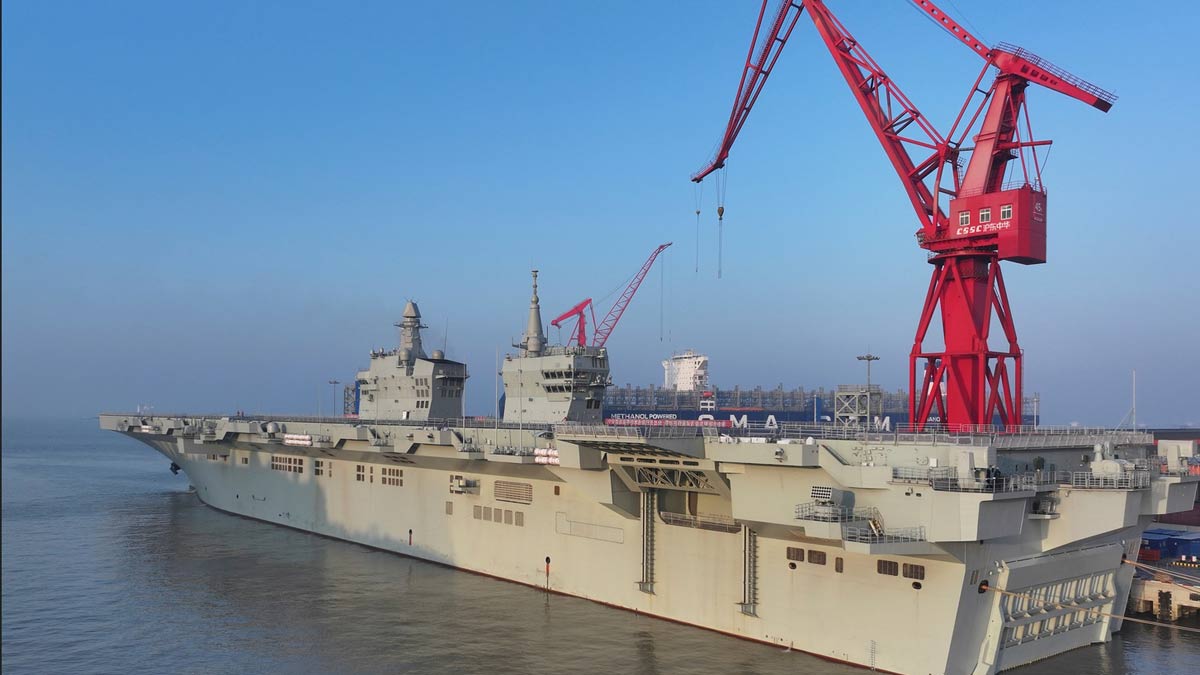
A few weeks after the commissioning of the country's third aircraft carrier, Fujian, China began the sea trial of Sichuan, a large amphibious assault ship fitted with an electromagnetic aircraft launch system (EMALS) to operate fighter planes, helicopters and drones.
EMALS can accelerate an aircraft's landing and take-off smoothly and quickly on the aircraft carrier deck.
China now has the world's largest operating fleet, with 234 warships compared to the United States Navy's 219.
According to the Chinese Navy, Sichuan, the first hull of China's Type 076 amphibious assault ship, set off from a port of Hudong-Zhonghua Shipyard in Shanghai and sailed toward the relevant sea area for its maiden sea trial. Bearing the hull number 51, the assault ship has a full-load displacement of over 40,000 tonnes.
According to official media reports, Sichuan is the first amphibious ship fitted with EMALS, which uses electromagnetic linear motors powered by electricity, unlike traditional steam catapults.
State-run China Central Television (CCTV) News reported that Sichuan uses electromagnetic catapult and arrestment technologies to carry fixed-wing aircraft, helicopters, amphibious equipment, and other assets. Xinhua news agency added that the vessel incorporates innovative electromagnetic catapult and arrestor technologies, enabling it to carry fixed-wing aircraft, helicopters, and amphibious equipment.
The sea trial, which comes after the mooring tests, equipment installation and system debugging, will mainly test and verify the reliability and stability of Sichuan's power, electrical and other systems.
China currently has three aircraft carriers: Liaoning, a refit of the Soviet-era ship commissioned in 2012; Shandong, built indigenously and operationalized in 2019; and Fujian, commissioned earlier this month. Beijing is also developing new fighter aircraft, including the J-15T, J-35, and KongJing-600, to operate from aircraft carriers.
