



In what will substantially change India’s military air-power architecture, the Indian Air Force (IAF) is set to increase the number of fighter aircraft squadrons from the currently mandated 42 squadrons to size up to tackle the possible scenario of fighting a two-front war.
The total number of IAF’s sanctioned fighter aircraft strength may even cross the thousand mark. Pakistan and China are seen as possible adversaries.
“The IAF and the country’s military establishment have been looking to revise the benchmark of a total of 42 fighter aircraft squadrons as a basic requirement to fight a two-front war. A review reveals that the 42 number may be very small. So there is an urgent requirement to increase the benchmark number substantially,” a top official of India’s military establishment told THE WEEK.
The top official, speaking on condition of anonymity, declined to name the exact number of squadrons required although it has been given to understand that the number has already been agreed upon.
The 42 fighter squadron requirement was zeroed in when the Indian military architecture was Pakistan-centric. Now the focus is primarily on China.
The IAF currently faces the huge problem of depleting fighter aircraft squadrons. The IAF’s fighter fleet strength will stand at 29 totaling 464-522 fighters after September 26 when the IAF’s work-horse—the MiG 21—is set to retire. This is about 250 short of the requirement of 42 squadrons. But the revision of the benchmark figure will require several hundreds more of fighters.
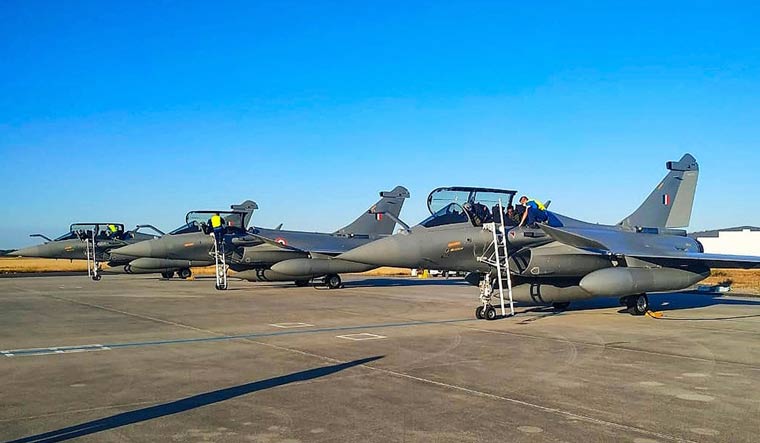
The 29 IAF fighter squadrons include 12 Sukhoi-30 squadrons, three Mirage 2000, two Rafale, and two Tejas LCA squadrons besides the Jaguars and the MiG 29s.
While China’s People’s Liberation Army Air Force (PLAAF) operates more than 2,000 fighter aircraft, the Pakistan Air Force has about 500 fighter aircraft.
The much-delayed production of Tejas fighters for the IAF has been a key factor for the acute scarcity in fighter numbers. The very long gestation period for new procurements from abroad is another key reason. India is aiming to be totally self-reliant in designing, developing and producing fighters by 2047.
Besides the planned future procurement of 83 LCA Tejas Mk 1A fighters, 120 LCA Mk 2, and 126 numbers of the fifth-generation, twin-engine stealth Advanced Medium Combat Aircraft (AMCA), the government is understood to be looking closely to urgently procure 114 Multi-Role Fighter Aircraft (MRFA).
The source told THE WEEK that the French-origin Rafale leads the competition because of several factors—First, the familiarity factor. The IAF already flies Rafales, hence spares, training and tooling won’t require major adjustments. Second, maintenance costs would be lower. Third, the immensely bureaucratic process of procurement would be relatively much easier in case of the Rafale as the Indian Navy too has ordered the maritime version of the aircraft. Moreover, at this point of time, urgency in procurement is of paramount importance.
