



Amid a global churn in strategic ties among nations, with bilateral ties with the US well set in reverse gear, and the economy preparing for a resultant big hit, India’s 79th Independence Day celebrations could have been a muted one.
But no, it is not to be. Rather it could be one of unfettered celebrations with the Indian Air Force (IAF) chief sounding the victory bugle that Prime Minister Narendra Modi will do well to dwell on when he addresses the nation from the ramparts of the iconic Red Fort on Friday.
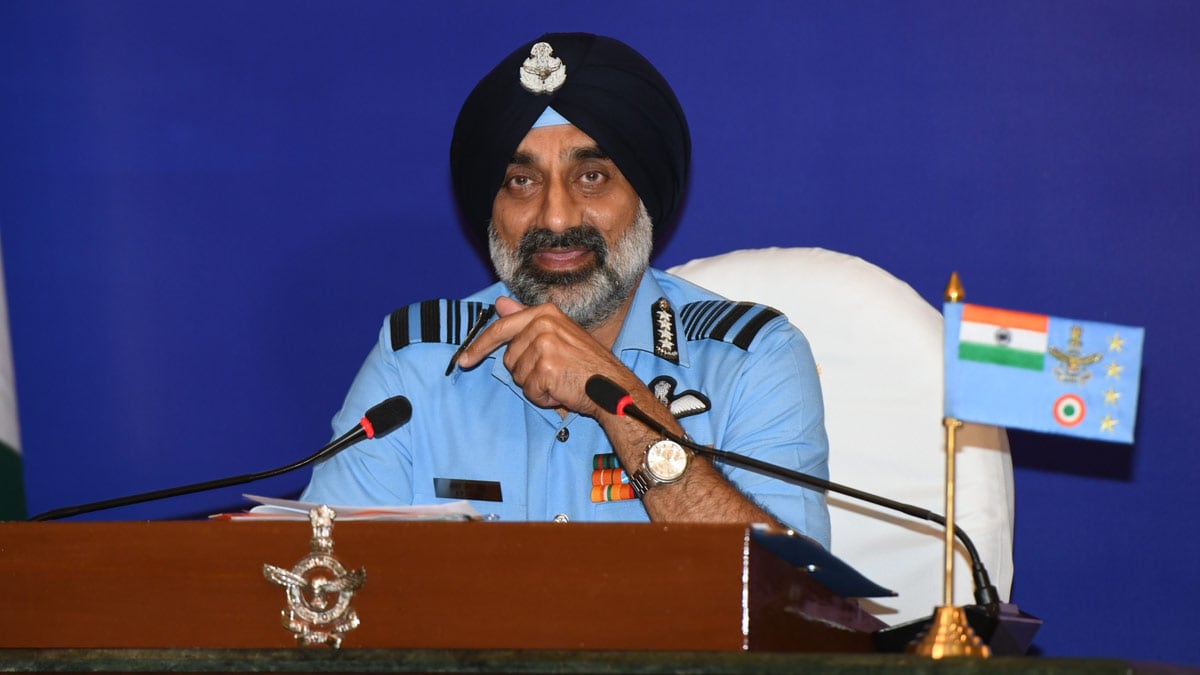
The IAF chief has made no small claim. In what could throw freezing cold water on Pakistan’s claim of downing ‘several’ IAF fighter aircraft, Air Chief Marshal A.P. Singh on Saturday said India’s Russian origin S-400 missiles had damaged at least five Pakistan Air Force fighter aircraft in addition to bringing down an AEW&C/ELINT (Airborne Early Warning and Control/Electronic Intelligence) aircraft.
Recounting the IAF’s hits on Pakistan’s military targets, the IAF chief said: “...We have at least five fighters confirmed kills and one large aircraft, which could be either an ELINT aircraft or an AEW &C aircraft, which was taken on at a distance of about 300 km. This is actually the largest-ever recorded surface-to-air kill that we can talk about.”
The ‘kills’ took place at Pakistan’s Jacobabad air base where F-16 fighters are stationed.
“One of the major airfields that was attacked. Here there’s an F-16 hangar. One half of the hangar is gone. And I am sure there were some aircraft inside which have got damaged there…”
Talking about other hits, Singh said: “The IAF also hit at least two command and control centres, like Murid and Chaklala. At least six radars, some of them big, some of them small. Also, there is an indication of at least one hangar for surveillance planes and few F-16s.”
This is the first such claim from the IAF chief on the destruction wrought on Pakistani air assets during Operation Sindoor. His declaration came during his address at the 16th Air Chief Marshal LM Katre lecture in Bangalore on Saturday.
The loss of air assets, among other damages, may have prompted Pakistan to request for a ‘pause’ with its Director General of Military Operations (DGMO) called for a cessation of strikes on May 10 during Indian’s Operation Sindoor and Pakistan’s Bunyan al-Marsous that was launched just a day before.
With the Pak DGMO initiating the call for ‘pause’ in fighting, both the countries agreed to halt strikes at 3:35 pm with India officially confirming the ceasing of military action at 5:30 pm on May 10.
Pakistan had been claiming that “several” IAF fighter aircraft had been shot down during the fight.
Operation Sindoor was in retaliation against the April 22 Pahalgam terror attack. It comprised waves of precisely-aimed attacks in the intervening night of May 6-7 on nine terror targets by the IAF and the Indian Army that began at about 1:05 am and ended at 1:30 am.
While many targets were near to the Line of Control in Pakistan Occupied Kashmir, the farthest was the Markaz Subhan Allah of the Jaish e Muhammad terror network or the JeM in Bahawalpur in Pakistan’s Punjab province, about 100 km from the border.
If anything, the fact that these attacks were executed deep inside Pakistan right under the nose of a military that has been in a state of complete alert since the Pahalgam massacre was demonstrative of the Indian military’s capability to hit hard and deep.
Pakistan retaliated by attacking Indian military installations on the nights of May 7 and 8 that were effectively thwarted and led to an Indian military action.
The Indian offensive against military targets in Pakistan on May 10 included bases and installations in Rafiqui, Murid, Chaklala, Rahim Yar Khan, Sukkur and Chunian using air-launched precision weapons from fighter aircraft.
A key take-away from the IAF chief’s speech that spoke eloquently about India’s war doctrine was the ability and capability to retain the escalatory control which contained the conflict between the two-nuclear armed South Asian neighbours.
