


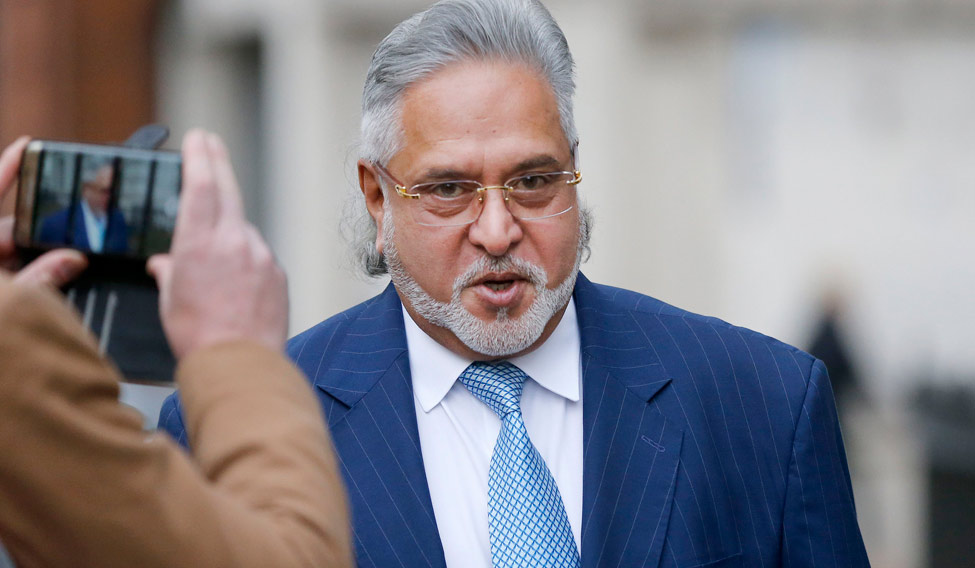
In the end, the eight days over a fortnight allocated to the Vijay Mallya extradition hearing earlier this month by the Westminster Magistrates' Court in London – following the Government of India’s request to Britain to send him back to India for interrogation and investigation – proved to be insufficient. The arguments for the prosecution and defence will resume in January. A verdict will then be delivered in February or March.
62-year-old Mallya’s Kingfisher Airline borrowed an estimated Rs 5,500 crores from various Indian banks, which it did not repay when it closed down. The lenders claim KFA’s liability is now Rs 9,000 crores taking into account interest, penalties and such like. For the purpose of the court case, though, what was cited was Rs 750 crore borrowed, allegedly, fraudulently from IDBI Bank in 2012.
The hearing so far also charted a different course from the reasons originally given to justify the need to have Mallya back in India. The first was, he colluded with senior executives of IDBI Bank to obtain the mentioned loan. The other was he illegally siphoned off money overseas from India. The Indian government believes it just has to establish a prima facie case against him so as to justify why he is required in India to pursue the matter, without being obliged to prove he is guilty in an English court.
However, the lawyer representing India’s Central Bureau of Investigation and the Enforcement Department of the Indian finance ministry surprised observers on the very first day of hearing by stating that he had no intention of dealing with the collusion aspect. He also only indirectly suggested Mallya unlawfully moving money out of India – by claiming his England-based Force India Formula 1 racing coming had overcharged Kingfisher for the advertisements on the former’s cars. In short, the prosecution’s case was far from the tall claims made in deliberate leaks dutifully reproduced by a section of Indian media, especially TV news channels, who had declared the businessman guilty before he has been formally charged of any wrongdoing – let alone convicted – anywhere. Furthermore, the CBI and ED’s charge-sheets were so badly drafted that the Indian high commission in London spent long hours polishing the wording in order to make them presentable to an English court.
It was, therefore, unsurprising that the defence not only seemed to tear to smithereens the Indian government’s contentions, but dragged India through the coals with a series of embarrassing facts. From accusing the CBI of being under a ruling party’s thumb to Mallya being a political victim – not to mention the media trial that had taken place in India and influenced public opinion against him, the awful prison condition and ill-treatment of prisoners – his formidable barrister Clare Montgomery left no stone unturned to attack Indian authorities and the Indian system.
Where the prosecution lawyer Mark Summers, thanks to the Indian government’s incompetence, un-seriousness or unavailability of hard evidence, only produced witness statements signed in India – some of which are likely to be contested as inadmissible by the defence in its closing arguments – Mallya paraded several live witnesses who underlined in no uncertain terms that the KFA’s matter was one of business failure and neither fraud nor money laundering; and that if he was extradited to India he would be dealt with unfairly and not in keeping the British or European Union standards of human rights and justice.
Mallya’s counsel pleaded her client had offered to repay 80 per cent of KFA’s borrowings from the banks, but that this was rejected. While public sector banks are understandably under pressure not to compromise on the tax-payers’ money, surely this was at least a platform for further negotiations. For instance, without waiving the 20 per cent, Mallya could have been asked to settle this element within a finite period of time.
Of course, Mallya hasn’t as yet explained why he defaulted on salaries to his employees – a major reason for pubic sentiment in India to tilt against him and for Indian news media to turn hostile towards him. At the end of the day, though, a British court will take nothing on hearsay, everything on evidence. The judgement will adjudicate whether Narendra Modi and Arun Jaitley had adequate cause to go after Mallya or were they doing so to play to the gallery. If it is the latter, this would not only be egg on India’s face, but the two would, arguably, have a political case to answer to the Indian people, especially since toadies of the current central regime are getting away with murder.
No Indian has till date been extradited to India against his will since the Indo-British treaty on the subject came into effect a quarter of a century ago. Not even suspected terrorists have been sent back. It would be an extraordinary and unprecedented leap of faith for an English court to send back Mallya, who has significant investments in Britain and directly or otherwise provides jobs at least a 1,000 people, for he also wholly owns Kingfisher Beer in the UK.
If anything, he has been inconvenienced by an order by the High Court in England to freeze his assets, in application of a decree in India as an afterthought. He is fighting against this; but his weekly allowance has been restrained to Rs 5 lakhs a week.
Disclaimer: The views expressed in this article are solely those of the author and do not necessarily represent the views of the publication.