


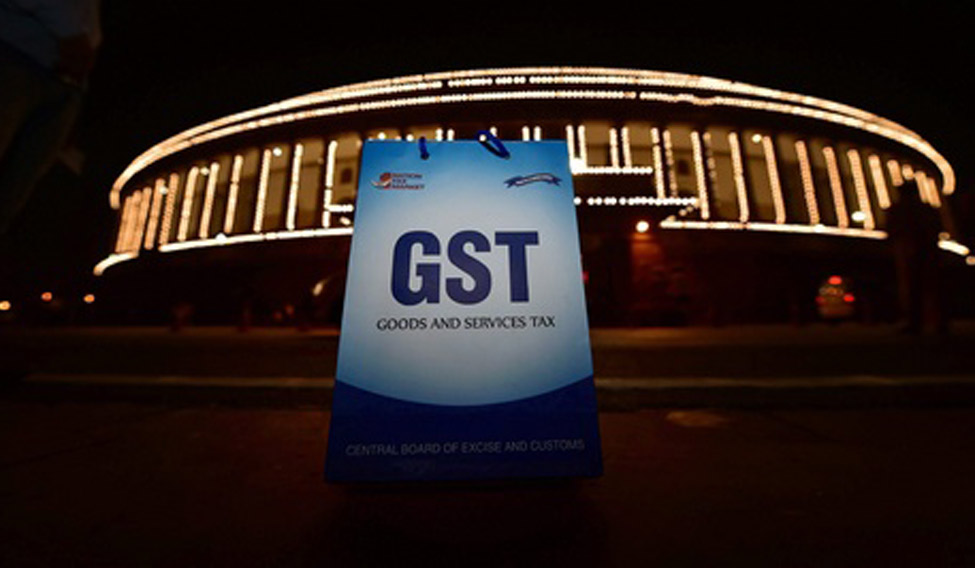
In a historic moment for the Indian economy, the much-awaited Goods and Services Tax (GST) has been rolled out in a special midnight session of the Parliament, in the presence of President Pranab Mukherjee, Vice President Hamid Ansari, Prime Minister Narendra Modi, Lok Sabha Speaker Sumitra Mahajan and Union Finance Minister Arun Jaitley, among other dignitaries.
A minute after the stroke of midnight, President Pranab Mukherjee and PM Modi pressed the button to launch the new indirect tax regime on a digital screen with "GST" emblazoned on it in a golden hue.
Conceived on the principle of 'one nation, one tax, one market', the tax that subsumes 17 central and state levies was launched in the presence of Vice President Hamid Ansari, former Prime Minister H.D. Deve Gowda, Lok Sabha Speaker Sumitra Mahajan, Finance Minister Arun Jaitley, MPs, chief ministers, state finance ministers, officials of the Centre and states.
Notwithstanding the fact that the GST was a consensus product evolved over 14 years, the function in the colorfully-decked Parliament House was boycotted by major opposition parties like the Congress, the Trinamool Congress, RJD, DMK and the Left parties, saying the government was making a spectacle of a legislation for self-promotion, a charge Jaitley rejected. In keeping with his party's decision, former primer minister Manmohan Singh kept away from the event. However, MPs and leaders of Congress allies NCP and Samajwadi Party attended the function.
Addressing the gathering, President Pranab Mukherjee said the introduction of GST is a moment of precedent for the country and a matter of personal satisfaction for him because of his role as finance minister earlier. "I had always believed that GST was a matter of time and was happy when it was enacted and I gave assent to the Constitution amendment last year," he said.
He said the new law is a tribute to the maturity and wisdom of Indian democracy. The GST Council was a unique experiment under the Indian Constitution because of the shared sovereignty.
Prime Minister Narendra Modi said the GST is not the legacy of one political party, but the collective legacy of all political parties, adding that the GST will ensure economic integration and will bring all the states closer.
Addressing the Central Hall of Parliament ahead of the midnight GST rollout, Modi said from now India will move in a new direction.
"It is not a success of any party or any government. It is the result of everyone's effort. The scope of the GST is unlimited to financial system. Now, India will move in a new direction. With the launch of the GST, we are ensuring the progress of the country. The launch of the GST is not the achievement of a particular party or a particular government; it's a collective achievement," he said.
Asserting that the GST is an example of strength of 'team India', Modi said it is setting India's roadmap as it is becoming a reality tonight.
"I welcome you all to this launch ceremony. I express my gratitude...Central Hall was always the most sacred place to launch the GST. The GST is a system that will allow states and the Centre to work together towards a new India. And GST will be an important aspect of a new India," he added.
Congratulating the GST council and all those who took the tax reform forward, Modi said whoever forms the future governments, they will abide by the pro-poor principal of the GST.
"On November 1949, it was this place, where the Constitution was adopted. And now, we have gathered again at this sacred place for GST rollout. There could not have been a more sacred place," he said.
The PM said just as Sardar Vallabh Bhai Patel unified India by helping several princely states subsume into a common entity, the GST will bring economic unification.
Recalling theoretical physicist Albert Einstein, the prime minister said the most difficult thing to understand is the income tax and if Einstein was here, he would ask what is happening.
"The number of taxes have caused confusion in this country. Now we are free of that. The GST is beyond economics. The country is moving forward due to a modern taxation system under the GST," he added.
Modi said that it is coincidental that the Bhagavad Gita has 18 chapters and the GST council also had 18 meetings before the implementation.
Finance Minister Arun Jaitley said India was making history with the launch of GST, which would open the country to limitless possibilities to expand its economic horizons with the regime of one tax, one nation and one market.
Jaitley also hailed all the political parties for rising above the narrow politics in the national interest by backing the pan-India indirect tax regime.
"We have assembled today (Friday) for an important journey of the nation. We are in the process of making history with the launch of the GST," Jaitley said.
"At the midnight hour we will be launching one of India's strongest and most ambitious tax and economic reforms in history," he said.
Jaitley said the GST may be a destination tax but for India it will begin altogether a new journey. "It's a journey where India will awake to limitless possibilities, to expand its economic horizons, and loftier political visions," he said.
"The old India was economically fragmented. The new India will create one tax, one market and for one nation. It will be an India where the Centre and the states work together cooperatively and harmoniously towards the common goal of shared prosperity," he said.
Jaitley also hailed the unanimity of all the political parties for supporting GST and said, "The unanimity and support for the constitution amendment and the consensus based work of the GST Council highlights that India can rise above narrow politics and speak in one voice for larger national interest."
He also highlighted that the quality and the maturity of the debate leading to the constitutional amendments in the GST Council underscores this point that "India can collectively think and act with maturity for a broader purpose".
Jaitley also emphasised that India is a union of states. "The union is strong if both the states and the Centre are strong. That is the real meaning of the cooperative federalism. While enacting the GST neither the Centre nor the states give up their sovereignty. They have pooled their sovereignty to make joint decisions on indirect taxes," the fiance minister said.