



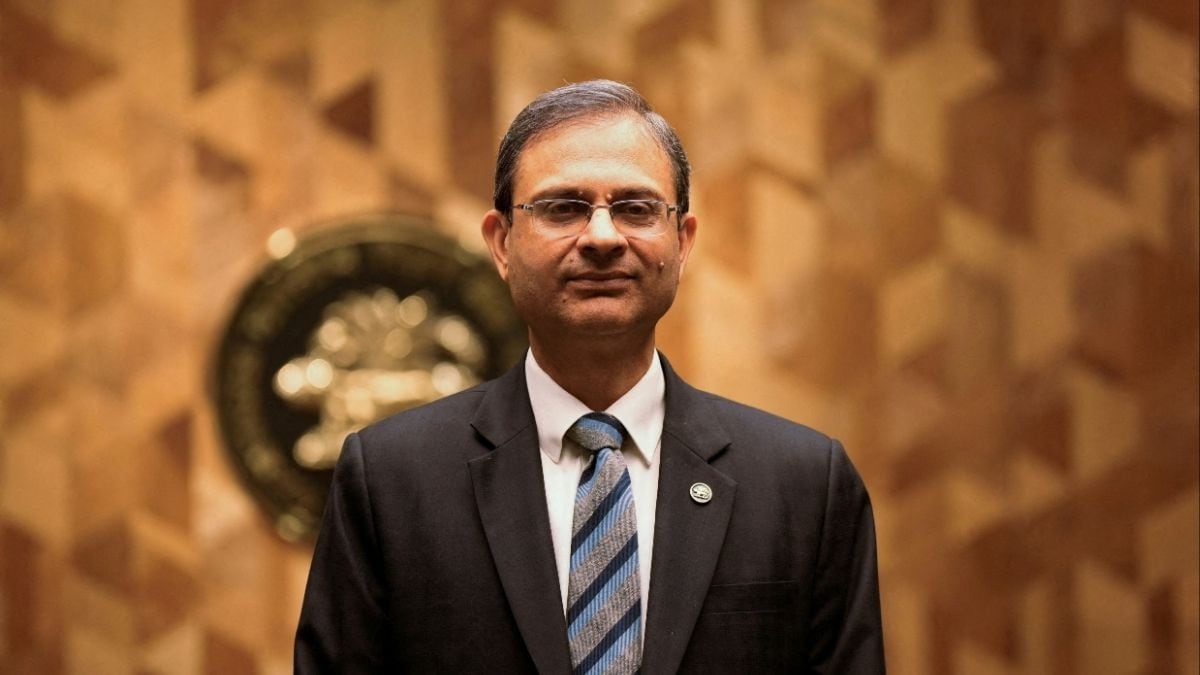
Reserve Bank of India (RBI) Governor Sanjay Malhotra on Friday defended the mandatory stock listing for non-banking financial companies (NBFCs) and Core Investment Companies (CICs), explaining that it helps protect the public’s funds.
Speaking at the NDTV World Summit, Malhotra said large NBFCs and CICs with direct or indirect access to public funds need to be registered with the RBI because of the systemic risks they might pose.
“We do not answer questions relating to any specific regulated entity,” Malhotra said. “But let me mention to you that NBFCs and CICs, like for example Tata Sons and others, are required to be registered with us because of the systemic risks, because they sit on top of group companies where they leverage funds, they can leverage funds, they do leverage funds, and they use the balance sheets of the group companies to return those funds.”
His remarks come amid a row within India’s largest conglomerate, Tata Group, about whether their holding company, Tata Sons, should go public.
Under the RBI’s Scale-Based Regulation (SBR) framework, NBFCs are classified into four large categories based on the asset sizes they handle. NBFCs that handle more than ₹1,00,000 crore are classified as NBFC-Upper Layer (NBFC-UL) and are required to mandatorily list on the stock exchange as they handle huge public funds.
Tata Sons, with a massive asset size and a group holding structure, is classified as a CIC under the larger NBFC umbrella. According to the RBI, the company was to list within September 2025, but the company tried to drop its NBFC status by paying off all its direct borrowings. In 2024, it claimed it had zero debts from the public. But it could still access indirect public funds through the companies it holds.
In August 2026, Tata Sons was part of the RBI's list of NBFC-ULs. The RBI clarified, “Inclusion of Tata Sons Private Limited in the list of NBFC-ULs is without prejudice to the outcome of its application for de-registration, which is under examination.”
However, the RBI eventually rejected the request after amending the definition of public funds to include indirect access. Tata Trusts, which holds a major stake in Tata Sons, has now proposed merging Tata Electronics Systems Solutions (TESS) and Tata Consulting Engineers (TCE) to change the nature of the company and avoid the listing.
The Tata conglomerate remains divided on the listing, as some of the senior trustees believe it changes the very foundation of the company as a philanthropic entity which funds multiple charities and social programmes. The trustees argue that public markets will enforce a short-term, profit-driven mindset.
Malhotra’s comments also come as several Parsi and Zoroastrian community organisations reportedly urged Prime Minister Narendra Modi to protect the Tata Group’s values, cautioning them against viewing the proposed stock market listing of Tata Sons as a mere regulatory issue.
“The debate surrounding the listing of Tata Sons should not be viewed merely as a regulatory or technical matter. The implications reach much further. Any change that alters the balance between long-term stewardship and short-term market expectations could affect the very fabric, ethos and defining character of Tata Sons and, by extension, the wider Tata Group,” their letter stated, according to ANI.