



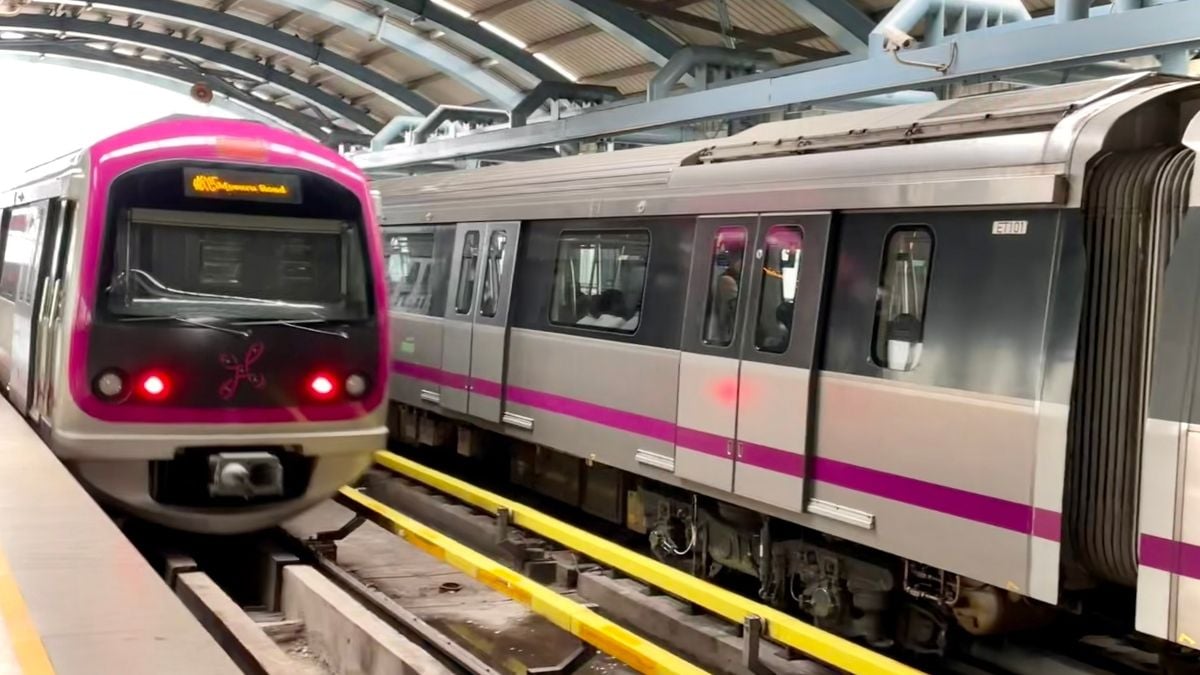
Bengaluru will always have a special place in my heart as the first metro I lived in. I landed there 14 years ago as a trainee correspondent for Thomson Reuters, and was introduced to one of the greatest infrastructure innovations in public transport. And thus began my love-hate relationship with Namma Metro.
Today, Namma Metro enters its 16th year of commercial operations, having grown from a 6.7-kilometre corridor that no one wanted into a 96-kilometre lifeline of modern Bengaluru.
The inaugural run of Namma Metro began on October 20, 2011, with the first full-fledged passenger service running the very next day. These 15 years of the metro service began with a small corridor from M.G. Road to Baiyappanahalli, which at that point was considered the outskirts. Baiyappanahalli is now well within the city, nestled between the north of Indira Nagar, south of Kalyan Nagar, and east of the famous Tin Factory-cum-KR Puram railway station. I distinctly remember going on this line only to fancy a metro ride, for an autorickshaw could take you faster via Trinity Circle from Indira Nagar to M.G. Road. The first lane was a joke, many thought, and many barely used it.
Fast forward fifteen years later, and Namma Metro is by far the only public transport system in the city that runs on time and gets you from point A to point B without getting stuck in traffic vortices like the "Silk Board timeskip" and the "Sony Signal slowdown", if I factor in inputs from 36-year-old technocrat Rahul N., who lives in Kalyan Nagar and 28-year-old startup founder Anjali B. who resides at BTM Layout.

As the service marks its 15th anniversary, operator Bangalore Metro Rail Corporation Limited is undertaking its first major overhaul of the 57 original trains. These include refurbishing the traction equipment, brakes, air-conditioning and other systems.
The next phase is expanding the network beyond 100km. And that will come when the elevated Pink Line section between Kalena Agrahara and Tavarekere gets the necessary safety clearance.
The Yellow Line, inaugurated in August last year, added a 19km 16-station corridor towards Bommasandra, connecting Electronic City and surrounding areas.
In November 2024, the 3.14-kilometre Nagasandra–Madavara extension added three stations to the Green Line, improving access towards the Bangalore International Exhibition Centre. Back in October 2023, the original line got a new lease of life when the Baiyappanahalli–Krishnarajapura link connected the eastern section with the Purple Line. The Kengeri–Challaghatta extension also opened the same day.
But it was the Silk Institute and Kengeri extensions in 2021 that took Namma Metro beyond the original corridors.
I left Bengaluru in 2015 for Mumbai when the original M.G. Road–Baiyappanahalli line was the only active metro network. It was not until 2017 that the first phase of 42.3-kilometre began operations, interconnecting the east–west and north–south network.
Last year, I was travelling from Mysuru to meet a friend at 100 Feet Road. Imagine my surprise when I got down at Kengeri, boarded the Purple Line, and in under an hour, I was sitting in Toit, Indira Nagar. Back when I was working in the city, half of that journey would have taken me double the time on the road.
Fifteen years on, Namma Metro is clearly shaping up as South India’s most useful city public transit system when you look at the sheer savings in time. But now, the challenge lies in expanding this proven infrastructure beyond the city of Bengaluru to more of its outskirts.
