



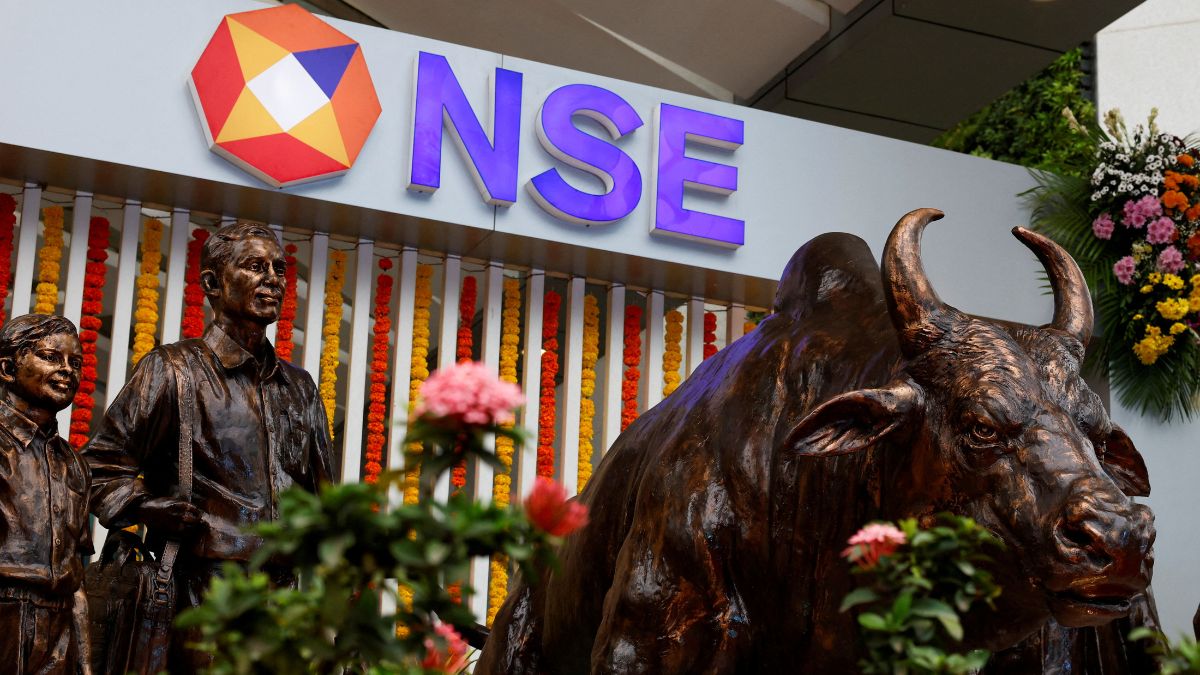
Investors are delighted as one of the most anticipated IPOs of the year opened at 10am on Thursday. After years of regulatory delays, the National Stock Exchange (NSE) shares finally debuted with an estimated ₹22,569 initial public offering (IPO) in an Offer for Sale (OFS) issue. As the IPO of India’s largest stock exchange, it is set to be the country’s second-largest public offering after Hyundai Motor India in 2024 and will remain open till September 21.
As of 12:30 pm, Retail Individual Investors bid for 28 per cent or 1,25,17,784 of the 4,41,01,125 shares offered. Qualified Institutional Buyers bid for 28,08,352 or 11 per cent of the 2,52,07,867 shares offered. In total, only 26 per cent of the 8,86,42,911 shares have been bid for.
The price band for the IPO has been fixed at ₹1,700 to ₹1,785 per share. An investor will have to buy 8 shares in a single sitting, which means that, at the upper-band price, a minimum investment of ₹14,280 is required. Market Premium (GMP) for the NSE IPO was initially estimated at around ₹120 to ₹160. Some market watchers indicate a listing gain of up to 9 per cent.
The IPO is structured as an Offer for Sale (OFS), meaning existing shareholders will sell their shares.
Who gains from the NSE IPO?
Following the Harshad Mehta scam in 1992, the government mandated the creation of a transparent stock exchange to break the monopoly of the Bombay Stock Exchange (BSE). This led to the creation of NSE. To fund the new entity, the government drew in investments from a group of public sector companies, including SBI, IDBI, LIC, Bank of Baroda and IFCI.
Hence, this group of companies are expected to make a windfall as they sell shares during NSE’s IPO.
State Bank of India (SBI) is expected to gain ₹2,849 crore from the NSE IPO’s listing, with the price band set at ₹1,785. According to the Red Herring Prospectus (RHP) data, the state-owned lender had bought shares at ₹0.8. SBI Capital Market, its wholly owned subsidiary, which had acquired shares at just ₹0.38 apiece, is expected to pocket ₹1,567 crore.
Bank of Baroda stands to gain ₹1,372 crore, while General Insurance Corporation is expected to gain ₹1,101 crore.
The New India Assurance Company can pocket up to ₹1,874 crore, making it the largest beneficiary of the NSE IPO. It had acquired the shares at ₹0.32 apiece.
