



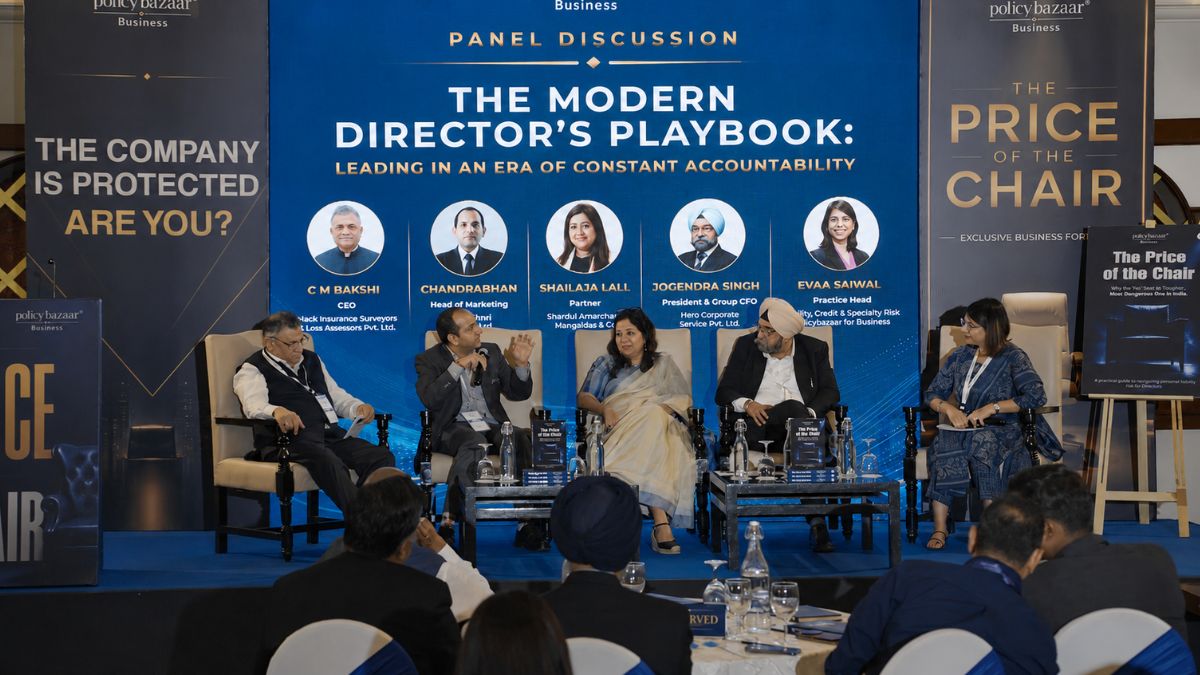
With regulators taking a tougher stance on corporate governance and courts increasingly scrutinising boardroom decisions, corporate leaders and legal experts on Friday said the era of symbolic directorships is over, warning that board members face greater legal exposure than ever before.
The consensus emerged at the launch of the book The Price of the Chair by author Eva Saiwal, cyber and liability specialist at policybazaar for business. Speakers at the event said evolving regulations, rising shareholder activism and increasing litigation are fundamentally reshaping the role of directors and senior management.
Sanjay Joshi, Chairman and Managing Director of Oriental Insurance Company Ltd, said India's corporate landscape is witnessing a significant shift as regulatory oversight deepens and demands for accountability grow.
"The regulatory landscape is changing. The legal landscape is also developing. Litigation is increasing and so is the demand for accountability. Decision-makers need to adapt to this changing environment," Joshi said. He added that greater awareness of governance practices is essential as companies navigate an increasingly complex compliance framework.
The discussion comes at a time when regulators such as SEBI, the Ministry of Corporate Affairs and other enforcement agencies have heightened their focus on board accountability, placing greater responsibility on directors to demonstrate due diligence rather than merely approve decisions.
Padma Shri awardee Sanjeev Bikhchandani, founder and Executive Vice Chairman of Info Edge (India) Ltd, said the foundation of good governance lies in the intent of promoters and chief executives.
"Building a company in India is not easy. If you are determined to build it clean, governance follows from that intent," he said, while acknowledging that businesses often encounter regulatory grey areas requiring careful judgement.
Recalling the company's early years, when Info Edge was operating at a loss with limited financial runway, Bikhchandani said the company chose to subject itself to an additional audit after changes in tax rules rather than risk a compliance lapse.
He also highlighted what he described as one of the biggest concerns for independent directors today, the burden of legal proceedings. "The problem with Indian law is that the process itself becomes the punishment. Even when you are ultimately not guilty, you still have to undergo the entire process," he said.
The issue of directors' liability dominated a panel discussion titled "The Modern Director's Playbook: Leading in an Era of Constant Accountability," moderated by Eva and featuring Jogendra Singh of Hero Corporate, Shailaja Lall of Shardul Amarchand Mangaldas & Co., and Chandrabhan of JK Lakshmi Cement.
Shailaja Lall said the expectations from board members have undergone a fundamental transformation. "There is a huge price to the chair. The role of a board member is no longer symbolic; it carries enormous responsibility. Directors are accountable for their actions," she said.
She said independent directors are now expected to go beyond attending meetings and recording dissent where necessary. "Asking the right questions, staying informed and demonstrating active oversight have become essential. Boards today are accountable irrespective of legal opinions obtained by the company," she said.
Jogendra Singh said governance has become central to sustaining business credibility as companies innovate and expand into new sectors. "Trust is built through consistent governance. Regulation and governance together create the environment in which businesses can grow responsibly," he said.
"The regulatory landscape has changed dramatically. With increasing legal scrutiny and accountability, directors today need to be far more aware and engaged than before. The role is no longer ceremonial; it comes with real responsibility," Eva told The Week.
