



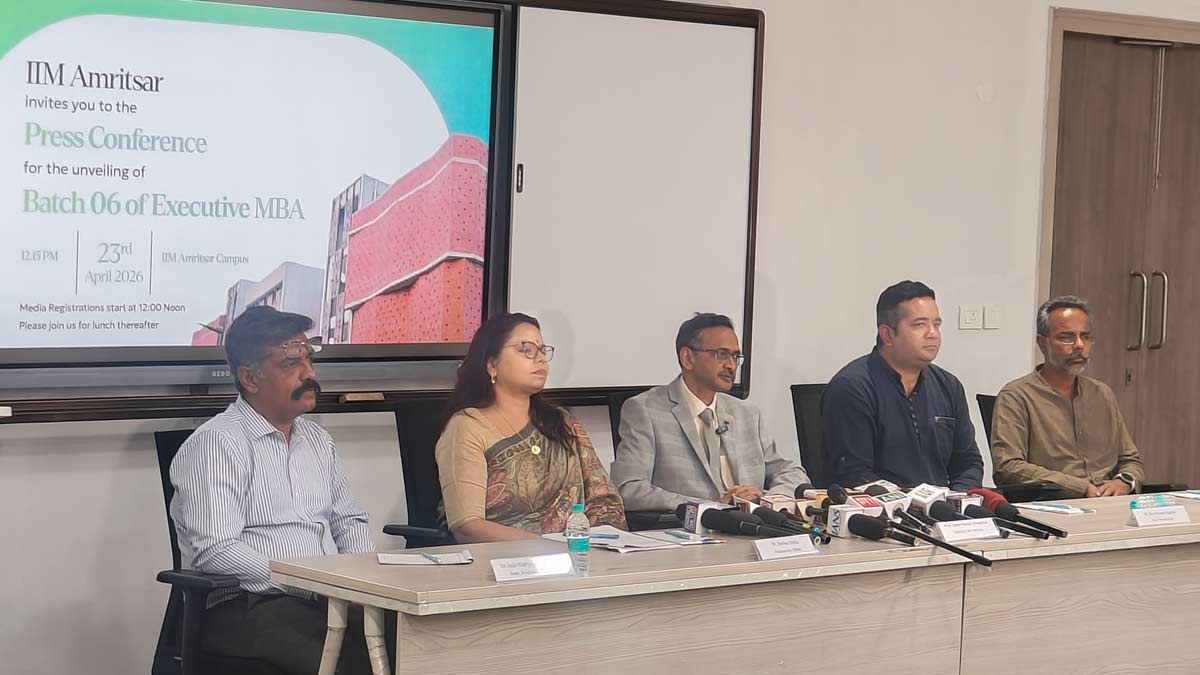
For working professionals looking to step back into the classroom without stepping away from their careers, Indian Institute of Management Amritsar is trying to make a case for flexibility with substance. As it opens applications for the sixth batch of its Executive MBA (EMBA), the institute is pitching the programme as a space for mid-career reset rather than just skill upgradation.
Director Samir K. Srivastava does not shy away from the institute’s relatives on the phone every time newness. Established in 2015, IIM Amritsar is far younger than older IIMs, but he argues that this allows room to experiment.
The emphasis, he says, is on reinventing and realigning rather than replicating legacy models. The institution, in his telling, is still learning what works and leaning into that process.
Like many newer IIMs, credibility often comes down to academic depth. Here, the institute points to its numbers, around 700 students and 39 faculty members as a sign of a tighter academic ecosystem. The pitch is simple: smaller scale, closer engagement, and a stronger role for faculty in shaping outcomes.
The EMBA itself is designed around the realities of working professionals. Classes run on weekends, in a live online format, but the institute insists the experience is not meant to feel distant. The learning leans heavily on discussions, case studies and what it calls boardroom-style engagement, an attempt to mirror how decisions are actually made at work.
The programme began during the pandemic, when online delivery was more compulsion than choice. That origin still shapes it. What started as a workaround has now settled into a hybrid structure that prioritises flexibility but tries to retain rigour. Whether that balance works in the long term is something the institute is still testing.
According to programme chair Vartika Datta, four batches have graduated so far, with just over 120 alumni. The numbers are modest, but the institute sees that as a base to build on. The programme distinguishes itself through an embedded international immersion in Denmark, developed in collaboration with the Danish cultural association of Copenhagen.
At the institutional level, IIM Amritsar has also been adding credentials, including membership with the Association to Advance Collegiate Schools of Business and association with the United Nations Principles for Responsible Management Education framework.
Placement data is around 90 per cent, according to the institute remains part of the narrative. But there is also an attempt to shift the conversation beyond immediate outcomes.
Srivastava frames the goal as long-term: building not just careers, but professional judgement and character.
Applications close on May 25, with classes beginning June 27. For now, the EMBA at IIM Amritsar sits somewhere between promise and proof, an evolving programme from an institute that is still finding its place, and inviting working professionals to be part of that journey.
