



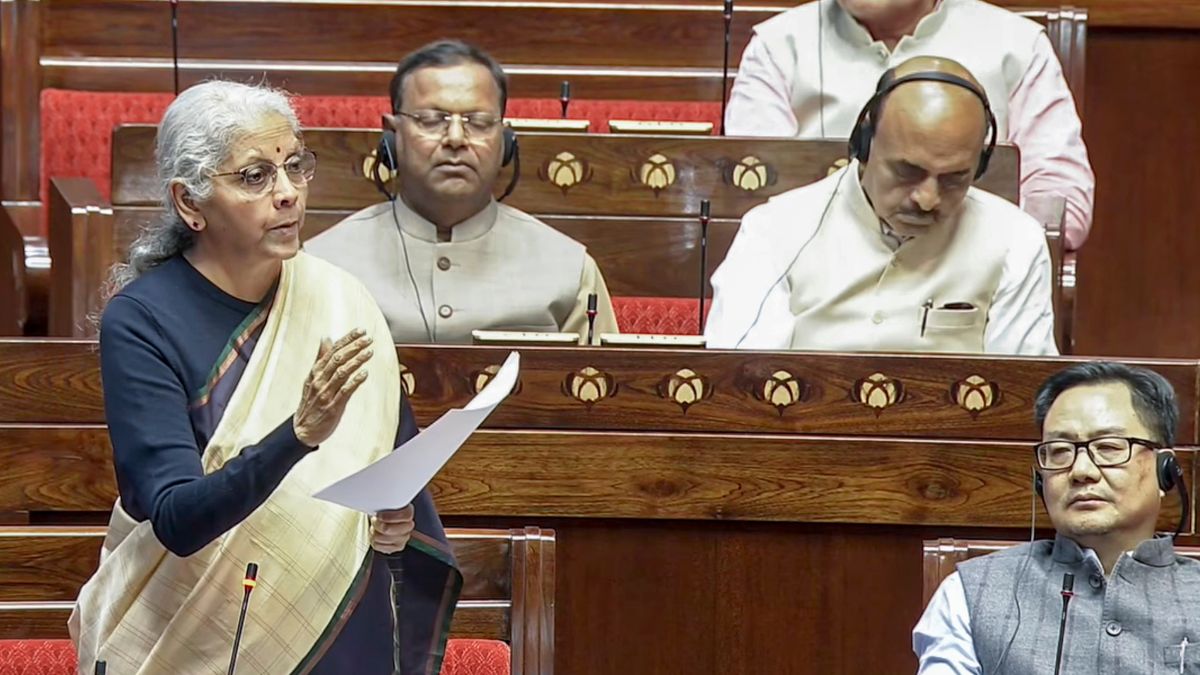
Finance Minister Nirmala Sitharaman on Thursday rebutted the opposition’s criticism of the Budget on welfare spending and state share, saying that her ninth budget was a long-horizon economic framework aimed at sustaining growth and investment.
She rejected allegations that the Goods and Services Tax burdens essential services, maintaining that milk, education, textbooks, healthcare and funeral services remain exempt and accusing opposition leaders of misrepresenting the tax structure.
Sitharaman said the Budget intended to address future priorities while aligning with the cycle of the 16th Finance Commission.
In her speech, she highlighted sustained public spending in sectors such as biopharma, biosimilars, semiconductors and carbon capture, arguing that early investment is necessary because technological outcomes take years to emerge and India must secure leadership in emerging industries. Infrastructure expansion, she added, now extends beyond highways to freight corridors and inland waterways to reduce logistics costs and improve connectivity.
On industry, the minister emphasised support for medium-sized enterprises capable of scaling globally, saying policy measures are intended to ensure such firms do not lose existing benefits as they grow and can evolve into sectoral champions. Employment initiatives spanning healthcare, tourism, caregiving, veterinary services, self-help groups and disability skilling were presented as direct job creators, alongside education reforms integrating skills and entrepreneurship.
In agriculture and the rural economy, Sitharaman highlighted technology-driven reforms through digital agri-stack systems and scientific crop practices aimed at reducing farmer risk and improving productivity. Fertiliser subsidies of Rs 1.71 lakh crore, she said, were approved to prevent shortages, while fisheries, plantation crops and allied sectors would receive expanded support.
Presenting fiscal estimates, she stated that gross tax receipts are projected at Rs 44.04 lakh crore against total expenditure of Rs 53.47 lakh crore, with the fiscal deficit targeted at 4.3 percent of GDP. Effective capital expenditure, including support to states, is placed at Rs 17.1 lakh crore. She rejected opposition allegations of inadequate devolution, maintaining that the Centre has transferred the full share recommended by the Finance Commission and that states have not been deprived of funds. Resource transfers to states in 2026–27 are estimated at Rs 25.44 lakh crore, alongside enhanced interest-free 50-year capital loans.
Addressing welfare and inflation concerns, Sitharaman said food inflation has declined to below two percent and confirmed continuation of free grain distribution to about 80 crore beneficiaries, backed by a Rs 2.27 lakh crore food subsidy. She also cited allocations for economic stabilisation, technology security, critical minerals, nuclear energy and green hydrogen as buffers against geopolitical and supply-chain risks.
The minister criticised the previous Congress-led government’s 2013 commitments at the World Trade Organization, arguing they could have constrained food procurement and the public distribution system without later renegotiation. She maintained that current policies protect national interest while sustaining support for farmers and vulnerable households.
Sitharaman rejected the contention that rising personal income-tax collections indicate pressure on the middle class, saying available indicators instead point to expansion rather than distress. She argued that Budget measures demonstrate a commitment to building a resilient and self-reliant economy and urged states to participate actively in announced schemes.
She also dismissed opposition claims of curtailed welfare expenditure, stating that funds to states have neither been denied nor halted and noting that unspent allocations in key social programmes over the past decade were significantly lower than during the previous government.
Highlighting delivery mechanisms, Sitharaman said more than Rs 48 lakh crore has been transferred directly to beneficiaries through direct benefit transfers, generating savings exceeding Rs 4.3 lakh crore by reducing leakages. She added that the Budget reflects lessons from earlier periods marked by economic fragility and double-digit inflation.
