



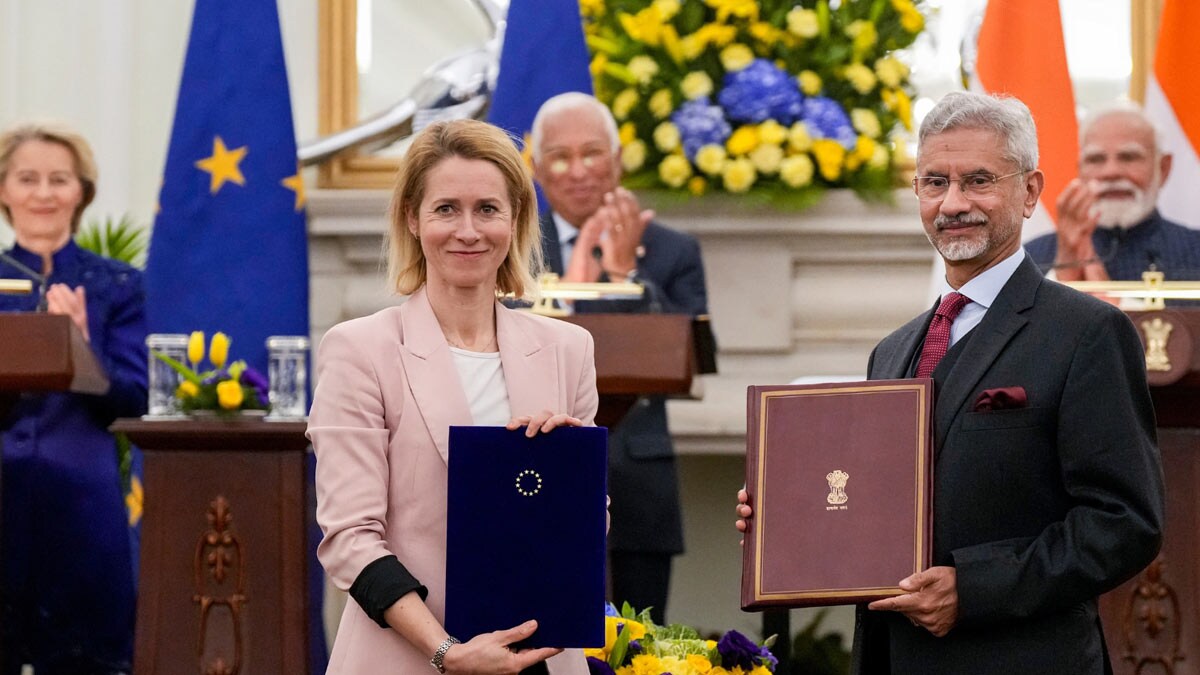
The scale and significance of the India-European Union (EU) free trade agreement (FTA) becomes clearer when viewed against the long history of stalled negotiations. Talks that began in 2007 were repeatedly derailed by the “three Cs”—cars, cows, and carbon.
For years, Europeans demanded the removal of India’s 110 per cent automobile tariffs. But given that automobiles were seen as a critical part of India’s manufacturing ambitions, the negotiators failed to find a middle path. However, this week’s breakthrough has been achieved through a calibrated compromise, where India lowers tariffs on Motor Vehicles (above ₹25lakh) to 10 per cent (with a capped annual quota of 250,000 vehicles) over a decade. And in exchange, India secures zero-duty access to the 27-nation bloc for its labour-intensive sectors such as textiles, apparel, and footwear. This effectively neutralises the 10–12 per cent tariff disadvantage India previously faced relative to competitors like Vietnam and Bangladesh.
Next, agriculture, in particular, dairy, was a challenge given its political sensitivity. Here, India has held firm. The agreement excludes dairy products, preserving rural economic stability, but offers European manufacturers access to India’s growing middle class. Tariffs on premium wines will fall sharply—from 150 per cent to 20 per cent—while duties on processed foods such as pasta and chocolate will be eliminated entirely.
The final and most complex challenge was carbon. With the EU’s Carbon Border Adjustment Mechanism (CBAM) now live, Indian steel and aluminium exports are faced with a "green tax" of up to 35 per cent. The agreement eases this through a two-part strategy.
First, it includes a most-favoured-nation clause on carbon treatment, ensuring that any future concessions granted by the EU to other trading partners automatically extend to India. Second, the EU has committed €500 million in green transition grants to support technology upgrades among Indian MSMEs. This reframes carbon not as a barrier, but as a shared transition challenge.
In addition to the trade negotiations, what is noteworthy is that the deal also sits alongside a new Security and Defence Partnership. As European Commission President Ursula von der Leyen noted, this shift is about the world’s largest democracies delivering security for their people. Which shows that India and Europe are viewing each other not merely as markets, but as strategic partners in a fragmented and volatile world.
However, we must be clear-eyed in interpreting the announcement. While the political negotiations have concluded, the deal is not yet "done." The document now enters the next phase, where lawyers will ensure the text is consistent and compliant with applicable laws.
Following this, the agreement will be translated into the EU’s 24 official languages and presented to the Council of the EU and the European Parliament for formal ratification. While India’s Union cabinet approval is expected to be swift, the European Parliament’s vote later this year will be the litmus test for the deal’s political durability. Only after these institutional hurdles are cleared, likely by early 2027, will the "mother of all deals" transition from a diplomatic milestone to a commercial reality.
Hence, the success of this deal should not be measured by today’s headlines, but by the ability of all parties to navigate the regulatory alignment that follows. While the "Three Cs" have been settled on paper, the real work lies in the technical adaptation of Indian firms to European standards and the sustained political will needed to implement this agreement. Ultimately, this pact should not be viewed as the final destination, but as an opening that promises long-term predictability in an era of global volatility.
(The writer is team lead at the New Delhi-based think-tank Foundation for Economic Development)
(The opinions expressed in this article are those of the author and do not purport to reflect the opinions or views of THE WEEK)
