



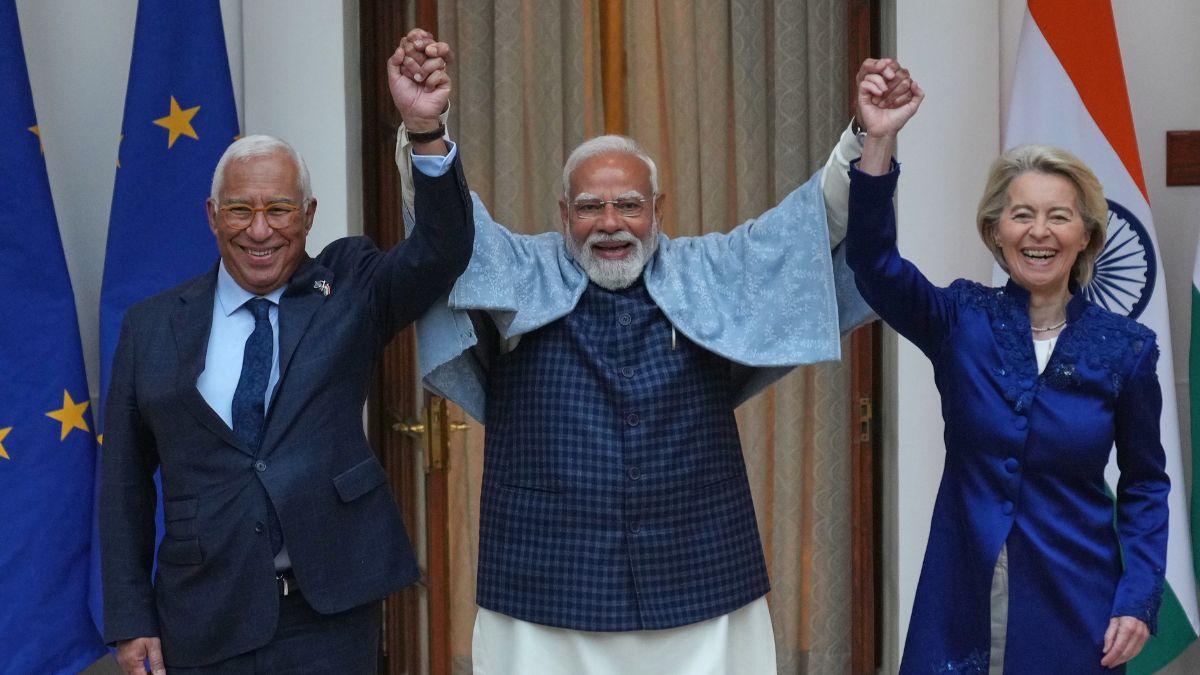
It has been a marathon effort of protracted negotiations. Talks of a Free Trade Agreement (FTA) between the world’s most populous country India and the 25-nation European Union (EU) began about two decades ago but moved forward only in spurts and bursts.
That is until Tuesday, when the two geographies—together making up for one fourth of the world’s gross domestic product—announced a “landmark” trade deal. The EU is already India’s largest trading partner in goods with the bilateral trade amounting to $136 billion.
While European Commission President Ursula von der Leyen called it the “mother of all deals”, Prime Minister Narendra Modi termed the deal “historic”.
At the core, the FTA deal will substantially ease movement of goods between the two with much reduced tariffs and allowing reciprocal market access.
Calling it a ‘strategic breakthrough’ in India’s global trade engagement, Chandrajit Banerjee, Director General, CII said: “The unprecedented preferential access secured for over 99 per cent of Indian exports is a game-changer for Indian industry. It decisively improves competitiveness in the EU’s high-value market, anchors Indian manufacturers and service providers deeper into global value chains, and accelerates investment, technology inflows, and scale.”
But what makes the deal very significant is the timing.
Faced with the common threat of heavy and very aggressive tariffs by a Trump-led US administration besides the sheer unpredictability of the Trumpian policies, both India and the EU were on a desperate lookout for new trading partners.
Earlier, obstacles in the India-EU FTA talks had been New Delhi's refusal to open up its politically and economically sensitive farm and dairy sectors.
India has managed to protect sectors like dairy, cereals, poultry, soy meal, etc in the inked deal while has offered glad tidings to Indian textiles and apparel, leather and footwear, gems and jewellery, marine products, engineering goods, automobiles, agriculture and processed foods, IT and IT-enabled services, and other business and professional services.
But this FTA acquires much more significance when viewed in the context of the Joint India-EU Comprehensive Strategic Agenda which aims to enhance the strategic partnership by “broadening, deepening and better coordinating” EU-India cooperation in areas such as sustainable economic growth, technology and innovation, security and defence, connectivity, etc.
There are other advantages too.
With the US-EU gap widening and the India-EU distance narrowing, it will mean another multi-polar entity that India can align itself with besides just the US and Russia. It can only serve to strengthen India’s policy of ‘strategic autonomy’.
But one must not forget that EU and US policies and positions converge on major ongoing concerns like on China, West Asia, and even on Venezuela.
In this backdrop, to what extent India’s strategic autonomy position will be allowed free play is anybody’s guess. At the same time, a India-EU strategic relationship will also curb the space for a South-South relationship that is exemplified by the increasingly powerful and assertive BRICS platform.
Second, EU countries can offer India an entire range of world class and cutting-edge military equipment and platforms with favourable terms and conditions including genuine transfer of military technology. Already Germany is helping India with the Thyssenkrupp Marine Systems teaming up with the state-owned Mazagon Dock Shipbuilders to build six submarines with technology transfers ranging from 45 to 60 per cent. France too is actively collaborating with India on the Rafale fighter aircraft.
Third, the India-EU trade partnership can be much favourable to India as the EU nations will seek access to newer markets like India to make up for a loss in the US.
The next step in the deal is for it to be okayed by the European Parliament and the European Council. In all probability, it is still almost a year away for the deal to be implemented.
Already, in the last two years, India has inked key trade agreements with the UK, Oman, New Zealand, the four-nation European Free Trade Association (includes Switzerland, Norway, Iceland and Liechtenstein) and Australia.
