



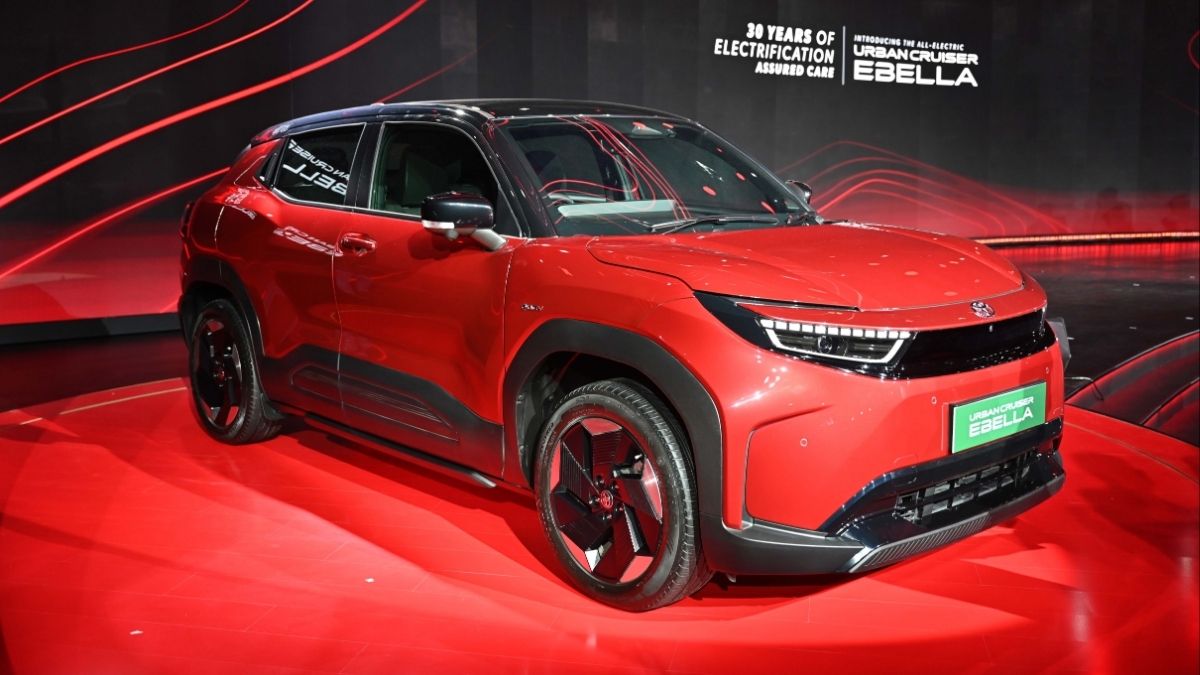
Toyota on Tuesday revealed the new Urban Cruiser Ebella, as the Japanese automotive giant takes its first steps in the small but growing electric vehicle market in India. The company, which also sells strong hybrid vehicles in the country, apart from conventional ICE (internal combustion engine) SUVs, will follow a multi-pathway approach towards offering sustainable mobility and becoming carbon neutral, Toyota Kirloskar Motor officials say.
The Ebella EV is based on Maruti Suzuki’s eVitara and will compete with other mid-size electric SUVs like the Hyundai Creta, Mahindra’s BE6, Tata Harrier EV and the VF6 from Vinfast.
Urban Cruiser Ebella EV: Features and booking
The new SUV will be offered with two battery pack options in 49 kWh and 61 kWh, and will offer a driving range of up to 543 kilometres in the larger battery pack variant.
The company has opened bookings for the Ebella EV from today, January 20, 2026, with a token amount of Rs 25,000. But, it hasn’t revealed the pricing or when the deliveries of the e SUV will begin.
This launch is part of Toyota’s multi-pronged approach towards offering sustainability and carbon neutrality. Toyota Kirloskar Motor already sells the Urban Cruiser Hyryder and the Innova Hycross in a strong hybrid electric option. The premium Camry sedan and Vellfire MPV are also sold here with a strong hybrid powertrain. Toyota has also been trialling the Mirai hydrogen fuel cell vehicle in India. It has also, in the past, showcased flex-fuel prototypes.
“We continue to make consistent efforts to ensure that every customer has access to a wide range of technologies. This is our multi-pathway approach to enable a faster, practical and scalable transition towards greener mobility,” said Tadashi Asazuma, deputy MD at Toyota Kirloskar Motor.
According to Sabari Manohar, executive vice-president, sales-service-used car business at Toyota Kirloskar Motor, demand for hybrids has already been strong. A sizeable portion of sales of Innova Hycross and the Urban Cruiser Hyrider are of the strong hybrid variant, he pointed out. Officials are hopeful the EV will do well and have taken several customer-centric initiatives towards that.
For instance, it will have over 500 EV-enabled service touchpoints and will offer 24/7 roadside assistance. There will also be 2,500 EV master technicians with over a decade of electrification experience to offer a hassle-free service across the country. Customers will also get an 8-year battery warranty, battery as a service option and an assured buy-back programme, providing up to 60 per cent residual value after three years, noted Vikram Gulati, executive vice-president, corporate affairs, Toyota Kirloskar Motor.
The unveiling of the Ebella electric SUV follows Maruti Suzuki’s eVitara launch in India in December. The electric SUV is already being exported to Europe.
In India, Tata Motors Passenger Vehicles leads the electric vehicle market. Mahindra and Mahindra too has seen strong traction with its electric offerings, especially BE6 and XEV 9e. The MG Windsor EV, too, has found many buyers.
India’s electric passenger vehicle market is very small, but it is growing. In 2025, sales rose 77 per cent to over 1.76 lakh units, from 99,875 units in 2024, according to the Federation of Auto Dealers Association of India (FADA). In contrast, total passenger vehicle retails in India stood at over 44.75 lakh units in 2025, up 10 per cent from year-ago sales of around 40.80 lakh units.
Tata Motors PV was the top seller in India’s EV market with retail sales of 70,004 EVs. It was followed by JSW MG Motor India, which sold 51,387 EVs and Mahindra and Mahindra sold 33,513 units.
Hyundai Motor India and BYD India were a distant fourth and fifth with sales of 6,726 and 5,402 units, respectively.
Range anxiety and a limited charging network have been among the reasons behind India’s slow adoption of EVs.
Toyota, apart from offering home charging solutions, will also create charging infrastructure at its dealers. Additionally, it is also collaborating with EV charging network ChargeZone and Jio-BP for easy accessibility to the nationwide charging infrastructure of the two companies.
