



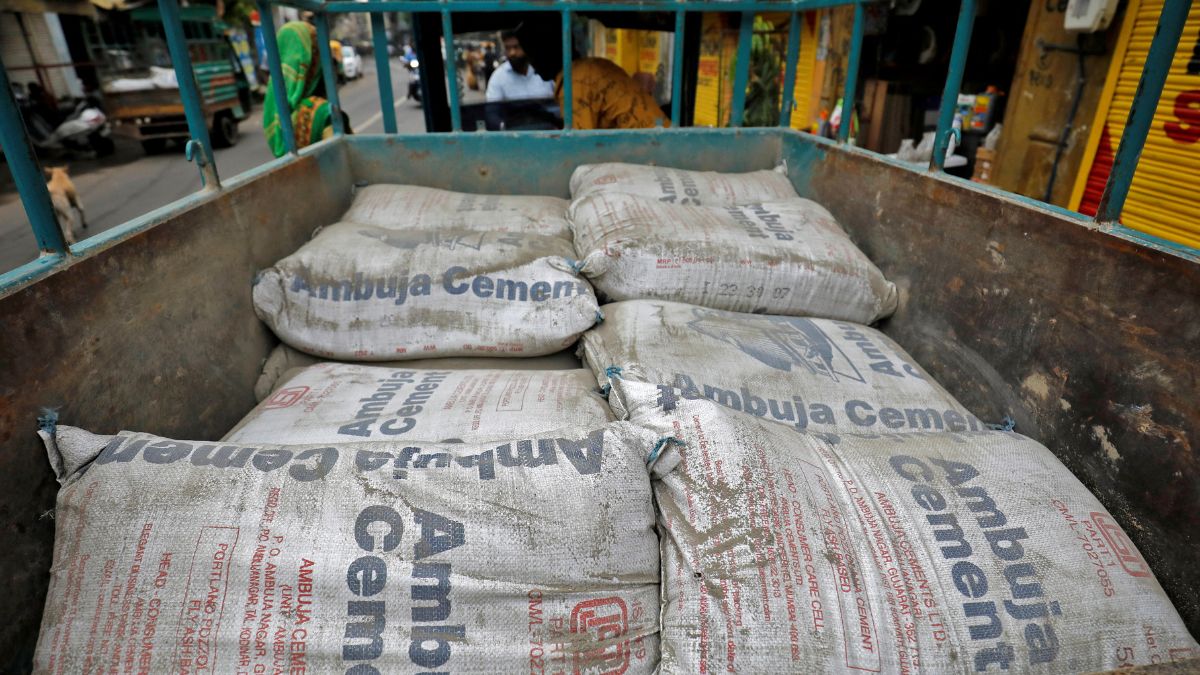
Three years since making major inroads in India’s cement industry through the acquisition of Holcim’s stake in Ambuja and ACC, the Adani Group is set to consolidate its various cement assets under Ambuja Cement—a move analysts say will not only simplify the operating structure, but will also drive cost efficiencies.
Adani Group had acquired Switzerland-based Holcim’s entire stake in ACC and Ambuja Cement back in 2022. Then in 2024, the group acquired Orient Cement. Over 2023 and 2024, it also acquired Penna Cement and Sanghi Industries, and their scheme of amalgamation is also at different stages of approval.
Now it will merge ACC and Orient with Ambuja, which is expected to deliver operational synergistic benefits by optimising manufacturing and logistics networks, streamlining corporate structure, strengthening balance sheet and facilitating efficient capital allocation to support growth.
For every 100 shares of ACC with a face value of ₹10, Ambuja will issue 328 equity shares with a face value of ₹2 to eligible ACC shareholders. Separately for every 100 shares of Orient Cement with a face value of ₹1, Ambuja will issue 33 equity shares with a face value of ₹ 2.
“By bringing Ambuja Cements, ACC, and Orient Cement under a single corporate structure, we are strengthening our ability to drive operational excellence, accelerate growth, and deliver sustainable long-term value. This merger builds on our already proven track record to further position the business to drive efficiency and productivity,” said Karan Adani, non-executive director of Ambuja Cements.
Adani may be a late entrant in the market, but it has big growth plans. Ambuja Cements aims to increase production capacity to 155 million tonnes per annum (MTPA) by the financial year 2028 from 107 MTPA.
According to analysts at JM Financial Institutional Securities, there are no material incremental merger synergies as these are already being extracted through the MSA (master supply agreement).
“That said, further simplification of the group structure, along with the elimination of significant MSAs and related party transactions, should enhance transparency and governance standards, which we view as sentimentally positive for the stock,” they said.
According to Ambuja Cements, the amalgamation eliminates structural duplication, reduces administrative costs, and enables faster, more agile decision-making. In addition, there will be no specific MSA required with ACC, Orient, Penna & Sanghi as these subsidiaries will become an integral part of Ambuja Cements, it said.
Harsh Mittal of Emkay Global Financial Services said this is a long-awaited step towards simplification of the group structure.
He noted that at current prices, the transaction was neutral for ACC shareholders and mildly positive for Orient shareholders.
“The amalgamation will unify ownership and control of the group’s cement operations, streamline manufacturing and supply chain functions, logistics, and procurement, and simplify the corporate structure for better decision-making,” said analysts at Motilal Oswal Financial Services.
The analysts pointed out that Ambuja Cements had reported steady improvements in profitability, achieving EBITDA (earnings before interest, taxes, depreciation and amortisation) of ₹1,000 per tonne in the third consecutive quarter. The integration of acquired assets Orient Cement, Penna and Sanghi brands with the company was encouraging, they added.
Indian cement industry is rapidly growing on the back of strong infrastructure as well as real estate demand. As of March 2025, India had over 200 large cement plants. Total cement volumes touched 453 million tonnes in the financial year 2025, up 6.3 per cent from a year ago, according to India Brand Equity Foundation. That is why big groups like Adani and the Aditya Birla Group have been massively investing in the sector.
Aditya Birla Group-owned UltraTech, which is the largest cement maker in the country, will cross 200 million tonnes per annum of capacity this year. The company had acquired the cement business of Kesoram Industries in 2023 and India Cements in 2024.
According to ratings agency Crisil, the domestic cement industry is poised for an expansion spree, with grinding capacity of 160-170 million tonne (MT) expected to be added between fiscals 2026 and 2028, up sharply compared with the 95 MT added in the past three fiscals.
Over fiscal 2026-2028, cement makers are expected to see healthy incremental demand of 30-40 MT annually, prompting a strong growth in capacities, Anand Kulkarni, director, Crisil Ratings, has pointed out.
