



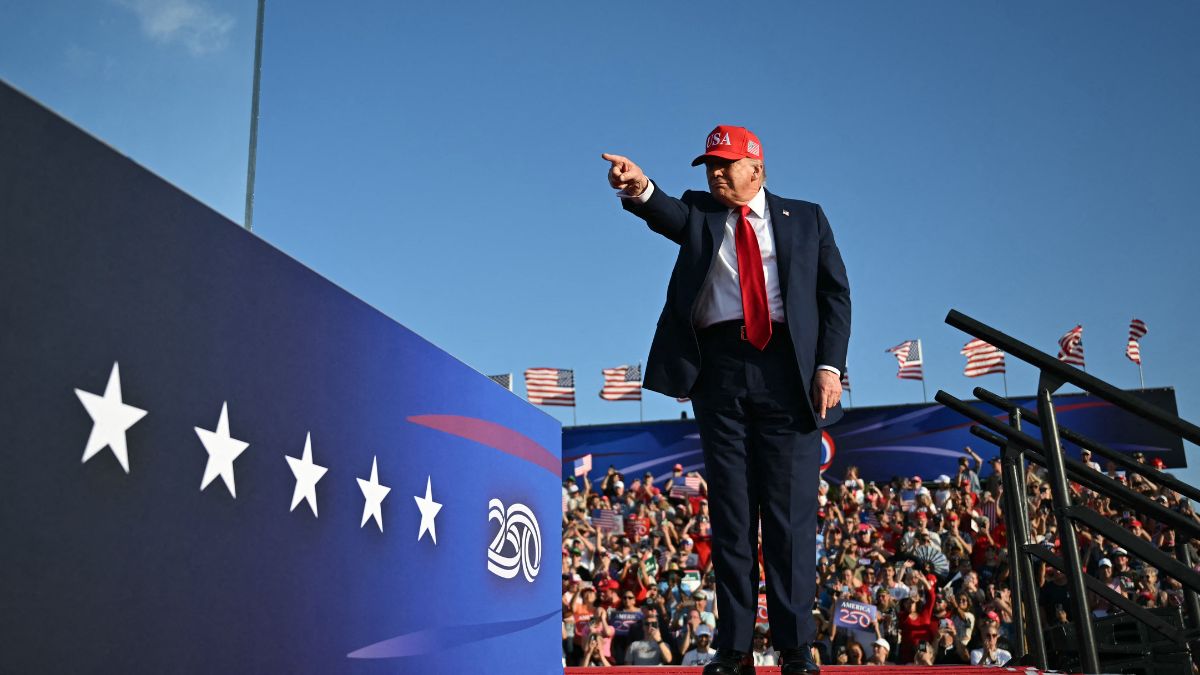
Can you believe it is just eight months since Donald Trump took over the presidency of the United States for the second time — and unleashed a mayhem that has shook the world to the core? So much so that it almost seems like this havoc has been battering the world for way more than just a half year or so period.
Be afraid, be very afraid. For this means two things for India — one, Trump is just about getting started, considering that he has lots of time — about three-and-a-half years of marauding still left to do. And if upending of the world order as we knew it in this generation in just a few months is any indication, the man does have miles to go
And secondly, by now the writing on the wall is pretty clear in case some on Raisina Hill are still deluded: The Don is just not ready to let India off that easily. And even giving him an arm and a leg in the treaty negotiations might just be hors d'oeuvre for him.
The tonight show
The temperamental head of the world’s powerful country had started off with something akin to PDAs — photo ops in the White House, praising Modi, and Indians, to the skies and setting the stage for a bilateral trade agreement that would double trade between both countries to 500 billion dollars by the end of the decade. It was just after Valentine’s Day and it seemed like candy floss season was here to stay — in return Modi promised to buy bourbon whiskey, oil and arms from the Americans.
But the vitriolic against Indians that was seen during Trump’s election campaign hadn’t been forgotten, nor it seems now, the promises the Don made to his core voter base, the working class whites of middle America who were feeling insecure about ‘the other’. Soon came the tariff tirade, akin to a daily soap, whereby Trump tried target practice, aiming at anyone from oldest ally Britain to China, who everyone would have thought conventionally was the primary target of the entire tariff exercise, as well as others.
In fact, when the first set of tariffs were announced on ‘Liberation Day’, there were trade industry experts back home who thought New Delhi had gotten off lightly. “We are much better off, since the tariffs (at that time set at 26 per cent) are lower than our main manufacturing competitors China and Vietnam,” a senior trade official told me, while the lead negotiator in trade talks during Trump’s first presidency, Mark Linscott actually said, “India is first in line.”
It may have been when Trump launched his trade missile — he had said optimistically several times that he expected a deal to be sewn up with New Delhi quickly, but the over tenacity displayed by Indian negotiators — something which those on the opposite side of the table during the FTA talks with both UK and the EU have grudgingly rued and admired in equal measures, was too much for the New York cowboy. His patience wearing thin as India stayed adamant in not opening up agri or dairy sector as well as GM crops, Trump wasn’t also thrilled (perhaps even more so) with India refusing to acknowledge what he billed as a Nobel peace prize-worthy intervention in stopping the India-Pak conflict over the Pahalgam terror attack.
What India perhaps had not calculated in the midst of it all were two developments. One, the swift moves by other nations in the face of Trump’s tariff threats, and two, Trump’s own domestic compulsions.
In the former, China quickly got a quid pro quid secret understanding with the US at a hurried meet-up in Switzerland in May itself, while even nations like UK, Japan, South Korea and Vietnam (since India often fancies itself as a competitor to this South East Asian nation in the China Plus One sweepstakes) all quickly went for a ‘next-best-thing’ deal.
And second, how he is president of the United States first, and after winning elections on the promise of bringing production back to the US to satiate his MAGA base, did other nations actually expect him to keep the interests of the rest of the world first? The H1B bomb should be seen in that respect, as well as today’s 100 per cent pharma tariff. In fact, on the face of it, there is nothing stopping him from imposing tariffs on the services sector, though so far all the talk has been on goods trade only. And if he does that, it could well be the last nail on the coffin of the already AI-badgered Indian IT and ITeS sector.
Last in line
From being ‘first-in-line’ as thought by many initially to half a year after the Liberation Day tariffs, it is now evident that India could well end up becoming the biggest loser. Trump’s ire has been maxed out on India along with the likes of Brazil, Russia and Canada, its fellow BRICS member nations.
But where India loses out on is the fact that unlike India, the other three have immense national resources and domestic industry which can help them tide over any loss of business with the US (Russia didn’t have much to start with, anyway) — nor do they have any strategic relationship they will lose by throwing shade back at Washington. But India simply cannot afford that, as evinced by the fact that Modi has not bluntly criticised Trump’s recalcitrance even once, except for some euphemistic reference to atma nirbharta and swadeshi in some hinterland speeches.
In fact, every time the PM or any Indian high-ranking leader or official has emphatically denied Trump’s claims of brokering a truce between India and Pakistan (something Trump, too, has repeated scores of times by now), the US administration has clapped back with another rap on India’s knuckles. Be it a penalty for dealing with Russia, or a crippling one lakh dollar entry fee for H1B professionals, Trump is classic ‘big bully’ personified when he takes on what he probably considers as a petulant ally that refuses to dance to his tunes.
Find your USP
Over the past quarter century, India had cultivated the US as a power buffer against both its rivals China and Pakistan. The belief was that both nations had too much in common, from people-to-people dynamics to democratic values, for the relationship to suffer any sudden blowback.
But New Delhi missed one crucial lacunae: it was always an unequal relationship where India could not stake any claim to a valid USP that would’ve made it important to Trump’s scheme of things. And unwisely for India’s diplomacy, too much was read into the Trump-Modi chumminess.
For Indian diplomacy and for the sake of the Indian economy, the blueprint is clear: throw out the existing blueprint (Trump already has) and reimagine India-US relationship fresh. It’s a frightening prospect which will have the powers-that-be on unfamiliar grounds, but such is the upending geostrategy has undergone in recent times. What is good for the goose should be good for the gander, too.
