


India, UK ink landmark free trade pact: Biggest for Britain since leaving EU

The free trade agreement allows tariff exemptions for 99 per cent of Indian exports to the UK and makes it easier for Britain to import whisky, cars

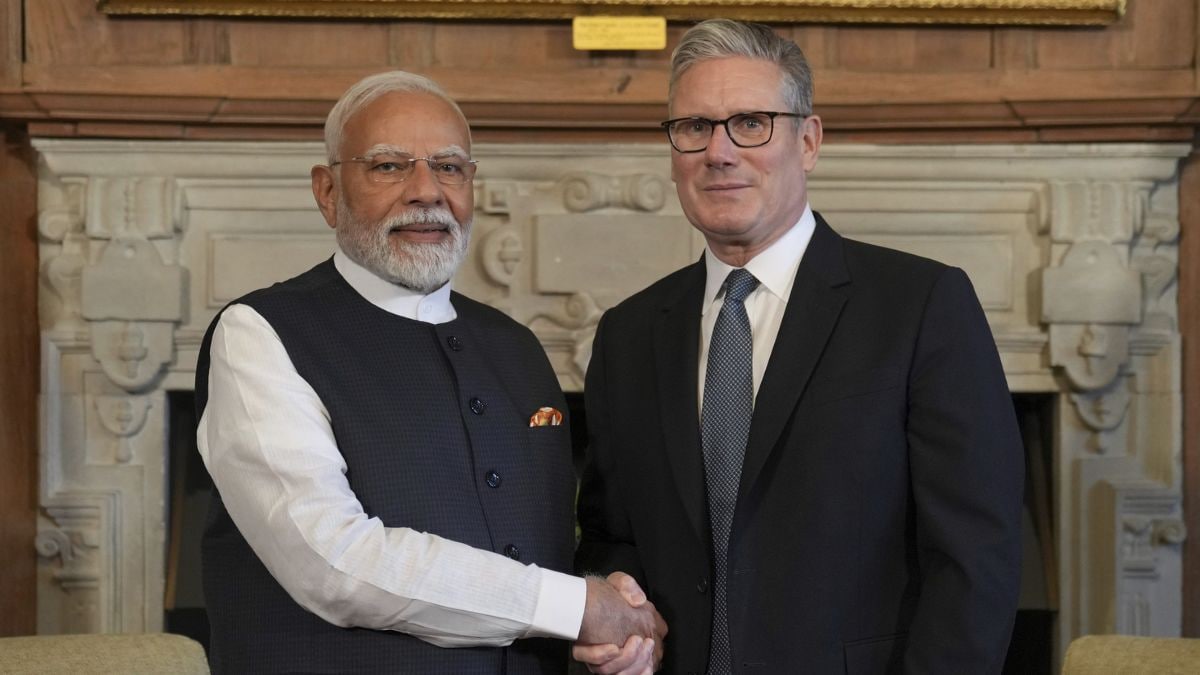
Keir Starmer and Narendra Modi - India-UK FTA Britain's Prime Minister Keir Starmer welcomes Indian Prime Minister Narendra Modi at Chequers near Aylesbury, England on July 24 2025 | AP

The free trade agreement allows tariff exemptions for 99 per cent of Indian exports to the UK and makes it easier for Britain to import whisky, cars and certain products to the country

Indian Prime Minister Narendra Modi has one more feather in his cap after the country signed a landmark free trade agreement (FTA) with the United Kingdom in his presence at London on Thursday.

The free trade pact, signed by Commerce Minister Piyush Goyal and his British counterpart Jonathan Reynold in the presence of Modi and British PM Keir Starmer, is touted to exempt 99 per cent of Indian exports from tariffs and make it easier for UK firms to import whisky, cars and other products to India.

The FTA comes after three years of intense and comprehensive negotiations.

Earlier in the day, Starmer hosted Modi at Chequers, the country residence of the British PM, where the two leaders held a tete-a-tete before serious talks. The formalisation of the FTA is said to be the key highlight of Modi’s two-day trip to the UK. The free trade pact with India is the biggest the UK has inked since leaving the European Union.

Apart from the FTA, India and the UK also sealed a double contribution convention, which means that employers of Indian workers are exempt from paying social security contributions in the UK.

The UK now imports 11 billion pounds in goods from India. However, the new FTA would make Indian goods cheaper for British consumers and businesses, benefitting Indian exporters. “Our landmark trade deal with India is a major win for Britain,” Starmer reportedly stated.

The Comprehensive Economic and Trade Agreement or CETA

Union minister Piyush Goyal, who signed the FTA—officially called the Comprehensive Economic and Trade Agreement (CETA)—said that the deal would provide duty-free access to several domestic sectors such as leather, electrical machinery, and chemicals in the UK market, leading to $23 billion in opportunities.

“Duty-free access for about 99 per cent of Indian exports unlocks nearly $23 billion in opportunities for labour-intensive sectors, marking a new era for inclusive and gender-equitable growth,” Goyal posted on X.

“The deal will also have a transformative impact on manufacturing-intensive sectors like engineering goods, electronics, pharma, chemicals, food processing, and plastics. This agreement will also provide Indian consumers high quality goods at competitive prices,” he added.

“The three-year exemption from social security contributions in the UK as part of the Double Contribution Convention is a significant breakthrough for Indian workers and their employers,” Goyal further elaborated.

In fiscal 2024-2025, exports from India to the UK soared by 12.6 per cent to $14.5 billion, while imports to the country were 2.3 per cent higher year-on-year at $8.6 billion.

CETA slashed the duty on Indian engineering goods from 18 per cent to zero, and their exports to the UK might nearly double in the next five years, even hitting $7.5 billion by 2029-30, a commerce ministry official told agencies.

The UK is the country’s sixth-largest engineering export market, but it currently only imports $4.28 billion worth from India’s total global engineering exports of $77.79 billion.

Join our WhatsApp Channel to get the latest news, exclusives and videos on WhatsApp
