



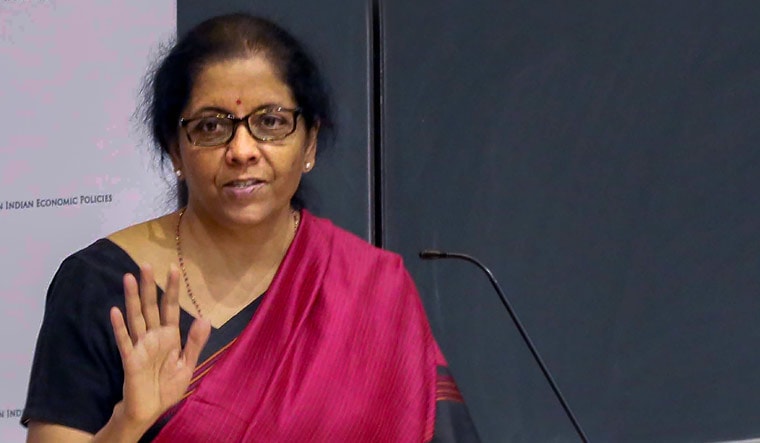
Prime Minister Narendra Modi's vision of making India a $5 trillion economy and a global economic powerhouse by 2024-25 is "challenging" but "realisable", Finance Minister Nirmala Sitharaman has said, underlining that more reforms are on the anvil before the close of the fiscal year.
Delivering a lecture on the theme 'Indian Economy : Challenges and Prospects' at Columbia University's School of International and Public Affairs on Tuesday, Sitharaman indicated that Indian economy has been on a growth trajectory ever since the Modi government came to power in 2014.
"In 2014, when the National Democratic Alliance (NDA) was voted to power by the world's largest democracy, India was a $1.7 trillion economy. In 2019, India has become a $2.7 trillion economy, having added one trillion US dollars in the last five years. Our vision to become a 5 trillion dollar economy by 2024-25 is challenging, but it is realisable, Sitharaman said.
The lecture was organised by the University's Deepak and Neera Raj Center of Indian Economic Policies.
She also emphasised that a $5 trillion economy will make India a global economic powerhouse moving it from the 7th to 3rd position in terms of current dollar exchange rate.
The Modi government has underlined its priorities in the first 50 days of its second term, setting sights on making India a $5 trillion economy and hitting the ground running on spurring growth.
She said that the realisation of the government's goal is not fraught in uncertainty but is connected to a single-minded dedication to reforms, the evidence of which is there for the world to see.
"To become a $5 trillion economy, India's GDP needs to go faster than what we grew at an average of 7.5 per cent in the last five years. That's a matter of fact statement. Inflation needs to be at 4 per cent to ensure commensurate increase in purchasing power, she said, adding that inflation in the last five years was 4.5 per cent and has been on a declining path to reach 3.4 per cent in 2018-19.
She stressed that the fixed investment rate needs to increase from 29 per cent to 36 per cent in the course of the next five years, with some depreciation of the rupee.
"We are well and truly on our way to becoming a $5 trillion economy by 2024-25. A five trillion dollar economy will make India a global economic powerhouse moving us from the 7th to 3rd position in terms of current dollar exchange rate.
"However our ambition to become economically strong has been driven more by our desire to become a less poorer nation, she said.
Sitharaman said that in July 2019 when she presented the first budget of the second term of the Modi government, India's GDP had decelerated in four consecutive quarters.
"Yet we projected the GDP to grow at 7 per cent in 2019-20, slightly higher than the 6.8 per cent realised in 2018-19. Even when our GDP decelerated in the fifth successive quarter, we did not revise downwards our projections as some institutions around the world have already done," she said.
She said India has just entered the second half of the Fiscal Year 2019-20 and already implemented a series of reforms, with more on the anvil before the close of the year.
In September this year, the government slashed the income tax rate for companies by almost 10 percentage points to 25.17 per cent and offered a lower rate to 17.01 per cent for new manufacturing firms to boost economic growth rate.
"The reforms were and will be guided by close scrutiny of growth evidence in the economy. Our mission to become a $5 trillion dollar economy in 2024-25 remains unchanged and further strengthened by our resolve to deliver on the resounding mandate given to us by the largest electorate in the world," she said.
"A critical component of our mission is high levels of investment, driven by the private sector, a larger presence in the global markets, and a lower level of public debt," she said.
Citing figures by the International Monetary Fund, she said it has projected a growth for India at 6.1 per cent for the year 2019-20 with the world growth revised downwards at 3.2 per cent.
"We continue to remain one of the fastest growing economies in the world, she said.
She stressed that in an emerging economy, poised for higher growth, some increase in income inequality is inevitable. India is no exception to this trend.
The poverty headcount ratio in 2011 measured 21.2 per cent of India's population, earning less than $1.90 per day.
The World Bank has estimated the level in 2019-20 at 7 per cent and will further decline to 4.6 per cent of the population by the year 2022.
"This means that in a decade, we have lifted 168 million people out of actual poverty which I think is a fitting tribute to Mahatma Gandhi, who dreamt of ridding the country of this scourge, she said.
She underlined that India's growth story is not hostage to performance in some quarters alone.
"As a big member of the G-20 group of countries, India has already entered the big league on the strength of its economic performance and vibrant democracy.
Sitharaman further said that the growth impulses in the economy have been buffeted by the winds of trade wars, protectionism and volatility in crude prices, as well as improved supplies that the world is witnessing.
'Worst phase' under Manmohan Singh, Raghuram Rajan
India's public sector banks had the "worst phase" under the "combination" of former prime minister Manmohan Singh and ex-RBI governor Raghuram Rajan, and giving the ailing banks a "lifeline" was her primary duty now, Sitharaman has said.
The public sector banks have been grappling with bad loans and the government has been taking measures to address the issue. In August, the government announced upfront capital infusion to the tune of Rs 70,000 crore into the public sector banks. Besides, 10 public sector banks are being consolidated into four.
"While economists can take a view of what prevails today or prevailed years ago, but I will also want answers for the time when Rajan was in the Governor's post speaking about the Indian banks, for which today to give a lifeline is the primary duty of the Finance Minister of India. And the lifeline-kind of an emergency has not come overnight.
"I do respect Raghuram Rajan as a great scholar who chose to be in the central bank in India at a time when the Indian economy was all buoyant, she said during the lecture organised by the Deepak and Neera Raj Centre on Indian Economic Policies of the Columbia University.
Asked about the ex-RBI governor's comments during a recent lecture at Brown University in which he had apparently mentioned that in its first term, the Narendra Modi government had not done better on the economy because the government was extremely centralised and the leadership does not appear to have a consistent articulated vision on how to achieve economic growth, the minister said instead there were major issues with bank loans during Rajan's tenure as the central bank head.
Responding to the question, Sitharaman further pointed out that if there is a feeling that there's been a centralised leadership now, "I'd like to say that very democratised leadership led to a whole lot of corruption. Very democratised leadership. The Prime Minister, after all is the first among equals in any cabinet".
"You need to have a country as diverse as India with an effective leadership. A rather too democratic leadership, which probably will have the approval of quite a lot of liberals, I'm afraid, left behind such a nasty stink of corruption, which we are cleaning up even today," she said.
"It was in Rajan's time as Governor of the RBI that loans were given just based on phone calls from crony leaders and public sector banks in India till today are depending on the government's equity infusion to get out of that mire," she said.
"Dr Singh was the Prime Minister and I'm sure Dr Rajan will agree that Dr Singh would have had a 'consistent articulated vision' for India, the minister said amid laughter from the audience.
"With due respect, I'm not making fun of anybody but I certainly want to put this forward for a comment which has come like this.
"I have no reason to doubt that Rajan feels for every word of what he is saying. And I'm here today, giving him his due respect, but also placing the fact before you that Indian public sector banks did not have a worst phase than when the combination of Singh and Rajan, as Prime Minister and the Governor of the Reserve Bank, had. At that time, none of us knew about it, she said.
Sitharaman said while she is grateful that Rajan did an asset quality review, but people should know what makes the banks ailing today.
"I am grateful that Rajan did an asset quality review but I'm sorry, can all of us put together also think of asking what ails our banks today. Where has it been inherited from, she said.
According to RBI data in June on global operations (provisional data for the financial year ending March 2019), Gross Non-Performing Assets (NPAs) of Public Sector Banks have declined by Rs. 89,189 crore from the peak of Rs. 8,95,601 crore in March 2018 to Rs. 8,06,412 crore in March 2019 (provisional data).
