



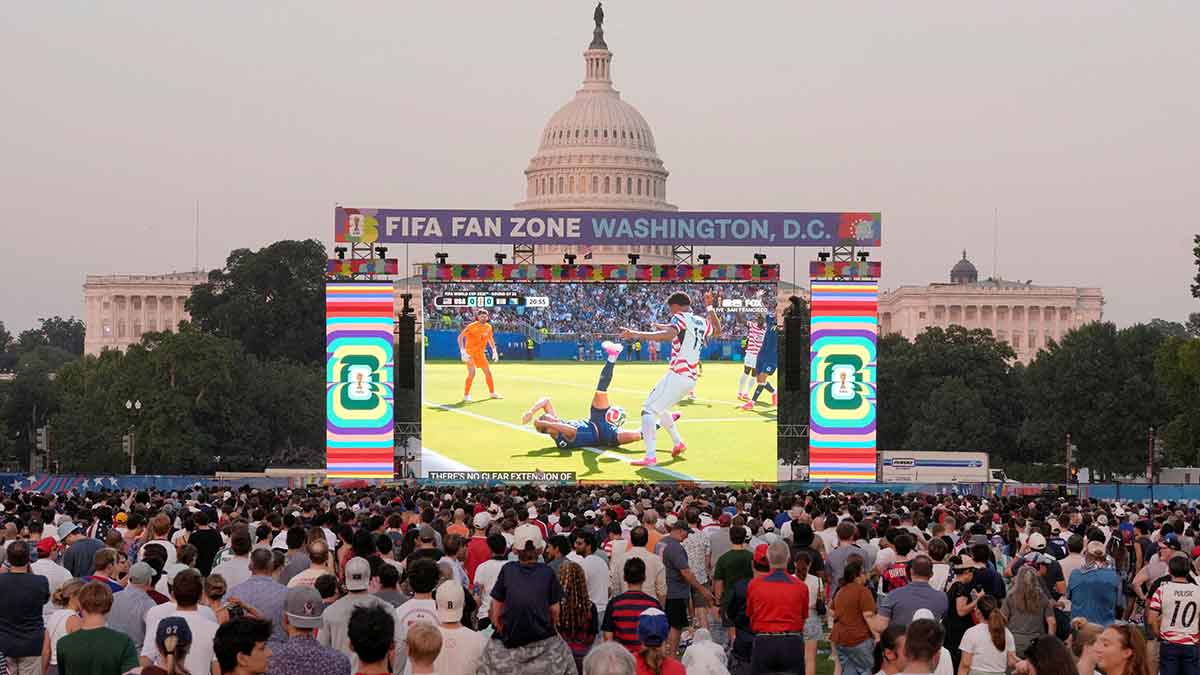
In the days before I left for the US, friends and colleagues all asked me the same question: how many matches would I watch, and which ones?
That question puts you in the position of a goalkeeper awaiting a bullet from the penalty spot. You have to face it, because that is what you are there for. So, I answered: “I will watch as many matches I possibly can, and not just inside stadiums, but at the fan fest venues known as fan parks.” However, when people in India hear that someone is watching matches at a fan fest, and counting that as part of their World Cup, the usual reaction is a dismissive “yikes”.
For me, every trip to a World Cup host country is a pilgrimage. Many football fans in India want the same thing, but practical obstacles—visa, funds, endless travel and unfamiliar terrain—make it tough for most of them. This is my seventh World Cup, and what gets you past those obstacles is careful planning, which in turn demands good research. For instance, even places which are not hosting World Cup matches, like Washington, DC, and Chicago, are hosting fan parks. So, if these locations help you save money or time or effort, they can be woven into your plan. In the past, learning bits of foreign languages was common, but these days translator apps take care of that.
India has never played in a World Cup final round, and there is little hope of that changing in the next decade. So there are those who ask, rather foolishly, what an Indian is doing travelling to the World Cups. That is where the pilgrimage becomes meaningful. The devotion, the passion, the excitement— all of it is directed at football itself, and then at the teams that do play in the World Cup final rounds. It is not only the football history of Argentina, Brazil, Portugal and France that Indian fans study, but the influence football has on the culture of these nations, and the part it plays in shaping their younger generations. And this kind of learning does not happen over the internet—it happens during the World Cup itself, by mingling with fans of many nationalities. That is exactly why fan parks matter so much to the football pilgrimage. They are the real life and energy of a World Cup pilgrimage, not the stadiums.
Inside a stadium, fandom follows clearly drawn national boundaries. Say Germany is playing the Netherlands: spectators are seated in three broad categories. German fans get a designated block and are seated there, and if they are in the east stand, Dutch fans will be in the west—kept apart to avoid confrontation. A third category is set aside for local spectators, a neutral, no-war zone, and teams from what one might call the Third World of football—India among them—would be seated there. So while a stadium can be a melting pot of excitement, it rarely becomes a genuine meeting point of cultures. That kind of fusion is what fan parks offer.
On the big screen there, the match unfolds just as it does inside the stadium, but around that screen, friendships take shape between total strangers. Even without a common language, there are mutual greetings and small exchanges of affection and cooperation. Discussing and sharing football heritage and history are common, usually over food and drink.
Beyond the referee’s whistle, beyond the players and the cameras, the fan fest is where the personalities and emotions of fans come through.
Fan fests became a fixture after the 1998 France World Cup, the first one I covered, and by 2006, in Germany, they had developed a character of their own. Football was still the soul of Germany’s fan fests, but music was a clear second. The Berlin Fan Festival featured Simple Minds, Nelly Furtado and Andrea Bocelli. In South Africa, alongside Shakira’s ‘Waka Waka’, the unique flavours of Ziggy Marley and Fatboy Slim lit up the Johannesburg Fan Festival. In Brazil 2014, the fests took on the dynamism of samba and capoeira, along with the local drinks, cachaca and caipirinha. In fact, Brazil gifted pilgrims a carnival outside carnival season. In Russia, musical nights, big and small, unfolded across the parks. By Qatar, the fan fest had its own official anthem, with 146 artists involved. It was practically a curated art festival in itself.

In 2026, music has gone from being merely a colouring element to a theme running alongside football—very much a main act. Food, too, has become a lead character at this World Cup’s fan venues. Beyond basic local fare, the fan parks have turned into global flavour villages: Los Angeles ran a ‘Taste the World’ theme built around Brazilian and African dishes, while Dallas leaned into Mexican and Afro-Caribbean food. Boston hosted a lobster festival, the lobsters caught live from water tanks, cooked and served within four minutes. Some venues did charge more than eateries outside, and fans complained about that, but food at this World Cup is not functional. It is experiential.
Local participation has become family-oriented, which is my biggest takeaway from this World Cup’s fan experience. Organisers offer various benefits to those arriving with children, including football-themed games and stalls to help polish kids’ basic skills.
Over two decades, the fan fest has built its own traditions. Beyond the giant screen, the music and the footballing excitement, the sharing of human warmth has become its central theme, with the host city’s customs forming the backdrop. To me, the fan parks are a global village, strangers from many countries linked, however temporarily, into something like family, giving human meaning to the tournament itself. For those who arrive without match tickets, the fan fest is the fuel that carries them through to the final—the engine driving the World Cup forward.
What is genuinely interesting is how the character of the host countries and cities blends with the habits fans bring with them, creating something new. For example, Norwegian fans bring their Viking chants; Scottish fans pick them up against the backdrop of American cities, and the 2026 World Cup gains a flavour never seen before.
Collective chanting is central to football’s identity, whether it is Kerala Blasters or Barcelona, and at the fan parks these chants take on a life of their own. Watching a roar organically turn into a chant, with no script or agenda behind it, has always struck me as something close to wonder, and Mexican fans making the old “Ole... Ole... Ole” part of their routine was one such marvel this year. In tense moments, the disappointment of fans whose team has just missed a goal and the relieved exhale of the fans of the side defending it, seemed to move to the same rhythm.
A beautiful sight I saw at the Dallas Fan Festival: the night after an Argentina match, when people, reluctant to leave, were lingering at the venue, a fan finds a lost wallet. Inside, a credit card gives a name but no phone number: Juan Manuel Bottero. Right there, the crowd invents a chant: “Billetera... perdio la billetera... Juan Manuel Bottero (Wallet... he lost his wallet... Juan Manuel Bottero).” Some 30 young fans, men and women, sing it with total abandon until it spreads through the whole fan fest. Hearing his own name carried by the wind, the owner comes running, and then come the hugs and kisses, the cheers, bracelets and jerseys exchanged, and out of the joy of a returned wallet, new chants are born.
Flags and bracelets are markers of identity here. One new feature of this World Cup is the bracelet Bank of America has been giving away to hundreds of thousands of fans, with kilometres-long queues forming at the fan parks for them. Despite standing in line for hours, I never got mine, a disappointment I still carry. Branches also gave them out directly, but the rush was so heavy that distribution was limited to account holders only. Flags, meanwhile, are not simply patriotic symbols: Japanese fans walk around with Argentine flags, Latin Americans with African ones, and I saw plenty of outfits stitched from the US flag, too. A fan from Panama told me this had nothing to do with the US government, only excitement about the tournament the US happened to be hosting. Atlanta was where African flags showed up most.
While stadium security clears spectators out within minutes of the final whistle, fans linger at the fan parks well into the night, some until 2am. Often it is after the match that the dancing and singing peak, once the tension of the result has lifted. I saw fans from different countries sitting in circles on the ground, going over the match, and where the result was heartbreaking, I also saw people crying it out together, partners consoling each other, children patting the backs of crying parents. It can be argued that the richest sights of this World Cup were outside the stadiums.
A host city lends its greenery, its food, its hospitality, all steeped in the love of football, and the very air of that city starts to carry a new language, the culture and longing that visitors bring with them. I like to think I have passed on some of the salt of the Arabian Sea to these cities on the Atlantic coast. On match days and non-match days alike, we take in something new and leave something of our own behind, which is why, even after full time, we linger, certain there is still more to be had.
What gets picked up at a fan fest might be a few words in a new language, a fragment of a new culture, a story never heard before, an art exhibition, a new song. Sometimes it is a word said with affection; often, it is a swear word.
Not everything fits under one label, but together it might be called fan community culture. Some fan parks made a deliberate effort to weave their own local identity into this global passion. In Kansas City, one such theme was ‘Heartland Hello’, not just a custom of greeting whoever you meet, but an attempt to build a habit of everyone smiling at and talking to everyone else. In a country where football has not yet put down deep roots, that effort carries real meaning. The fusion of cultures, in miniature. Another Kansas City theme was ‘Dog Days’. Dogs are already part of the family in western life, perhaps more so than is common in India. So bringing them to a fan fest is not new, but during these fan fest days, every dog wore a football jersey, visitors got photos with them, and there were free vet check-ups and adoption drives on site.
For a football pilgrim, these experiences give life new meaning. That sense of shared humanity, and the lightness it brings to a conflict-worn mind, is not something money can buy or medicine can replicate. We arrive as pilgrims, and by the time we leave, we have become part of the World Cup itself, depositing something of our own identity there, and carrying something of it back, usually without noticing. The fresh layer of this USA-Mexico-Canada tournament is settling on top of what earlier World Cups left behind. A delightful additional layer of this beautiful and multifaceted game.
The Bible says: “Blessed are the poor in spirit, for theirs is the kingdom of heaven.” Let me add to it: Blessed are the football pilgrims without match tickets, for theirs is an experience with no final whistle.
