



FAITH PERMEATES ALMOST every aspect of life along Karnataka’s coastal districts. In this culturally rich Tulunadu region, religion shapes social relationships, and issues like ‘love jihad’, the hijab row and lynchings involving cow vigilantes often expose the fault lines between communities.
On October 20, the air around Mangaluru is heavy with humidity. It is Navaratri, and it feels like the heat emanating from communal frictions could at any moment spark a communal fire.
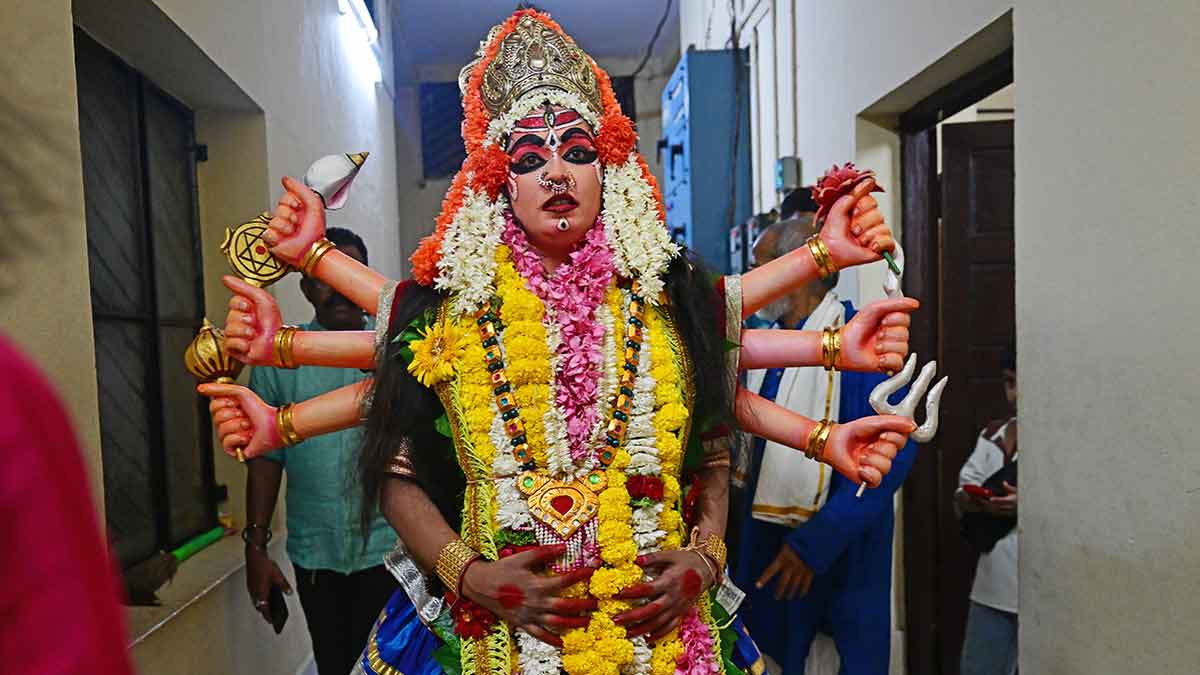
At the historic Shri Kadri Manjunatheswara Temple, a sizeable crowd has gathered to watch a performance of Yakshagana—a traditional dance-drama art form that enact episodes from Hindu epics like the Mahabharat and the Ramayan. Preparing to enter the Yakshagana stage is Arshiya Khan, a 33-year-old Muslim artiste. The crowd is waiting to witness a historic moment.
Arshiya is playing Durga, revered as Devi in the Yakshagana play Sri Devi Mahatme. This is the first time she is playing the part. As an amateur artiste, she trained under Yakshagana guru Ramesh Bhat, who runs the Kadali Kala Kendra near the temple.
Hailing from a village in Mada in Dakshina Kannada district, she has been a performance-art enthusiast since childhood. “I used to participate in Bharatanatyam performances,” she tells THE WEEK as she prepares for the performance. “I would come home with traces of makeup still visible beneath my hijab, for which my mother would beat me.”
As Arshiya emerges from the chowki, or green room, dressed as a fierce-looking eight-armed Durga, a ripple of excitement spreads across the crowd. Men, women and children bow their heads in veneration, and a few prostrate themselves before her, blocking her way. But, carrying the oversized costume, she manoeuvres her way to the stage, amid the rhythmic beats of the maddale, the traditional drum.
The stage is not much larger than a 100-inch television screen. Arshiya climbs on to it, revealing herself as the goddess and starts performing. The crowd listens to her Kannada dialogues with rapt attention. For them, Sri Devi Mahatme is a recreation of the triumph of good over evil. For Arshiya, the performance is an ode to her love for the art form.
The performance, fierce and passionate, ends with the killing of Mahishasura. The rousing climax wins the crowd’s applause. A few experience goosebumps. Bhat, who had been standing near the stage and watching his pupil’s performance closely, hears a friend say, “By drawing such a large crowd, you have created history.”
Bhat’s Kadali Kala Kendra trains students aged six to 70 years. When asked about Arshiya, he says, “She came to learn eight years ago. Initially, she performed characters such as Ganavesha, Shankadurga and Nishumbha. When she said she wanted to play the character of Devi, I explained the vows one has to observe to play Durga. She agreed and committed herself to following all the vratas.”
The following day, THE WEEK meets Arshiya again. She reveals that the hype around the event made her nervous before the performance. She says she is surprised that her performance has generally been well-received, even though a few hardliners expressed their displeasure over her religious identity.
“Becoming Sri Devi yesterday on stage was the ultimate achievement of my life,” she says. “Surprisingly, neither the Hindu or the Muslim side opposed my performance. There was some cursing on social media, but I think they were fake IDs.”
Her relatives, too, have been supportive; after the show, her maternal uncle in Bengaluru called to congratulate her. Arshiya’s next dream: to play Mahishasura one day.
Her performance has quietly broken a barrier. “What Arshiya is doing is historic,” says Harinarayanadasa Asranna, chief priest of the Durga Parameshwari Temple, from where the Devi Mahatme performance tradition originated. “No Muslim woman has ever played this powerful Devi character before.”
Yakshagana performances, too, are evolving. Though the art form has long been dominated by male artistes, the participation of female artistes has been increasing in recent times. People from communities outside the Hindu fold, too, are now performing Yakshagana.
Says Prabhakar Joshi, a retired professor and Yakshagana arthadhari (principal speaker in a debate-and-dialogue art form derived from Yakshagana): “There have been artistes from other religions participating in Yakshagana, such as Nallikaru Khadri Beri and Jabbar Samo.”
Samo, 63, a celebrated arthadhari and a practising Muslim, says professional jealousy is a major reason for the opposition to Muslim artistes performing Yakshagana. “The opposition to my participation in Yakshagana did not come from my own community,” he says.
In this sense, Arshiya’s performance could well be a breakthrough. It is for the first time, according to Joshi, a Muslim woman has played one of the most revered characters in Hindu mythology. “It is,” he says, “a good sign.”
