



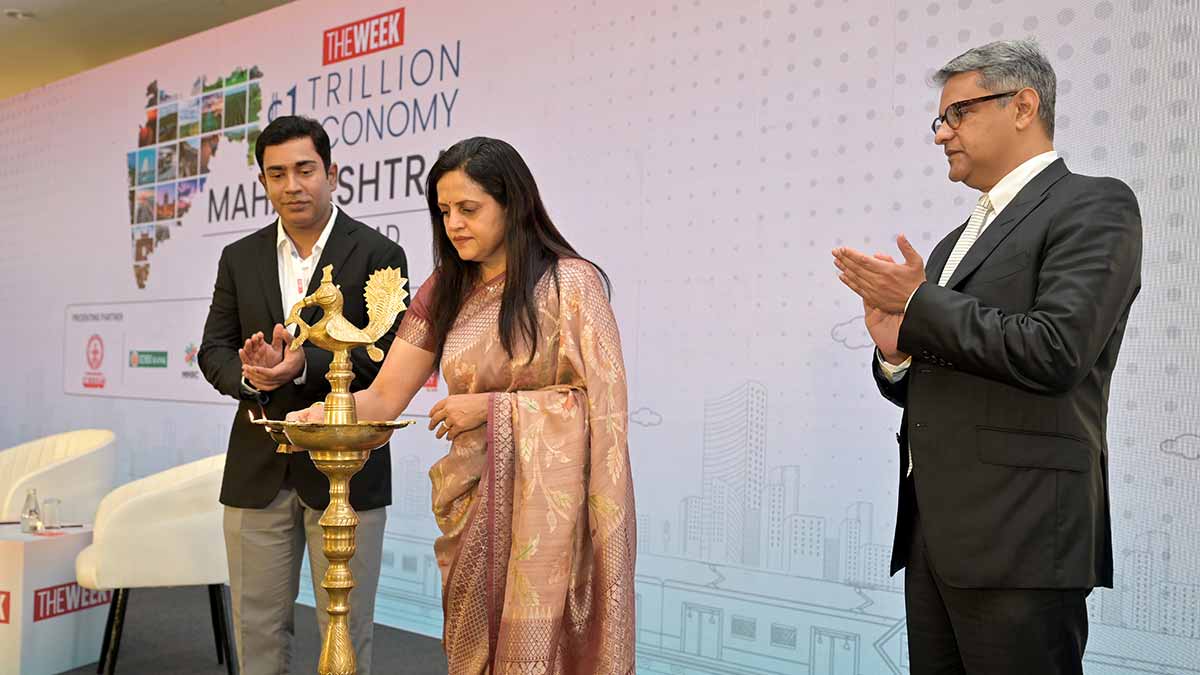
ONE TRILLION DOLLAR economy has a nice ring to it, but achieving it can be daunting. Maharashtra, however, is up for the challenge. It has set an ambitious target of becoming a $1 trillion economy by 2030. And THE WEEK $1 Trillion Economy Maharashtra: The Road Ahead event, held recently in Mumbai, brought together lawmakers, policymakers and economic experts to discuss how the state can get there.
The event opened with a video message from Chief Minister Devendra Fadnavis, who said that Maharashtra’s push towards $1 trillion was built on two pillars: speed and infrastructure. The state’s economy currently stands at $660 billion, contributing nearly 15 per cent of India’s GDP. “To accelerate approvals, the government has introduced the MAITRI single-window platform with statutory authority. If a department misses its clearance deadline, MAITRI can step in and issue the approval directly. As a result, 96 per cent of projects and investment proposals have progressed on time,” he said. “Alongside this, Maharashtra has launched a 100-point reform agenda to benchmark the state against the world’s best-administered economies.”
Fadnavis noted that Maharashtra’s manufacturing base accounts for a fifth of India’s automobile output and is pivoting towards electric vehicles and clean tech, while the state hosts nearly a quarter of India’s Global Capability Centres (GCCs). “We are investing in semiconductors, artificial intelligence and clean energy sectors that will define competitiveness for the next 20 years,” he said. He cited the Vadhvan Port, the Mumbai Trans Harbour Link and the Navi Mumbai International Airport (set to handle 90 million passengers annually) as key infrastructure pushes, adding: “Inclusive growth is not an afterthought. It runs through every decision.”

Brihanmumbai Municipal Corporation Commissioner Ashwini Bhide, while highlighting that the Mumbai Metropolitan Region alone contributes 6.1 per cent of India’s GDP, said that a vibrant city like Mumbai was a work in progress. “Mumbai will have to continuously keep improving in every sector,” she said. “There are three major growth drivers for a greater Mumbai: the construction and real estate industry, the financial and tech services segment, and the entertainment and media industry.” She also talked about BMC’s work on the coastal road and flood mitigation, and reflected on Mumbai’s many challenges.
Chief Associate Editor and Director of THE WEEK Riyad Mathew said that a trillion-dollar economy is not merely a statistic or an economic milestone. “It represents a vision of Maharashtra as more prosperous, more innovative, more globally competitive and, most important, more inclusive,” he said, noting that the event centred on three themes: growth and investment, innovation and infrastructure, and sustainability and inclusive growth.
Panel discussions dug deeper into the roadmap. One panel, on how to fast-track the $1 trillion economy, noted that Mumbai, Pune and Thane drive most of Maharashtra’s economic numbers, but nearly a third of the state’s districts remain below the national average in capital income—in other words, the $1 trillion target needs a more balanced approach.
Another panel, on Maharashtra becoming India’s GCC capital, discussed how Mumbai and Pune still trail Bengaluru and Hyderabad, and suggested cities like Aurangabad, Nashik and Nagpur be developed as secondary GCC hubs linked by corridors to Mumbai and Pune—similar to Karnataka’s efforts beyond Bengaluru.
A panel on inclusive growth and sustainability stressed that GDP growth must come with equity, employment and infrastructure, including addressing migration to cities and power access issues for even people living just 60km from Mumbai.
Joint CEO of Maharashtra Industrial Development Corporation Dr Kunal Khemnar, in a presentation, said that Maharashtra remains India’s top investment destination. “Today, Maharashtra contributes around 31 per cent of the country’s total FDI,” he said, and added that the MIDC was working on “plug and play ready infrastructure” and cutting power costs via renewables.
The event ended on an artistic note with a freewheeling chat with acclaimed actor Rohini Hattangadi, known for her character roles in Gandhi and Saaransh. She spoke about her craft, Indian cinema’s technological rise and why theatre endures despite OTT’s popularity. “OTT doesn’t give you the kind of satisfaction that a theatre gives. Going to a theatre involves watching a performance live. Theatre also makes you think more,” she said. “At the same time, people who have come directly to cinema or to OTT don’t sustain for long. Most of the Hollywood actors have also come from theatre.”
