



Two cars pulled into 1 Safdarjung Road, New Delhi, on a mid-October morning in 1971. A civil war was raging in Bangladesh (then East Pakistan), and close to 10 million refugees had fled across the border to India. The spectre of another war between India and Pakistan hung over New Delhi. The two countries were already jostling geopolitically—Islamabad had secured American and Chinese support, while the Soviets had New Delhi’s back.
A tall gentleman, elegantly dressed in a dark suit and tie, stepped out of the first car. This was R.N. Kao, India’s legendary spymaster and founder of RAW (the Research and Analysis Wing), and one of prime minister Indira Gandhi’s trusted aides.
The second car dropped off a Sikh gentleman, also in a suit, and an Asian man. The two were Major General S.S. Uban, inspector general of the Special Frontier Force (SFF, also known as Establishment 22), and Jampa Kalden Aukatsang, the senior-most Tibetan military officer at 22—its first chief political officer and Dapon. In the Tibetan army, that title was the equivalent of a general and chief of the army. Jampa had just returned from Demagiri, a village on the border with Bangladesh. Demagiri was also the launch point for Operation Eagle, the secret 22 mission that was about to begin. Uban was Jampa’s commanding officer, in charge of Establishment 22 and overseeing Mujib Bahini (officially the Bangladesh Liberation Force) training and operations.
The three were ushered into the prime minister’s presence. She looked at Jampa and asked, in Hindi, “Have you come from the Assam border, from Demagiri? How is the situation there, and the morale of the Mujib Bahini people?”
Jampa—a Tibetan military officer who had fled the Chinese invasion and occupation of Tibet in 1959—was being asked to brief the Indian prime minister on the eve of a historic moment in modern Tibetan history: the participation and contribution of four battalions of Tibetan soldiers, around 4,000 men, in the 1971 Indo-Pak War. He briefed her. She listened attentively, appeared pleased with what the 47-year-old had to say in broken Hindi, and asked, “Do you have anything else to say to me?” Jampa drew her attention to a petition that the Tibetan senior officers of 22 had addressed to her and recently submitted through the IG, and asked whether she had received it. “Yes, I received it,” she said.
Nearly 4,000 Tibetan soldiers fought in the campaign that helped secure Bangladesh’s independence. Forty-nine were killed. Yet their contribution remains almost entirely absent from the histories of both Bangladesh and India.
THE MAKING OF ESTABLISHMENT 22
The origins of Establishment 22 lay in two events: China’s occupation of Tibet in 1959 and India’s defeat in the 1962 Sino-Indian War. Seeking a specialised force for operations along the Himalayan frontier, India established the Special Frontier Force in 1962 under Major General S.S. Uban. Recruited largely from Tibetan refugees and former Chushi Gangdruk (a Tibetan guerrilla force) fighters, the unit received covert American support and training through the CIA. By 1971, it had grown into a force of nearly 10,000 men and had become one of India’s most capable unconventional warfare units. The first four Tibetan officers of the unit were Chamba Wangdue, Jampa Kalden, Ratuk Ngawang and Thondup Gyadotsang. Figures such as B.N. Mullik, director of the Intelligence Bureau, and Gyalo Thondup, the Dalai Lama’s elder brother, played an instrumental role in setting up the SFF.
A WAR NOT THEIR OWN
In early September 1971, IG Uban confided to Jampa that war between India and Pakistan over the situation in Bangladesh was imminent. Thousands of Mujib Bahini fighters were already being trained in the hills around Dehradun and sent back to Bangladesh. Soon, Jampa was summoned to New Delhi, where, in a meeting with Uban and Kao, he was given more information on the situation along the East Pakistan border. Kao suggested soldiers from Establishment 22 go there. Upon returning to Chakrata, Jampa immediately convened the other seven political leaders—Thondup Gyadotsang, Ratuk Ngawang, Namgyal Wangdue, Tsewang, Pekar Thinley, Gapa Nyisang and Amdo Thondup. After intense discussion, the group decided to consult the Dalai Lama and his cabinet and to submit a petition.

Jampa and Thondup Gyadotsang travelled to Dharamshala to brief the Dalai Lama and the cabinet, and secured their blessing. The Tibetan military officers also submitted a petition to both the IG and the Indian PM in early October 1971. The petition, signed by all the Tibetan political leaders, made three points:
First, that the soldiers of 22 were going voluntarily and not under any coercion. It drew a parallel between the atrocities Pakistan was committing in East Pakistan and the actions of the communist Chinese government in Tibet, and asked that their decision be seen as an act of solidarity with, and support for, the people of East Pakistan.
Second, it asked for the Indian government’s help in fulfilling the Tibetan people’s aspiration to regain their homeland, and for political support for Tibet’s cause. Finally, it urged New Delhi to recognise the Tibetan government-in-exile in Dharamsala, under the leadership of His Holiness the Dalai Lama, as the legitimate government of Tibet.
With 22’s participation confirmed, an advance team led by Jampa was dispatched to Demagiri on the Bangladesh border to prepare for the arrival of the Tibetan battalions and coordinate with the Mujib Bahini leadership.
Demagiri was the staging area and the base of operations. From here the Tibetans infiltrated the whole Chittagong Hill Tracts (CHT), right up to the outskirts of Chittagong city. War had not yet been declared, but Pakistan was already facing a rising insurgency from the Mukti Bahini and Mujib Bahini, all trained and armed by India. The men of 22 would be another, more formidable front.
OPERATION EAGLE
Establishment 22’s campaign in East Pakistan was code-named Operation Eagle. It began in late October 1971, and the unit operated almost like a private army. Though formally attached to Eastern Command, it enjoyed unusual operational autonomy under Uban and worked closely with both Indian intelligence and the Mujib Bahini. Uban reported directly to General Sam Manekshaw and to R.N. Kao, his civilian boss.
Establishment 22 had several objectives. First, to clear the CHT of Pakistani and allied forces and protect the flank of the larger Indian force to the west. Second, to loosen Pakistan’s grip on the port of Chittagong by drawing its troops away into the hills. Third, to seal the Pak army’s only overland escape route to a third country: the Arakan Road, running south from Chittagong through Cox’s Bazar to Burma. Uban’s own ambition went further still—to take Chittagong city itself.
Uban set up his initial headquarters at Demagiri, which sat on a ridge, and later moved it to Rangamati. The command group organised three battalions into three columns—North, South and Central. North was led by Ratuk Ngawang, South by Thondup Gyadotsang and Central by Pekar Thinley. Each column also had an Indian lieutenant colonel as its commanding officer. Later, a fourth column, led by political leader Tsewang, joined the operation.
Establishment 22 faced three enemies in the CHT: Pakistan’s regular forces; the Razakars, the locally raised collaborator force; and the Mizo National Front (MNF) under Laldenga. The Mizos, who had launched their separatist uprising in 1966, had been given free rein in the CHT by Pakistan; Laldenga based himself at Rangamati with some 3,000 fighters, armed and trained by both Pakistan and China.
The CHT was rugged—hills, mountaintops and dense jungle, its narrow valleys mostly drowned by the reservoir behind the Kaptai dam, with few motorable roads. The men had to contend not only with the enemy but with the environment. The hills were mosquito-infested; every man took antimalarial pills, and many fell ill anyway. The jungle held snakes and scorpions and moving between villages carried the risk of being poisoned through food or drink.
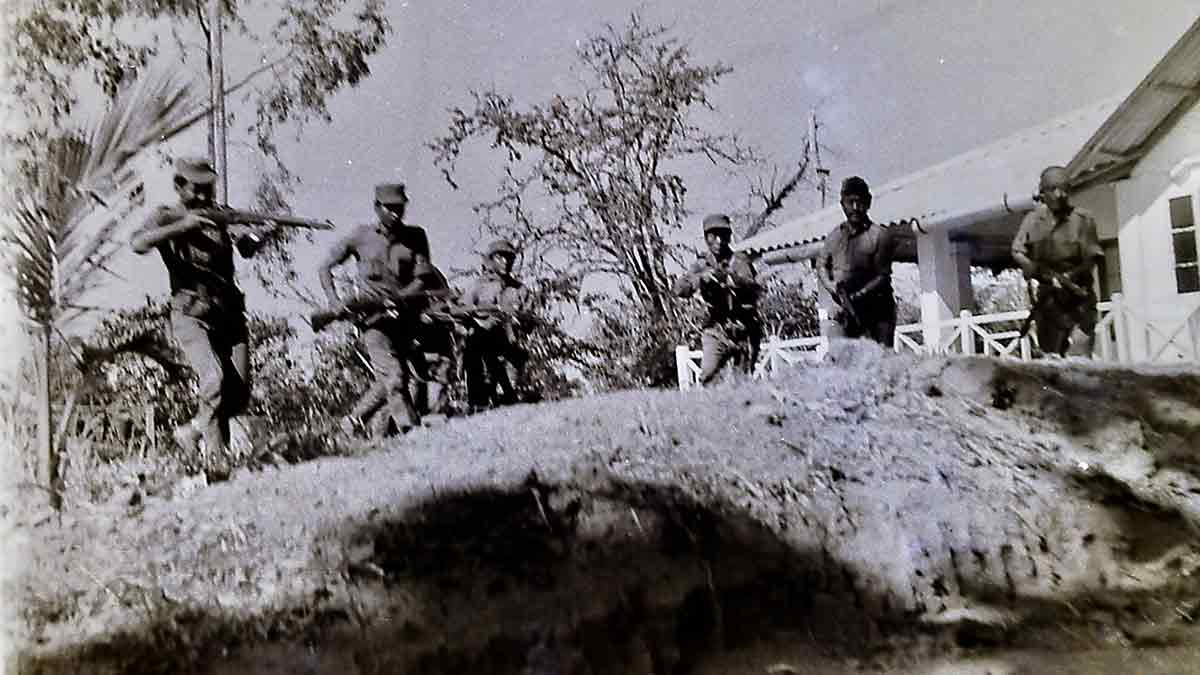
Establishment 22 was built for guerrilla warfare—lightly armed with machine guns, carbines, small explosives and 81mm mortars, supported by two or three ARC Mi-4 helicopters, with no heavy weapons or artillery. Its method was to ambush enemy patrols, cut communications and supply lines, carry out sabotage and melt away—a fast, mobile force meant to sow fear and chaos. The men of 22 attacked and vanished like phantoms, paddling improvised flotillas across the lakes and rivers to take one post after another. South of Barkal the fighting grew so fierce that the unit called in the Air Force against enemy troops dug in on high ground. The fight for Khagrachari, under Tsewang, was the bloodiest of all: 21 of its men were killed and dozens wounded.
THE FALL OF A BRAVE KHAMPA WARRIOR
It was in a major battle for Chota Harina that Establishment 22 lost one of its bravest members. The Southern Column’s base lay close to the headquarters. When Thondup Gyadotsang heard that enemy soldiers were approaching it, he disregarded his men’s appeals to hold back. He was a true warrior and always led from the front. He rushed out to confront the enemy and was gunned down in a hail of bullets. Jampa received an urgent rescue call and set off as soon as he could get hold of a helicopter.
There was no proper place to land, so a stretcher was lowered. Jampa had the chopper fly him first to the nearest military clinic, at Lunglei. The medical staff there took one look at the wounds and sent him on to the larger hospital at Aizawl. But the wounds were too grave; despite every effort to save him, Thondup passed away. He was cremated with full military honours at Demagiri, in the presence of General Uban and everyone at the headquarters.
Thondup’s death was felt keenly by all. He came from a prominent family in Lithang, in eastern Tibet, and had fought bravely against the Chinese PLA while serving with Chushi Gangdruk.
VICTORY WITHOUT RECOGNITION
Operating deep inside the CHT, Tibetan columns seized key positions, disrupted Pakistani supply lines and gradually isolated Chittagong. They captured Rangamati, and were poised to move on Chittagong city. Laldenga and his family, who had been living in Rangamati, fled south and eventually to Burma.
Uban’s ragtag band, with the Mujib Bahini already infiltrated deep into the city, could have taken Chittagong itself—but his repeated requests were declined with the high command asking, “How can you do that with no artillery and heavy armour?” In any case, Uban’s superiors would never have allowed it: Operation Eagle, and the very participation of 22’s Tibetan soldiers, was wrapped in total secrecy and it needed to stay that way.
In the war’s final days, as Lieutenant General A.A.K. Niazi, commander of Pakistan’s Eastern Command, neared surrender, Establishment 22 was given two last tasks: to seize the Marine Academy at Anwara (Juldia), on the south bank of the Karnaphuli near Chittagong, and to destroy the Dohazari bridge—about 40km south of the city on the Arakan Road to Cox’s Bazar and Burma—which Indian authorities feared Niazi might use to escape into Burma, and onward to China. It accomplished both, sealing off the Pakistanis’ escape route.
Forty-nine Tibetan soldiers lost their lives in Operation Eagle, and close to 200 were injured, some critically. Despite their bravery, the participation and sacrifice of 22’s Tibetan soldiers was never officially or publicly acknowledged by the Government of India. Jampa accompanied Uban to Sheikh Mujibur Rahman’s inauguration as head of government in Dhaka on January 12, 1972, where, on behalf of the Tibetan soldiers, he presented khatas (traditional scarves), Tibetan dresses and shoes to Rahman and his family. The Bangladeshi media, however, made no mention of the unit or the Tibetan contribution.
The four battalions were quietly shipped back in batches, on dilapidated vessels. They stopped in Calcutta and were then put on trains to Dehradun. At the Dehradun railway station, the soldiers were welcomed home with great joy by their families, the local Tibetan community and many Indians, too.
THE FORGOTTEN VETERANS OF BANGLADESH
While Indian officers received formal military decorations, Tibetan officers and soldiers received no comparable public recognition despite their sacrifices. All they received were cash awards.
In a signed copy of his book, Phantoms of Chittagong: The “Fifth Army” in Bangladesh, dated September 10, 1992, Uban writes: “Provided to my friend political leader Jampa Kalden who fought this war along with me with great distinction.” Yet in this slim book—often cited whenever the unit and the 1971 war come up—there is no mention of Tibetans fighting the war. The book, published in 1985, appeared at a time of almost complete secrecy around everything to do with the Establishment 22. There is a single, passing reference to Jampa, by his initials “JK,” even though the two worked closely together before, during, and after the war. Describing the founding of the unit, Uban writes: “The SFF was raised from the inaccessible Northern Hill tribes, soon after the Chinese invasion of India in October 1962.”
Within India’s defence and security establishment, though, the unit’s exploits had acquired almost legendary status. Indira Gandhi had a particular soft spot for 22. The unit was probably unique in training women as soldiers, not merely as nurses and clerks: a women-only unit, Training Four, learned to fight and to jump from planes. She invited a contingent of its women soldiers as her guests at the 1975 Republic Day, and in some photographs from those years she appears in Tibetan dress, alongside Jampa and Ratuk Ngawang. She even asked Jampa to send a company of Tibetan soldiers for her security detail.
The SFF remains intact today. Since 1971 it has served in Siachen, in the 1999 Kargil War and in the 2020 Ladakh standoff with China. Today’s officers and soldiers, unlike the earlier generation, draw pay and pensions close to those of regular army personnel and the force is no longer Tibet-centric.
India gave refuge to the Dalai Lama and tens of thousands of Tibetans. In 1971, thousands of Tibetan soldiers repaid a portion of that debt in blood and sacrifice. Forty-nine never returned home. Their role was largely forgotten by history. Yet their story deserves remembrance—not only because they helped create Bangladesh, but because they embodied a principle that remains central to the Tibetan struggle itself: that freedom is worth fighting for, even when the world does not notice.
The author is a nonresident senior fellow at the Atlantic Council’s Global China Hub in Washington, DC. He was the Dalai Lama’s representative in DC (2013-2016). Jampa Kalden Aukatsang was his father.
