



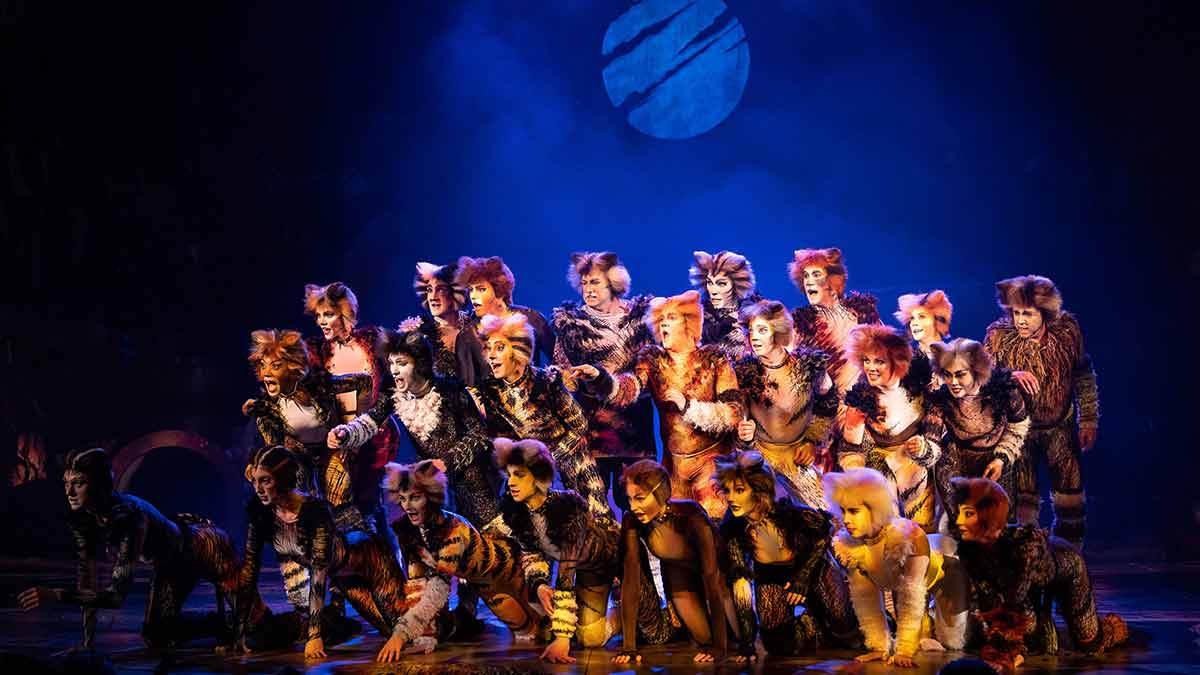
There are musicals that tell stories, and then there is Cats, a fever dream of dancing felines, junkyard poetry, lycra-clad performers and music so emotionally powerful that audiences still leave theatres humming its most famous song, ‘Memory’.
Forty-five years after it first opened in London’s West End, Andrew Lloyd Webber’s blockbuster musical continues to travel the world.
Cats is coming to India, with performances scheduled at Mumbai’s Nita Mukesh Ambani Cultural Centre (NMACC) in June. The enduring appeal of Cats lies precisely in its refusal to behave like a conventional musical.
“Because it dares to be different,” says Matt Krzan, resident director of the production. “It doesn’t follow a traditional linear plot; instead, it creates an experience. Audiences are invited into this world rather than told a story in the usual way.”
Based on T.S. Eliot’s Old Possum’s Book of Practical Cats, the musical unfolds over one Jellicle night, where a tribe of cats gathers for a ritual that will determine which one among them ascends to a new life.
There is no villain-driven climax and no conventional romantic arc. First-time viewers may not immediately grasp everything that unfolds on stage. But, with patience, the narrative gradually reveals itself. Yet, somehow, Cats has become one of the longest-running musicals in theatre history.
Part of its staying power lies in its universality. This is immersive theatre at its best, blurring the line between audience and performance, and relying on the movement, music and emotion more than dialogue-heavy storytelling.
“The storytelling itself doesn’t change, because Cats communicates in such a universal language, music, movement and emotion,” says Krzan. “Indian audiences are incredibly expressive and responsive, which creates a wonderful dialogue between stage and auditorium.”

For Krzan, certain elements remain sacred no matter where the show travels. “At its core, Cats is about atmosphere, movement and music working in perfect harmony,” he says. “The score by Webber is absolutely sacred; it drives everything.”
Equally untouchable is the choreography originally shaped by the legendary Gillian Lynne, whose feline physicality transformed performers into creatures that are neither entirely human nor fully animal.
That choreography remains one of the show’s defining signatures. Every twitch, leap and crawl is meticulously designed, yet performers are encouraged to find individuality within the ensemble. “Every performer understands the ‘rules’ of being a cat,” Krzan explains. “But within that, we ask: what makes your cat unique?”
That freedom to inhabit eccentricity also explains the show’s cult-like hold on its performers. “The only place where grown adults crawl around on stage professionally and somehow make it iconic,” jokes Charlie Follows, who plays Bill Bailey.
Some others describe the musical as a kind of theatrical escape hatch. “Cats is the ultimate example of escapism in its truest form—you visit a different world and leave your worries at the door for 2.5 glorious Jellicle hours,” says Ryan Flynn, a booth singer in the production.
But, beneath the spectacle—the oversized junkyard set, the glowing eyes, the gravity-defying choreography—lies a surprisingly emotional core.
At the heart of the musical is Grizabella, the once-glamorous outcast cat whose longing for acceptance culminates in the haunting ‘Memory’. “No matter how many times you’ve seen it, that moment has the power to feel completely new,” says Krzan, referring to Grizabella’s transformation scene. “That’s the magic of theatre, it keeps revealing itself.”
Several cast members point to these emotional themes as the reason Cats continues to resonate. “It speaks to the eternal truths of forgiveness, love and community,” says Noa Duckitt, who plays Jellylorum. Jackie Lulu, a swing performer, believes the show remains relevant because it mirrors society itself: “The outcasts, the show-offs, the popular kids—and how everyone fits into the world.”
In an age increasingly obsessed with realism and fast-paced storytelling, Cats remains gloriously strange. It asks audiences to surrender to mood and sensation rather than logical explanation.
“It is bold, it is iconic and people are still blown away by it,” says Tatum Coleman, who plays Bombalurina. “Which is exactly why they keep coming back.”
The scale of the production also continues to impress newer audiences raised on computer-generated imagery-heavy entertainment. Darren Rockman, who plays Coricopat, calls it “timeless” while giving credit to “the dazzling junkyard set, the athletic choreography, the iconic family-friendly music and humans behaving as cats”.
Yet, for all its theatrical excess, Cats ultimately circles back to something deeply human: the need to belong.
Stephan van der Walt, who plays Macavity, hits the proverbial nail on the head: “Beneath the spectacle, the strangeness and the lycra lies a simple truth—that our humanity is found in choosing love over judgment, offering grace, and never denying someone their way back home.”
