



It was another jarring note in the story of Bhatkhande Music Institute, one of India’s most respected establishments for the classical performing arts. A gulmohar tree on the institute’s boundary needed to be pruned, and an employee was “verbally” asked to do so. But once the job was done, the employee, a storekeeper, was suspended for stealing wood. He is just a year away from retirement, and is still too scared to speak of it.
That suspension illustrates most tellingly the disharmony in an institute that was deemed a university in 2000. Set up in 1926 as the Marris College of Music by Pandit Vishnu Narayan Bhatkhande, the institute’s vision was to make music education accessible to all. In 1966, it was renamed after its founder, a musician credited with developing the simplest, most precise system of notation for Hindustani music.
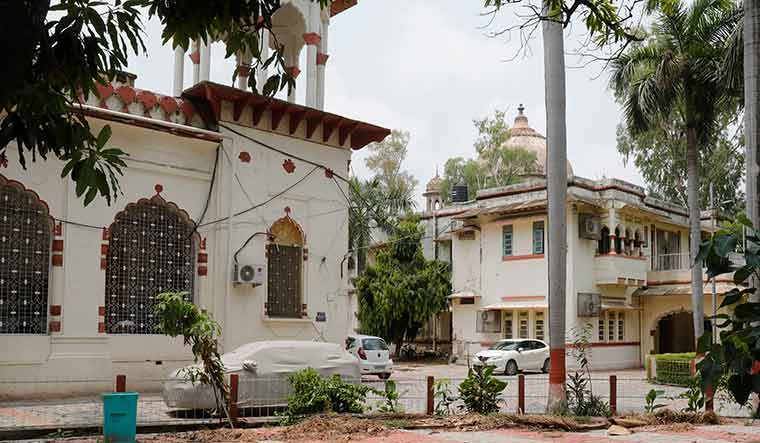
The building that houses the institute is in Lucknow’s Qaiserbagh heritage zone. It was once the ‘Pari Khana’ (Abode of Fairies) of Awadh’s last nawab, Wajid Ali Shah. The original building was destroyed in the revolt of 1857.
“When the British rebuilt it, they retained its original aesthetics and did not impose their own style of architecture on it,” said Mehmood Abdi, 60, a lawyer who is an exponent of Awadh history and culture. Thus, within its airy rooms and beneath its imposing domes, one can still be transported to a time when the most resplendent singers, dancers and musicians of the age carved an upward arc of Awadh’s cultural life.
“We were taught by giants of music,” said Anup Jalota, among Bhatkhande’s best known alumni. “The mere sight of them was a darshan (like seeing a holy person). They evoked such deep feelings of respect that it became innate to touch their feet and seek their blessings.” Jalota, 67, is a singer of a variety of songs, and bears the title ‘Bhajan Samrat’ (emperor of devotional songs).
For singer-composer-music director Vivek Prakash and his peers, Bhatkhande was as sacred as it was magical. “We would say, ‘Sunday ho ya Monday, roz jayein Bhatkhande (Be it Sunday or Monday, we go to Bhatkhande every day),’” he said.
The grant of a deemed university status to Bhatkhande, which made it the country’s only music university, was ostensibly to put the institute’s certifications on par with other universities. But the funds for it were granted by the state’s department of culture, rather than that of higher education. The government remained unclear on the limits of its autonomy. Thus began Bhatkhande’s unravelling.
Purnima Pande, 72, was Bhatkhande’s principal when the status was granted. A kathak danseuse of international repute, Pande said: “The grant of the status was a matter of great joy for us all for it would help students in their professional aspirations. But something went wrong. Perhaps the vice-chancellors did not have clear knowledge of norms and rules or perhaps these were not spelled out explicitly.”
Inherent in this ambiguous status was a clash between artistic freedom and the tangle of government rules. Appointments were made for posts that were not advertised and appointees lacked the requisite educational qualifications. Salaries were delayed and pensions went missing.
In 2009, there was a 49-day strike. “We were protesting the arbitrary removal of two contractual teachers. We decided that we would have to fight for our respect if it was not being duly accorded,” said Dharamnath, 72, a doyen of the Banaras gharana who was then teaching at the institute.
Today, as per the institute’s website, there is one case against it before the Supreme Court, and 41 before the Allahabad High Court. Most of these are against compulsory retirement, dismissal from service, denial of pension and non-payment of salary.
The genesis of Bhatkhande’s problems did not arise overnight. In 2018, a report on the management of universities in Uttar Pradesh dedicated a whole chapter to it. It labelled the institute as “...largely unenviable... as regards its infrastructure, faculty and position” and said that much of this was caused by the state government. The problems were listed under two categories—those born out of government inaction and those arising out of government’s lack of perception.
Sarang Pandey, 51, a tabla teacher at Bhatkhande, said: “It becomes difficult to teach with dedication amid uncertainty. It becomes difficult to discipline students.”
In December 2020, the state government sacked the VC Shruti Sadolikar Katkar, a popular khyal vocalist. There were 15 charges of financial and administrative irregularity against her. She later challenged her removal in the Lucknow bench of the High Court. Over a phone call from Mumbai, Katkar, 69, said: “Despite all odds, I upheld the dignity of the institution and never did anything to compromise its reputation.”
Such discord has, as Jalota said, “dented a little” the reputation of the institute. Ranjana Dwivedi, 58, an assistant professor at the institute said, “When Bhatkhande became a deemed university, it was like a child left in the wilderness, with no one willing to nourish it.”
To those who lament the fall of the institute, the damage inflicted by the branches of the overgrown gulmohar are still visible—a reminder of all that remains discordant in Bhatkhande.
