



SRINAGAR
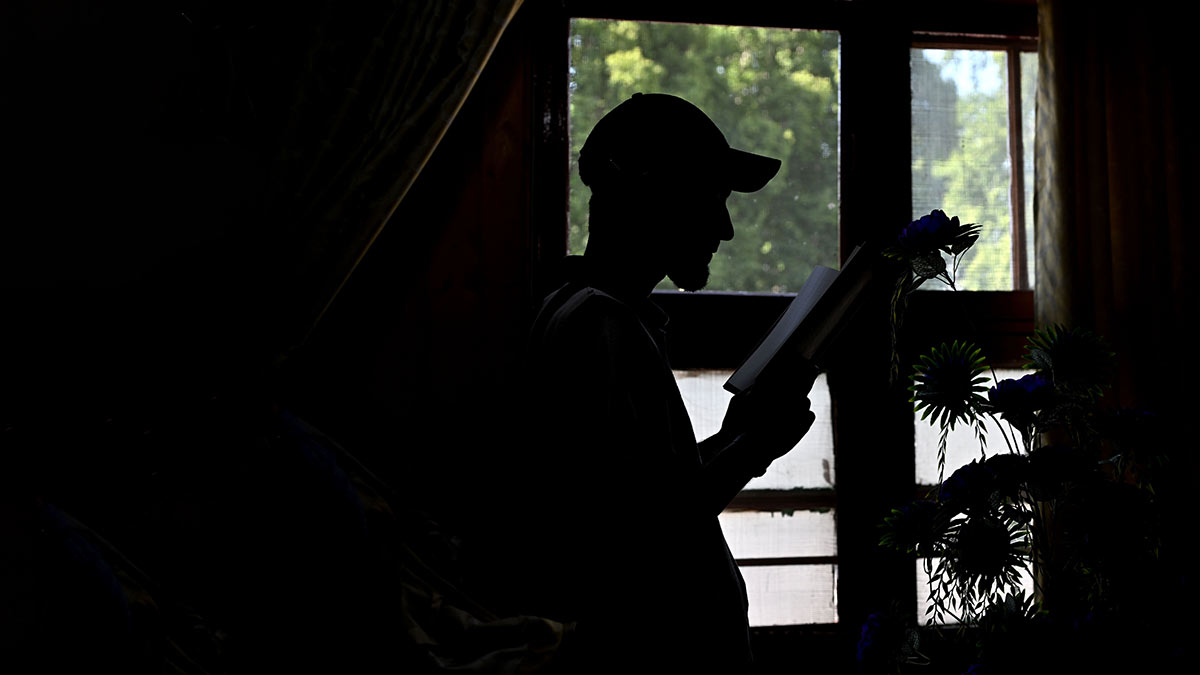
Twenty-seven-year-old Manzoor (name changed) keeps glancing at his elder brother seated beside him. For the first few minutes, the brother does most of the talking. Then Manzoor slowly begins to speak.
“I started consuming drugs after my parents died,” he says, so softly that one has to lean in to hear him. “There was no support. Friends introduced me to it. It gave immediate relief and made me forget everything.”
His father served in the Special Operations Group, Jammu and Kashmir Police’s counterinsurgency unit, and was killed years ago in a blast. What followed, Manzoor and his brother say, was not only grief but ostracisation.
“They used to raise slogans at my father’s grave, calling him traitor,” Manzoor says.
He borrowed heavily to sustain his addiction. “There was nearly Rs20 lakh in debt,” the elder brother says. “I had to sell land to repay it.” The family struggled to survive as Manzoor slipped deeper into heroin addiction.
After a month in rehabilitation, aided by medication-assisted treatment, Manzoor saw a glimpse of what he had lost. Today, he says he is “75 per cent recovered”. His weight has increased from 47kg to 53kg, as he has been eating regularly again. “Earlier, I would eat only once in three or four days,” he says.

An ardent Virat Kohli fan, he speaks cautiously about the future. But he gives a shy smile when asked whether marriage is on his mind. “First I have to become stable and earn. Then, yes, I would like to,” he says.
His friends often ask how he managed to quit. “I tell them to speak to my brother,” he says. “He takes them to rehabilitation centres.”
Manzoor is visibly recovering, but he remains fragile. He needs round-the-clock monitoring to protect him from temptations.
We met Manzoor, a resident of Baramulla, in Srinagar. Once among Kashmir’s most volatile districts, Baramulla is now at the forefront of the Jammu and Kashmir administration’s anti-drug campaign led by Lieutenant Governor Manoj Sinha.
Manzoor’s story encapsulates what four decades of conflict have done to the valley. We met several others that afternoon who narrated variations of the same story. A 33-year-old from Baramulla said he had been paid to throw stones at security forces. “The peddlers were also from the Jamaat (the Jamaat-e-Islami, which is banned in Kashmir),” he claimed. “After consuming drugs, we would join the protests.”
A taxi driver from the same town said he spent everything he earned on charas and neglected his family for years. A Srinagar singer performed at weddings for 75 consecutive days without a break, relying entirely on intoxicants to function. After a point, the stories began to merge into a single blurred portrait of a society where the most vulnerable—its youth—had internalised decades of trauma.
The Union territory has been relatively peaceful since the abrogation of Article 370. Stone-pelting incidents have virtually disappeared. Under sustained pressure from security agencies, the theatre of conflict has shifted from towns and villages to mountains and forests, where Pakistan-backed militants continue to operate.
But peace alone was not enough. The region needed a healing touch.
The somewhat bureaucratically named ‘Nasha Mukt Jammu Kashmir’ campaign—a 100-day drive launched by Lieutenant Governor Manoj Sinha in April—is beginning to show results on the ground.
We joined Sinha in Shopian, a district in south Kashmir that, for much of the previous decade, saw frequent clashes between security forces and protesters that drew international attention. The fact that a large public rally could be organised there—and filled—was in itself a statement.
The venue was packed. By some estimates, more than 60,000 people attended. Rain had brought temperatures down below 16 degrees Celsius, yet the crowd remained under the waterproof canopy.
There were street plays depicting how addiction destroyed families. Schoolchildren and local artists dramatised the social costs of drug abuse. The full rendition of Vande Mataram and the national anthem was sung twice; each time, everyone rose.
Sinha spoke about his administration’s efforts to curb the drug menace, which was now aiding the remnants of terrorism. Interspersing his remarks with Urdu phrases, he outlined the campaign’s three pillars: disrupting supply chains, generating public awareness, and facilitating rehabilitation. The authorities have registered more than 900 first information reports, suspended 450 driving licences, initiated cancellation proceedings for 116 passports, and revoked the licences of 268 drug stores.
Drugs, Sinha said, were worse than a bullet—with young people being the most affected. Mindful of the fact that bulldozer actions evoked strong reactions, he addressed the issue directly. “If even a single innocent person had been wrongfully targeted, I would personally order an impartial inquiry,” he said, asking the crowd if such an action was needed. Most responded in support.
Later, in an interview, Sinha emphasised what he called a “whole-of-government, whole-of-society approach”. “Rehabilitation is not optional,” he told THE WEEK. “It is the duty of the administration and the duty of every citizen.”
More than 7,000 women’s committees have been formed at the panchayat level, functioning as local vigilance groups. Around 7,000 religious leaders have been encouraged to address the issue during Friday prayers.
Sports, too, have become part of the strategy. More than 15,000 sporting events have been organised, drawing around seven lakh young people. A high-altitude training centre is planned for Pulwama at an estimated cost of Rs300 crore. Officials believe that a vibrant sporting culture is what this long-suffering region needs.
The symbolism is already visible. Earlier this year, the Jammu and Kashmir cricket team won its maiden Ranji Trophy title.
Insurgencies require reliable funding streams, and over the decades, narcotics trafficking has emerged as one of the most dependable.
Heroin that costs around Rs1 lakh per kilogram in Pakistan crosses into India through the Samba, Kathua and R.S. Pura sectors—and even through the Amritsar corridor—to reach major cities, where the same quantity can fetch close to Rs1 crore. “The margins are extraordinary. What does not reach Mumbai or Delhi is consumed locally, partly to sustain addiction among courier networks and partly to fund arms purchases,” police sources said.
Across the border states, drones have become the preferred means of transporting drugs. For traffickers, they are cheap. For security agencies, countering them requires expensive jammers and sophisticated detection systems.
As cheaper and increasingly effective drones emerge, security agencies face a growing challenge. The drones can transport drugs and guns by bypassing heavily guarded borders. More recently, investigators have encountered cryptocurrency. Cases have surfaced in which mule accounts were used to channel proceeds from drug trafficking into digital assets.
Narco-terrorism is emerging as the bigger challenge. It inflicts a deadlier blow—generations lost to addiction, while easy money is used for fomenting trouble.
The focus has shifted to handling this aspect with the whole-of-government, whole-of-society approach, as the number of terror attacks has declined. In 2020, there were 142 terrorist attacks in Jammu and Kashmir. By 2023, that number had fallen to 46. In 2024, it was 26. In 2025, including the Pahalgam attack, it was two. Civilian casualties, which stood at 27 last year, are currently zero. Security forces’ fatalities have dropped from 63 in 2020 to 17 in 2025— and every one of those deaths last year occurred in mountain encounters, not a single one in the valley or in an ambush.
Two elite police units—the Snow Leopards and the Markhor—have been trained specifically in guerrilla and mountain warfare, reflecting where the remaining militants have retreated after pressure on them in the valley.
The Pahalgam attack nearly broke the backbone of the region’s economy—the tourism sector. But today, visitors are returning. Current footfall is estimated at 70 to 75 per cent of pre-attack levels and rising.
The Vande Bharat service connecting Jammu and Srinagar through the newly completed rail link now carries between 2,500 and 2,800 passengers every day—80 to 100 per cent occupancy. Despite heavy snowfall earlier this year, when highways were blocked and flights suspended, the rail link served as a lifeline.
The valley has also attracted significant investment. More than 5,000 hotels have been established in the past few years. With Kashmiris getting accustomed to stability and opportunity, terrorism appears to be receding.
The sold-out Sonu Nigam concert on the banks of Dal Lake last year was an indication of the changing Kashmir. Srinagar is now hosting the third edition of its literature festival, while city roads are increasingly crowded with tourist vehicles.
But, despite the visible changes, peace remains tenuous. Officials say it will take several more years before the region reaches levels of stability comparable to its neighbours. In the absence of statehood, Sinha has been filling the governance deficit and has been occupying a central role in governance and public service delivery. Chief Minister Omar Abdullah faces the challenge of meeting electoral promises within a framework where key powers remain beyond his government’s control.
But conversations with a broad section of people suggest a more nuanced picture. Many voters appear focused less on constitutional arrangements and more on tangible improvements in governance, security and livelihoods.
For now, the priority remains consolidating the gains of recent years and ensuring that the region’s peace becomes durable.
