



As our car was minutes from the Jonnagiri Gold Mine in Andhra Pradesh’s Kurnool district, we saw a different kind of mining happening outside. A small crowd was digging shallow pits in an open area on the outskirts of the nearby Erragudi village. Men and women, with crowbars and small shovels, searched for rangu rallu, colourful precious and semi-precious stones, which have drawn fortune seekers to this region for decades. They had come not only from Andhra Pradesh, but also from Karnataka and Tamil Nadu. Among them was the elderly K. Nagamma, who said she had been making the pilgrimage for nearly two decades. She proudly displayed the stones she had collected over the years. “None of these is valuable,” interrupted M. Raghavendra Rao, a regular visitor from West Godavari district. Pointing to the surrounding chilli fields, he said, “We have come late. Otherwise, we could have been searching in those mirchi fields.”
Their hunt had yielded nothing that day, but optimism was high. “Yesterday, a woman and her son found a stone worth Rs1 crore,” Rao said with a glint in his eye. Whether the story was true hardly mattered. Even before reaching India’s newest gold mine, THE WEEK had stumbled upon another form of high-value mining, albeit a smaller, more informal one.
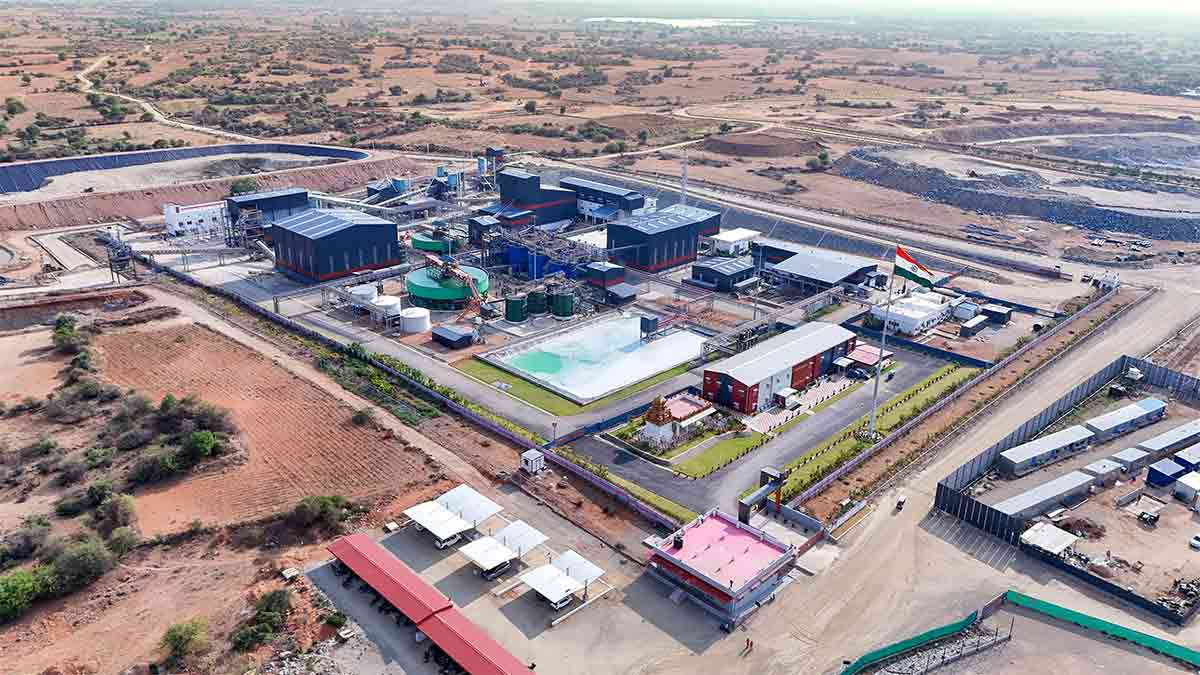
Two kilometres later, after crossing a guarded entrance, we reached India’s first private-sector gold mine. Developed by Bengaluru-based Geomysore Services, the mine occupies 1,477 acres spread across five exploration blocks, although mining is currently confined to a 30-acre open-cast pit. The project has certified gold resources of 13.1 tonnes and an estimated exploration potential of 42.5 tonnes, making it one of India’s most significant new gold discoveries.
Jonnagiri’s association with gold is old. Known in ancient times as Swarnagiri, it was an important settlement during the Mauryan period, and archaeologists have found evidence of early gold mining in the form of abandoned mine workings and scattered waste dumps. Those findings prompted the Geological Survey of India to explore the site between 1991 and 1994. It identified five prospective gold-bearing blocks and confirmed that the ancient workings sat atop gold. After decades of studies, feasibility assessments and statutory clearances, commercial mining finally began when Chief Minister N. Chandrababu Naidu inaugurated the project on June 24.

After securing the project in 2013, Geomysore Services had carried out extensive drilling, geological modelling, resource estimation and feasibility studies before concluding that the deposit could be mined commercially. Said company director B. Karthikeyan: “Once the reserves were established, the company obtained all statutory approvals required to build Andhra Pradesh’s first modern gold mine, including a 1,000-tonne-per-day processing plant and the supporting mining infrastructure.”
But for the engineers at Jonnagiri, opening the mine was only the beginning. The real challenge is in discovering where the next gold-bearing rocks are hidden. “Gold does not announce where it lies,” said M. Sai Narasimha Reddy, the mine engineer. “Every deposit has to be located, tested and confirmed.”
Although commercial production has begun in only one pit, exploration continues across the lease area almost every day. Six drilling rigs bore deep into the rock in search of mineralisation. Their work is not to extract gold, but to understand the geology beneath the surface.
Each rig brings out long cylindrical cores of rock that are carefully transported to the mine’s Core Centre, where they are catalogued and examined. Spread across rows of storage racks, the cores resemble neatly arranged pipes, each one a slice of the earth’s history. Geologists study every sample for foliation, which reveals the direction in which the rocks were deformed over millions of years; quartz veins, where gold is most likely to occur; and alteration, colour changes that often indicate the movement of mineral-rich fluids. Promising samples are then sent to laboratories in Bengaluru to determine the quantity of gold they contain.
“Reconnaissance and prospecting established that Jonnagiri had gold. Exploration tells us exactly where it is, how much is present and whether it can be mined economically,” said Shantanu Kumar, deputy manager (geology), Jonnagiri Gold Mine.
The rocks tell a story that stretches back more than 2.5 billion years. Jonnagiri forms part of the Eastern Dharwar Craton, one of the oldest geological formations on earth. The same geological formation also hosts India’s famous goldfields at Hutti and Kolar, making the Dharwar Craton the country’s most important gold-bearing terrain. That shared geology is shaping Andhra Pradesh’s ambitions beyond Jonnagiri. Mines Minister Kollu Ravindra told THE WEEK that the government has identified additional gold-bearing areas in Anantapur and Chittoor, and would develop a gold corridor stretching towards the Kolar Gold Fields in Karnataka. If exploration is successful, Jonnagiri could become the first link in a much larger chain of mines across south India.
The state government chose private investment for a reason. Gold mining demands heavy capital, advanced technology, specialised expertise and continuous geological monitoring. “Private investment ensures efficient mining operations while generating royalty revenue for the state. It also promotes industrial development and reduces the financial burden on the government,” said Ravindra. For Andhra Pradesh, Jonnagiri is not merely a mining project, but a test case for how private capital can unlock mineral resources while creating employment and value-added industries.
From a distance, the open-cast mine looks no different from a stone quarry. There are no glittering veins of gold waiting to be struck. Instead, massive trucks shuttle continuously between the pit and the processing plant, carrying thousands of tonnes of ore every day. The operation stops only on Sundays and major holidays. More than 1,000 workers work three shifts to feed about 1,000 tonnes of ore into the processing plant every day. Yet, yields are low. “The average grade is about 1.3 to 1.4 grams of gold per tonne of ore, and the plant produces around 1.3 to 1.4 kilos of gold every day,” said Reddy. This makes gold mining one of the most technology-intensive industries in the world. Extracting a kilo of gold means crushing, grinding and processing nearly a thousand tonnes of rock. Geomysore plans to increase the processing plant’s capacity from 1,000 tonnes to 2,500 tonnes a day, while simultaneously developing underground mining in the west block. “The expansion will increase the mine’s production capacity and extend its life,” said Karthikeyan.
The transformation from rock to gold begins with brute force. Large boulders are first broken in the primary crusher before passing through secondary and tertiary crushers, which reduce them to chips of about 10mm each. These chips enter a massive mill, where heavy steel balls grind them into a fine powder. Water is added to create a grey slurry that is pumped to a centrifugal concentrator. The plant operates two concentrators on a rotational basis. The concentrator spins at extremely high speed, using centrifugal force to separate the heavier gold particles from the lighter waste rock. The principle is simple. Gold has a specific gravity (how dense it is compared with water) of 19.3; the surrounding rock has a specific gravity of 2.6. Gold settles rapidly under centrifugal force, allowing it to be separated. Nearly half of the recoverable gold is extracted at this stage.
The remaining microscopic gold particles continue through the plant in the form of slurry. They enter a series of giant leaching tanks, where a dilute cyanide solution dissolves the gold still trapped inside the rock. The slurry is then pumped into another set of tanks containing activated carbon, which acts like a sponge by attracting and absorbing the dissolved gold. The metal is later stripped from the carbon using heat and chemicals before entering the electrowinning unit, where an electric current deposits it onto steel-wool cathodes. Finally, the recovered gold is dried, melted in a furnace and cast into 99.9 per cent pure gold bars, ready for quality testing and sale through authorised bullion traders and jewellers. This journey takes several days.
But beyond extracting gold, the project is beginning to reshape the local economy. Built at an investment of Rs405 crore, the mine has already generated more than 1,000 jobs. Karthikeyan said the workforce was expected to grow to about 1,250 direct employees as mining expands. Another 1,500 indirect jobs were created through transport, equipment maintenance, catering and other ancillary services. The company has also begun training youth and women from nearby villages to operate heavy, earth-moving machinery, which usually men operate.
But apart from jobs, does producing gold locally reduce the price for consumers? Not really. Kamisetti Jagadish, vice-president of the Kurnool Jewellery Association, said the difference between imported bullion and Jonnagiri gold is negligible. “We buy only when there is a difference between the two. Even then, the saving is only about Rs50 a gram,” he told THE WEEK. Jagadish was the first merchant to receive Jonnagiri gold from Naidu during the mine’s soft launch. He proudly showed THE WEEK one of the commemorative gold bars embossed with the mine’s insignia.
Seeing it, a question comes to mind: How is the gold from the mine protected? Reddy said not even a milligram of gold can leave the premises unnoticed. Everyone entering or leaving the plant—employees, contract workers and visitors—must pass through airport-style security scanners. Restricted access to sensitive sections of the plant, coupled with several layers of surveillance, has ensured that there has been no internal theft.
Also, you can only steal what you see. Neither visitors nor the workers get to see the processed gold. Only two or three top management members can access the final-stage gold production areas.
For both Geomysore and the state government, Jonnagiri is only the beginning. The company plans to increase annual production by expanding the processing plant and opening underground mining in the west block. The state, meanwhile, is looking beyond a single mine. Ravindra said the government has proposed developing Jonnagiri as a gold capital, complete with a gold jewellery manufacturing cluster and a skill development centre.
More importantly, Jonnagiri could mark a turning point for India’s gold mining industry. For decades, most of the gold demand has been met through imports, while many domestic deposits remained unexplored or commercially unviable. Jonnagiri shows how private investment, modern exploration and advanced processing technologies can unlock mineral resources. It could become a blueprint for the Centre and other states. In fact, beyond creating jobs, the project has already pushed up land prices in the region.
For a village once known as Swarnagiri, life has come full circle.
