



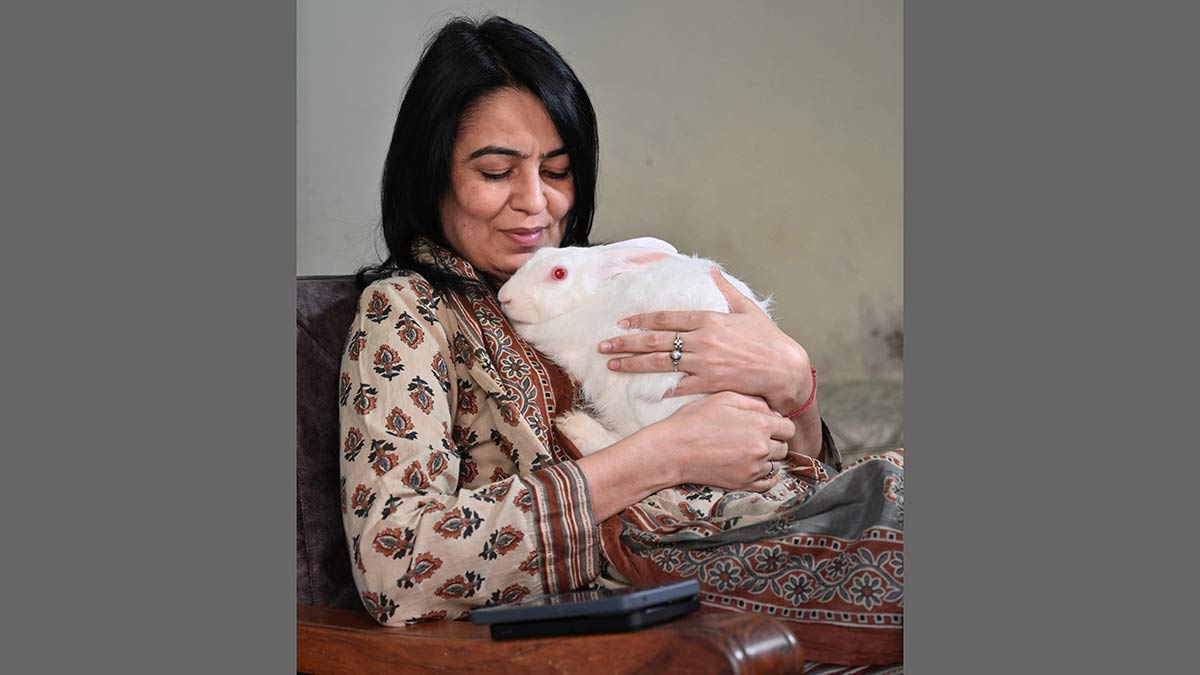
The rabbits were her idea. There are 12 in Anuradha Chaudhary’s home in Haryana’s Sonipat. The 41-year-old cared for them as proof that she could nurture life. Now, the cries of her newborn twins echo through her house.
On June 30, Chaudhary and her husband, jailed gangster Sandeep alias Kala Jathedi, welcomed their daughters through a Caesarean section. For a few precious hours on July 1, Jathedi was granted parole to visit the Gurugram hospital, hold his daughters and be with his wife.
“Hamare ghar Lakshmi aayi hai (the goddess Lakshmi has come to our house),” the couple said, unable to hide their happiness. Family members describe an atmosphere of celebration at their Sonipat home, where sweets were distributed and relatives gathered to welcome what they called the family’s biggest blessing. Chaudhary became a mother after an exhausting legal and social battle.

She has a long criminal record—extortion, kidnapping and organised crime—that saw her being called ‘Revolver Rani’. Now, she has a new identity—a woman who fought for her right to conceive and underwent fertility procedures with the assistance of her partner, making them perhaps the first couple accused in the same criminal case to secure reproductive rights through the justice system. It did not come easy.
Chaudhary, who is out on bail, said her decision to opt for IVF was shaped as much by circumstance as by social pressure. Although she technically had the option of meeting her husband during court appearances, the interactions were hardly private. “Policemen stand outside the room and even make fun of us,” she told THE WEEK. Such conditions made trying to conceive naturally both humiliating and impractical. “People would immediately ask how I became pregnant when my husband is in jail,” she said. “They may speculate and draw their own conclusions. My children should not be questioned about who their father is. I want their identity to be clear.”
Chaudhary is an articulate MBA. Police records show she was first drawn into criminal activity in her 20s, allegedly associating with gang members involved in arms trafficking and protection rackets. Over the years, having been a crucial part of gang networks across Rajasthan and Haryana, she has been accused in cases ranging from conspiracy and intimidation to involvement in violent confrontations between rival groups. Several remain under trial.
Since her marriage to Jathedi, her life has been under constant scrutiny. Investigating agencies, including the local police and the NIA, have repeatedly visited her home, most recently regarding alleged links to Canada-based gangster Goldy Brar, a charge she firmly denies.
Jathedi, who hails from Sonipat, has long been described by investigators as one of the most prominent figures in north India’s organised crime landscape. Police dossiers link him to extortion, contract killings, illegal arms supply and cross-border criminal coordination. Authorities across multiple states have registered cases against him, including those related to murder conspiracies, gang rivalries and financial crimes.
Over the years, his name has also surfaced during investigations into the wider criminal ecosystem surrounding Brar. While the police in Haryana and Punjab probed alleged links between some members of the Jathedi network and Brar’s transnational syndicate, investigators have not directly named or charge-sheeted Jathedi as part of Brar’s overseas crime network, citing lack of evidence establishing his operational involvement. Jathedi has consistently denied association with Brar. His counsel has maintained that although the two knew each other years ago when both operated in similar circles, those ties have long since ended.
Investigators, however, view the overlap as part of a broader evolution of organised crime in northern India. In recent years, gangsters based overseas, such as Brar, have increasingly relied on networks like Jathedi’s in Punjab, Haryana and neighbouring states to run their syndicates.
Chaudhary and Jathedi met through social circles connected to Haryana’s criminal networks, as per police accounts. Their relationship culminated in marriage in March 2024, conducted under heavy security and in accordance with prison regulations permitting marriages between inmates and outside partners.
Today, Chaudhary stands at the centre of one of India’s most urgent and ignored debates—the rights of prisoners and their families to love, intimacy and parenthood. THE WEEK had met her at her home while she was pregnant. “If I wanted his child, I couldn’t wait,” she had said. “Biology doesn’t wait for legal processes.”
Senior advocate Sumeet Verma, who has argued several cases involving prisoners’ family rights, says the philosophy of punishment in India is rooted in reform. “When a prisoner remains connected to family, it can reinforce responsibility and hope,” he said. “These are not luxuries, they can play an important role in rehabilitation.”
India continues to treat such requests as exceptional, almost indulgent, even as trials stretch for years and undertrials spend decades in custody. Verma said requests for conjugal access or fertility treatment do occasionally reach courts. Prisoners seek parole, temporary bail or medical permission to conceive, often invoking the right to dignity and family life under Article 21. “These cases are examined carefully by courts,” he said. “Judges have to balance multiple considerations—the nature of offence, security assessments, medical factors and the circumstances of the spouse.” The scrutiny has to be severe, as criminals sometimes try to use conjugal rights as a pretext for seeking concessions from courts.
As there is no uniform statutory framework governing conjugal rights, courts tend to decide such matters case by case. Prison authorities must also examine logistical and security aspects before any relief is granted. “It is therefore not a routine process,” said Verma.
Following Chaudhary’s plea, the court granted permission to obtain Jathedi’s semen sample—a rare judicial recognition that reproductive rights do not automatically end at incarceration. But what followed was her painful discovery that court orders do not necessarily translate into social acceptance. Clinics in Sonipat refused her entry once they learned her identity. Some declined politely, others simply stopped responding. “The stigma was louder than the law,” she said.
Her search eventually led her to a hospital in Gurugram willing to take the case. The doctors coordinated with prison authorities, travelled to Tihar to procure Jathedi’s sample and escorted it back for fertilisation.
Despite the high-risk pregnancy, she drove alone every week from Sonipat to Gurugram for injections. “I don’t want to look like a helpless woman just because I’m becoming a mother,” she told THE WEEK. “I manage what I can on my own.” Chaudhary’s aspirations are unexpectedly modest. She speaks of wanting to live quietly somewhere away from attention, with her husband, rabbits and daughters. As she navigated the pregnancy alone, the rabbits kept her company. They are dependent on her for everything, she had said with a small laugh, adding: “They remind me life can still be normal.”
Her IVF journey, however, was anything but—prompting the justice system to confront a dilemma it has long postponed: can the state deny inmates the possibility of parenthood if incarceration restricts liberty but not dignity?
Chaudhary does not frame her case in constitutional terms. She described it simply as a wife’s wish to have her partner’s child. By navigating courts, prisons, doctors and stigma, she has illuminated what she sees as a deeper fault line in the justice system—between punishment and humanity. In her view, incarceration is meant to restrict liberty, not erase every aspect of a person’s emotional and social life. Marriage, she argued, does not cease when one partner enters prison.
She also raised a concern about asymmetry: when one spouse is incarcerated and the other remains outside, the emotional and relational rights of the free partner cannot be ignored. “Any discussion on conjugal rights must recognise that marriage is a mutual relationship, and the dignity and needs of the spouse outside deserve equal respect,” she said.
Yet the law never explicitly sanctioned the total erasure of emotional life. The apex court has interpreted the right to life and personal liberty, guaranteed by Article 21, expansively to include dignity, privacy and the ability to live with human worth. The court has repeatedly emphasised that prisoners are not stripped of fundamental rights except to the extent that incarceration restricts them. The notion of imprisonment as civil death has been rejected in principle.
Constitutional experts say this jurisprudence has gradually reshaped how courts view prisoners’ rights. Senior advocate Archana Gaur said the Constitution does not treat incarceration as a suspension of personhood. “Indian constitutional law has consistently held that a prisoner remains a rights-bearing citizen,” she said. “Only those liberties incompatible with imprisonment can be curtailed. The rest—dignity, access to courts and family relationships—continue to exist, though they may be regulated.”
While the Constitution protects dignity and personal life, she added, how those principles translate within the highly controlled environment of a prison is still evolving. “Courts have addressed the issue in individual cases, but a clear, uniform framework has yet to emerge,” she said.
Legal scholar Anjali Mittal, former head of the law department at Meerut College, pointed out the tension between rights and administration. “Prisons are fundamentally security institutions,” she said. While the Constitution recognises that prisoners retain fundamental rights, practical implementation depends on infrastructure, security considerations and administrative feasibility. “That is why courts often proceed cautiously,” said Mittal.
This is one reason the judiciary, while acknowledging that family life and procreation form part of personal liberty under Article 21, stops short of declaring conjugal visits a universal right. The result is a middle ground where courts grant relief in specific circumstances without establishing a general rule.
The everyday reality of prisons—where rights relating to food, health care, legal access and protection from abuse remain a concern—tends to push intimacy and family rights further from constitutional guarantees into a limited bracket of discretionary privileges.
But conjugal rights cases are forcing the legal system to examine whether the state’s custody over a prisoner’s body extends to extinguishing his relational existence—whether punishment must include loneliness, whether discipline must include emotional severance, and whether denying intimacy serves any legitimate purpose beyond symbolism.
Advocate Rohit Dalal, representing Chaudhary and Jathedi, said the case reflects the unusual human situations that emerge within the criminal justice system. “When a person is in custody for long periods, the law inevitably has to confront questions that go beyond the crime itself,” he said. “Marriage, family life and the desire to have children do not simply disappear because someone is in prison. Courts therefore have to examine such requests with care, balancing the legal restrictions of incarceration with the realities of family life.”
For families, the issue is painfully personal. Imprisonment rarely affects only the accused. It reorganises entire households. Wives become single parents overnight. Children grow up knowing a parent through brief, supervised meetings. Marriages transform into administrative relationships sustained through paperwork, visitation schedules and the goodwill of prison staff.
In such circumstances, conjugal access becomes less about sexuality than about continuity. Correctional systems across the world have gradually begun to acknowledge this distinction. In parts of Europe, temporary home leave and extended family visits form part of prison regimes. Scandinavian prison philosophy in particular treats family ties as essential to facilitating reintegration. Several Latin American countries have long permitted structured spousal visits within prison premises, recognising that emotional stability is itself a correctional objective. Some US states have programmes allowing prisoners extended time with spouses and children, tied to behavioural incentives and rehabilitation outcomes.
“Continued association with family and the outside world is crucial,” said Naveed Mehmood Ahmad Khan, senior resident fellow and lead (crime and punishment team) at the Vidhi Centre for Legal Policy. “If imprisonment is meant to be corrective rather than purely punitive, individuals must be able to maintain relationships, remain connected to social life, and look forward to a meaningful life after incarceration.”
The need of the hour is to re-examine the theory of punishment and revise the country’s correctional policy—just as the colonial-era Indian Penal Code was renamed the Bharatiya Nyaya Sanhita—to treat correction, reform and rehabilitation not as retrofitted ideas but as principles that shape institutional design. “If rehabilitation is central to correctional policy, conjugal visits and similar mechanisms that sustain family ties can be formally integrated into the framework rather than left as ad hoc or discretionary arrangements,” said Khan.
Prison administrators often cite overcrowding, limited infrastructure and security concerns. The challenges mount when private spaces are misused for criminal coordination or such facilities create hierarchies among inmates.
Conjugal visitation rooms were made operational in both Delhi and Punjab as part of reform-oriented prison policies. For a brief period, several eligible prisoners availed the facility. In both jurisdictions, however, the scheme was eventually suspended after authorities reported instances of misuse and administrative concerns, prompting a review of implementation and oversight.
These concerns cannot be dismissed lightly. But critics point out that risk management is the core function of correctional administration. Parole, furlough, visitation and work programmes all involve potential for misuse, yet they are regulated rather than abolished. The same logic, they argued, could apply to conjugal access. “The obligation must be to build the institutional capacity to implement them safely and effectively,” said Naveed.
Studies across jurisdictions consistently show that prisoners who maintain strong family connections are less likely to be violent within institutions, too. Emotional stability reduces institutional tension.
In the long term, preserving relationships enhances public safety. Seen in this light, conjugal access is an investment in reducing future crime and strengthening social stability.
Chaudhary’s pregnancy may well mark the beginning of a reckoning with the absence of clear policy guidelines. It also throws into focus the invisible burden of prisoners’ spouses—stigma, financial strain, emotional isolation—largely unrecognised in law or policy.
Former prison officials argued that safeguards are essential, given concerns ranging from sexual health and family contact to moral anxieties and administrative constraints that have shaped judicial decisions over time.
In Jasvir Singh and another vs state of Punjab (2014), two convicted prisoners petitioned the Punjab and Haryana High Court seeking private meetings with their wives, arguing that imprisonment should not deprive them entirely of marital life or the chance to have children, and invoking Article 21 in support.
Similarly, the Delhi High Court in 2023 addressed the case of Kundan Singh, serving a life sentence in Tihar Jail with 14 years already spent in custody. His wife approached the court seeking permission for IVF, citing the need to protect their lineage and secure their family tree. Kundan was 41 and his wife, 38.
Justice Swarna Kanta Sharma noted that the biological clock of both the prisoner and the spouse could become a significant factor in such cases. Prolonged imprisonment, the court observed, may permanently foreclose the opportunity to conceive if medical assistance is not permitted. Constitutional courts must therefore examine such requests with empathy while remaining within the framework of the law.
The reasoning reflects the cautious approach Indian courts have generally adopted—acknowledging the humanity and personal aspirations of prisoners while leaving the larger policy questions unresolved.
When Jathedi briefly stepped out of prison to meet his wife and daughters, the few hours the couple got represented something years of litigation had struggled to secure—the chance to begin parenthood together.
Their story does not settle the constitutional debate over conjugal rights. It does, however, illustrate what is at stake. Behind every petition seeking reproductive rights lies not merely a legal question, but a family negotiating punishment, hope and the possibility of a future beyond prison walls.
