



Born in response to Chief Justice of India Surya Kant’s remarks during a court hearing on May 15, the Cockroach Janta Party (CJP) has quickly grown from an online joke into a nationwide campaign. Its demand for the resignation of Union Education Minister Dharmendra Pradhan over the question paper leak before the National Eligibility-cum-Entrance Test united students across regions and political affiliations.
The CJP’s emotive campaign drew thousands of people from across the country to Delhi on July 20, the opening day of Parliament’s monsoon session. Largely free of ideological underpinnings, the movement also revealed its organisational shortcomings the same day. As the crowd swelled through the afternoon, many participants—attending their first public protest—were unsure what to do. Mobilised through at least six student organisations that had joined the CJP’s weeks-long demonstration at Jantar Mantar, they struggled to coordinate, with poor mobile connectivity compounding the confusion.
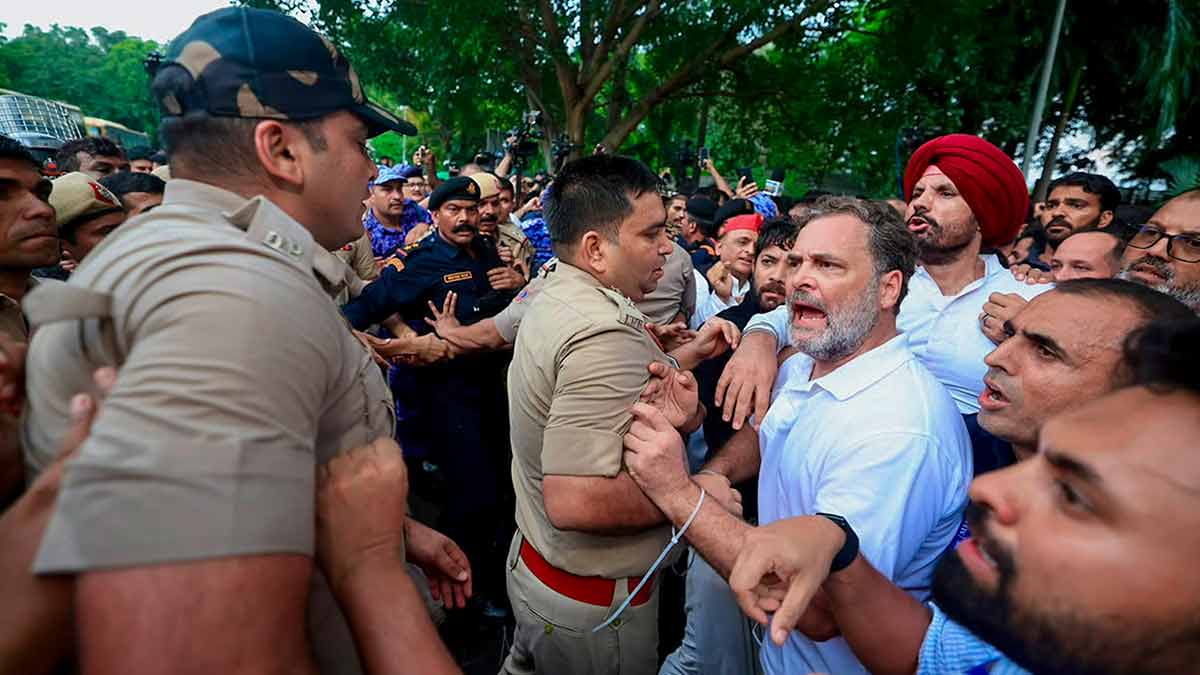
As tear-gas shells flew and lathis rained down, television cameras and an endless stream of social media posts captured the scenes of chaos: students being dragged away by policemen, visibly shaken young women, discarded placards, and injured protesters alongside wounded policemen. There were also scenes of vandalism. The police crackdown initially forced protesters to retreat, but many returned within hours—angrier, more resolute, and convinced that the movement had entered a new phase.
Abhishek Kumar, 26, who had travelled from Bihar, said he joined the demonstration in solidarity with students affected by the examination irregularities. “My brother appeared for the NEET examination,” he said. “The paper leak affected my family. This movement is about protecting the future of students, and I think it is important to stand with those demanding accountability.”
Another student, Chaitanya Madan of Delhi, said, “I saw videos of the police action. They were horrifying and a clear violation of human rights. I feel the protest can force the government to change.”
The movement gained legitimacy beyond social media when the 59-year-old educationist Sonam Wangchuk began an indefinite fast from the CJP stage at Jantar Mantar. The Delhi Police later removed him, citing his deteriorating health after a 21-day hunger strike during which he had lost more than nine kilograms.

A day after the violence, the Congress, which had largely stayed away from the agitation, escalated the issue. Leader of the Opposition Rahul Gandhi and Priyanka Gandhi Vadra, MP, visited Ram Manohar Lohia Hospital to meet injured student activists. Rahul then staged a sit-in outside Prime Minister Narendra Modi’s residence at 7, Lok Kalyan Marg. With that move, the country’s principal opposition party took the students’ cause to the prime minister’s doorstep and drew national attention to it.
When Union Minister of State Jitendra Singh’s attempt to persuade Rahul to end the protest failed, the Delhi Police moved quickly. Rahul was detained and taken to Chhatrasal Stadium, while Priyanka was taken to Mandir Marg police station. Samajwadi Party chief Akhilesh Yadav and several Congress MPs were detained at Kingsway Camp. Sonia Gandhi later arrived at Mandir Marg to join the detained leaders, helping create the optics that could serve as a booster shot to the Congress and its allies.
It was not the first time the BJP-led National Democratic Alliance government had faced mass protests. Over the past decade, the farmers’ agitation, the protests against the Citizenship (Amendment) Act and the wrestlers’ agitation had all drawn support from political parties and social groups largely outside the BJP’s traditional support base. The student protests, however, posed a new challenge. They drew in a large number of young people and their parents, many of whom had identified with the BJP’s nationalist appeal, making their growing discontent a political headache.
The BJP denies the criticism that it allowed the agitation to gather momentum before opening a dialogue. According to the party, it responded with restraint. Party MP Bansuri Swaraj said the Delhi Police had granted CJP founder Abhijeet Dipke permission to protest on the day he arrived in Delhi and allowed the demonstration to continue beyond the stipulated time.
“In a democracy, protesting is your right,” she said. “The government responded with empathy when there was a call for dialogue on July 20, the day of the march, by meeting them through [Union Minister J.P.] Nadda. The government asked them to withdraw the protest while it worked towards a solution, but they went back on their word.”
CJP spokesperson Ashutosh Ranka rejected the government’s version, describing the meeting as a “trap”. “We have been peaceful for 31 days at Jantar Mantar. The march was peaceful. It was only after the police used brutal force that peace was disturbed,” he said.
The protests have become both a lesson and a challenge for established political parties and their student wings. Although many had raised the issue of the NEET paper leak, none had succeeded in channelling the anger into a mass movement. Their space was instead occupied by the CJP and Dipke, a 30-year-old public relations graduate from Boston University.
Dipke may not have the appeal of a celebrity, but he understands how young people communicate. Gen Z has developed its own vocabulary, shaped by social media, internet culture and everyday online interactions. The CJP tapped into their idioms.
And, as crowds at Jantar Mantar grew, it also became a magnet that attracted people with their own grievances against the government.
Delhi has witnessed this trend before.
In April 2011, Anna Hazare launched a hunger strike demanding a special anti-corruption law. The India Against Corruption movement did not begin as an electoral project, but it eventually became one nonetheless. Within two years, one of Hazare’s closest associates, Arvind Kejriwal, had founded the Aam Aadmi Party and was fuelled by the movement’s momentum to power in Delhi. Dipke knows that history well. Before launching the CJP, he was part of the AAP’s social media operation during the 2020 Delhi assembly polls.
Unlike the Hazare movement, which was led by experienced activists who deliberately kept political parties at arm’s length, the current protests are driven largely by students with limited organisational experience. Several political parties joined the movement almost from the outset.
Among those who visited the protest site were CPI general secretary D. Raja, CPI(M) leaders M.A. Baby and Brinda Karat and CPI(Marxist-Leninist) Liberation general secretary Dipankar Bhattacharya. Arvind Kejriwal backed the CJP’s demand for Pradhan’s resignation. Uddhav Thackeray of the Shiv Sena (UBT) also visited in solidarity, while Rohit Pawar of the NCP (Sharadchandra Pawar) lent his support. CPI leader Annie Raja, who has been associated with the protest since its inception, said support for the movement was spreading beyond Delhi.
The Congress, though late in sending its leaders to the CJP stage, chose a different route. Rahul sought to amplify the issue through interventions in and outside Parliament, opening a new political front.
“Protesting is a constitutional right,” said Congress spokesperson Anshul Avijit, rejecting the BJP’s criticism of the opposition’s role in the agitation. He argued that the government had little moral authority to lecture the opposition on parliamentary discipline when youth unemployment, rising prices and a slowing investment climate remained unresolved.
According to Avijit, the anger on the streets reflected deeper economic anxieties rather than political provocation. He pointed to negative net foreign direct investment and manufacturing capacity utilisation remaining below 75 per cent as evidence of economic stress. Parliament, he said, had been reduced to “a marketplace” where MPs were bought and sold instead of debating issues such as repeated exam paper leaks. “Girl students come out to express their anger and you lathi-charge them,” he said, “Has this become China? Has this become North Korea?”
The BJP’s immediate priority will be to prevent the Gen Z discontent from evolving into a broader political unrest. “What began as a genuine student movement has been taken over by opposition parties for political purposes,” BJP spokesperson Tuhin Sinha said. “The Congress, the AAP and their allies have turned a legitimate student issue into a political campaign against the government. After repeated electoral defeats, they are trying to create instability rather than offering constructive solutions.”
The BJP is expected to counter the agitation by highlighting its record on systemic reforms, including anti-paper leak legislation and plans to make the NEET examination more secure through a possible shift towards digital testing. The BJP’s strategy is to argue that Gen Z is not represented only by those protesting under the CJP banner, but also by those who are employed, building startups and contributing to the country’s economic growth. Modi recently highlighted the average age of employees at Skyroot Aerospace while praising the company’s achievements, presenting them as another face of Gen Z.
The government is also expected to improve its engagement with Wangchuk. Removing Pradhan as education minister, however, appears unlikely. A veteran of many elections, he remains a key figure in the party leadership.
The protests have forced mainstream parties—and their student wings—to rethink how they engage with Gen Z.
The RSS-affiliated Akhil Bharatiya Vidyarthi Parishad accepts that the emergence of organic, non-political platforms such as the CJP posed a challenge to established student organisations. It conceded that traditional organisations have failed to communicate with young people in ways that resonate. But, at the same time, it says the CJP’s growth is aided by political “hijacking” and organised “toolkits”.
The ABVP also rejected the portrayal of Gen Z as a generation defined by internet slang and screen addiction. “Irregularities in competitive exams have increased the anxiety of millions of students across the country,” said ABVP national president Virendra Singh Solanki. “We have stood with students from the very beginning on these legitimate concerns. Any attempt to divert their genuine demands towards narrow political interests is an injustice to their welfare.”
All India Students’ Association (AISA) general secretary Prasenjit Kumar said the government remained “adamant” and had not engaged meaningfully with the protesters. “Instead of opening a dialogue, the government has tried to discredit the protesters,” he said. AISA, along with five other student organisations, is part of the coordination committee that decides the course of the agitation at Jantar Mantar.
SFI vice president Subash Jhakhar said the police crackdown intensified the student anger. According to him, the movement has spread beyond Delhi because of the wider anxieties over education, unemployment and police action.
University campuses have long served as nurseries for India’s political class. Leaders such as Arun Jaitley, J.P. Nadda, Ajay Maken and Sitaram Yechury all emerged from student politics before rising to prominence. Campus elections, however, traditionally revolved around both student issues and larger ideological debates.
According to political analyst Rahul Verma, a fellow at the Centre for Policy Research, Delhi, every generation has its defining political moment. In 2011, it was the Hazare movement. In the 1990s, it was the Mandal Commission protests.
“Dissatisfaction with the political system will always exist,” Verma said. “Every 20-25 years, a generation expresses it through a particular issue. It happened in the 1990s; it happened again in 2011; and now it is happening in 2026. These cycles are bound to recur.”
In 1974, Jaitley became Delhi University Students’ Union president before spending 19 months in jail during the Emergency. Yechury was arrested during the Emergency and later led the 1978 protest that forced Indira Gandhi to resign as JNU’s chancellor. Lalu Prasad, Nitish Kumar and Ram Vilas Paswan all rose to prominence during the Jayaprakash Narayan movement.
Against that backdrop, the CJP’s rise is striking. When it appeared on Instagram in June 2026, it did not need the approval of established student organisations. It bypassed them altogether. Student groups affiliated to left parties and the AAP joined the agitation once it gathered momentum.
“If you look at the last 10 to 12 years since this government came to power, all protests will tell you that mainstream parties didn’t start them,” Verma said. “These protests came about first, and then the opposition came to them. In that sense, this protest is not any different.”
Much will now depend on how the government responds. Verma does not believe the protests will trigger a structural political transformation. But since the movement is centred on the demand for the education minister’s resignation, its politics leaves the government without an effective counter-narrative.
“Earlier, the government could launch a counteroffensive because there was a policy or ideological debate,” he said. “Here, they don’t have a narrative, because this is about administrative failure. And a large number of protesters come from the government’s own social coalition—middle-class youth and their parents. That makes the politics much more complicated.”
