



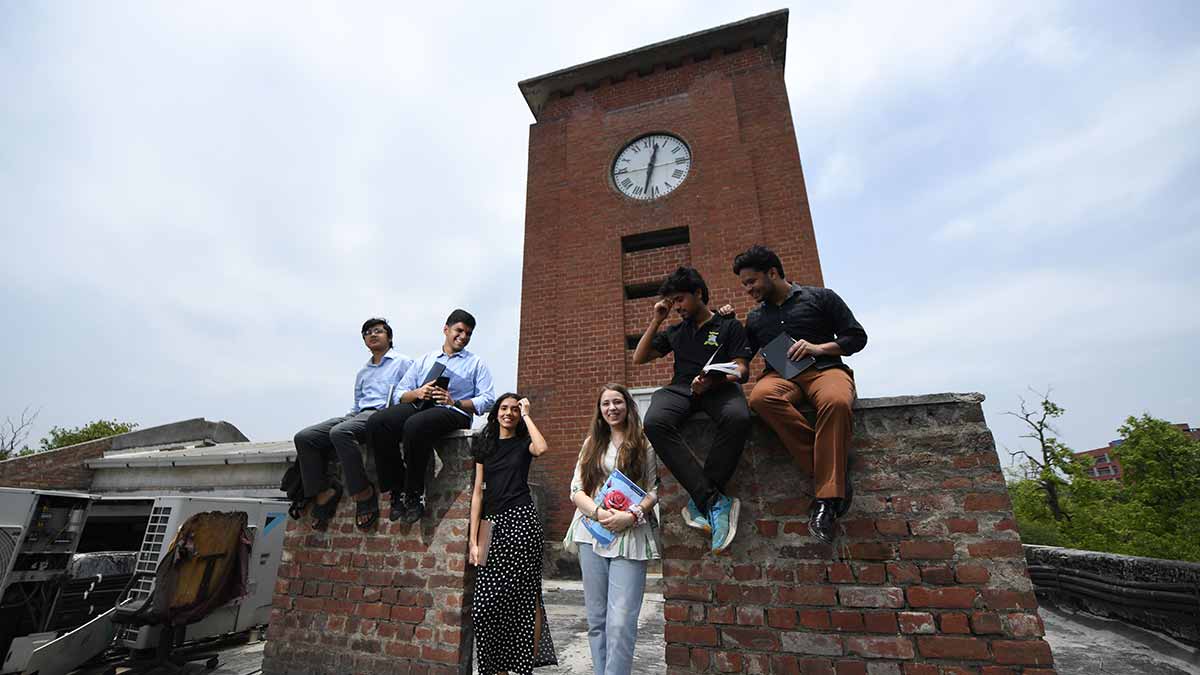
Not long ago, a commerce assignment at Shri Ram College of Commerce (SRCC) meant reproducing theoretical concepts on paper. This year, a faculty member replaced that with something different: students were handed publicly available government datasets and AI-assisted analytical tools and asked to investigate local economic issues and present policy recommendations. The quality of what undergraduate students produced, principal Simrit Kaur recalls, was remarkable. It was not an anomaly. It was a signal.
Across India’s top colleges, the lecture-and-examination model is being dismantled. In its place, institutions are building something harder to define but easier to recognise: a culture where students are expected not just to absorb knowledge but to question it, apply the learning and produce new knowledge.
At Lady Shri Ram College for Women (LSR) in Delhi, the top-ranked arts college in THE WEEK-Hansa Research Best Colleges Survey 2026, that culture has a name. The college is reimagining itself with “leadership, scholarship and reinvention”—a rebranding that signals a shift in ambition. Principal Kanika Ahuja describes a curriculum that now tests “the application of knowledge, the ability to critique and the ability to provide solutions”. Fourth-year students received a handbook titled A Beginner’s Guide for Research, attended weekly colloquia on research methodologies and participated in UGREE, the University of Delhi’s undergraduate research platform. The college’s research and publication forum has supported faculty and students alike in preparing for the new four-year honours programme. A forthcoming journal, Vimarsha: A Journal of South Asian Research, and more than 30 departmental publications reflect how seriously LSR is institutionalising this culture. The college has also conducted surveys with industry stakeholders, recruiters, think tanks and NGOs to align student research with policy-relevant challenges, with the aim of involving co-supervisors from industry to identify emerging research gaps. History students have worked on heritage conservation and women’s participation in panchayats; psychology students have designed mental health interventions for academic competitions. LSR alumnus and Bharatanatyam expert Geeta Chandran, a Padma Shri recipient, remembers the institution as a place where “girls from ordinary homes turned vocal activists”. That transformation is now being built into the academic structure itself.
At SRCC, the top commerce college in THE WEEK’s survey, there has been a complete change in approach. Classrooms have moved from textbooks to real-world datasets, policy dashboards and AI-powered tools. The college, which is celebrating its centenary this year, is launching a one-year programme with EY focused on artificial intelligence and its industry applications. Its “AI to AI” initiative (Ancient India to Artificial Intelligence) offers courses ranging from navigating life lessons from the Gita to Python and business intelligence, building competencies across Indian knowledge systems, machine learning and literature simultaneously. Student societies undertake policy consultations, sustainability initiatives and financial literacy campaigns. The journal Strides publishes original student research written under faculty mentorship—developing, as Kaur puts it, not just technical competence but “intellectual confidence and scholarly curiosity”.

A research project with the Competition Commission of India and another for the ministry of consumer affairs on consumer protection and legal metrology in ancient India reflect the college’s policy engagement. Over 2,500 faculty members across the country have been trained through SRCC’s Malaviya Mission Teacher Training Centre. The Business Conclave, one of Asia’s largest undergraduate management fests, brings politicians, corporate leaders and senior bureaucrats to engage directly with students. Alumni connections span over 20,000 people across the world, with meets held in Dubai and London.
Rajiv Memani, chairman of EY India and an SRCC alumnus, recently told Kaur that while real-world skills were learnt in the industry, “the foundations had already been provided by the college education”. That, Kaur says, is precisely the point. “Students should graduate not merely knowing existing answers but also learning how to ask meaningful questions,” she said.
At Delhi’s Hansraj College principal Rama describes the shift from “teacher-centred instruction to student-centred, inquiry-driven learning” as the most significant change of the past decade. Research projects, internships, fieldwork and digital tools—once peripheral—are now central to the student experience. Through a research development cell, innovation council and entrepreneurship cell, students work on sustainability, public health, artificial intelligence and entrepreneurship alongside faculty. Students of environment conduct field studies and propose solutions to local sustainability challenges; biotechnology and climate science students apply computational tools and mathematical modelling to contemporary problems.
NEP 2020 has accelerated the process, Rama says, but lasting reform comes only when institutions remain responsive to changing realities while keeping student learning at the centre. “Our alumni often tell us that while classroom learning gave them a strong academic foundation, it was the ability to communicate, collaborate, adapt and lead that made the biggest difference in their careers,” she told THE WEEK.
The Institute of Hotel Management Pusa in Delhi—alma mater to chefs Sanjeev Kapoor and Manjit Singh Gill—has taken experiential learning to its logical extreme. The Entrepreneurial Promotion Incubation Centre assigns students the task of running the college canteen as a live project. The students have turned remarkable profits, with food stalls run by them having operated at Bharat Parv and on the Red Fort grounds. Workshops on cocktails and mocktails, live housekeeping demonstrations and Harvard Business School case studies and management projects have all been integrated into the curriculum. A partnership with Le Meridian Hotel under an MoU gives food and beverage students hands-on industry training. Virtual simulations prepare students for the pace of the hospitality sector.
Principal Kamal Kant Pant describes a model that trusts students with ideas and responsibilities—“do it yourself” projects that develop entrepreneurial instinct rather than just technical skill. Soumya Makreti, from the batch of 2026, recalls a practical kitchen class where she learned about concentrated flavour products from plant lipids—“even one drop can enhance a dish”. She also contributed to the institute’s podcast, an experience she found “creative and useful”. The 2025-26 batch is the first to graduate under the JNU affiliation system, marking a structural transition for the institute.
At St. Xavier’s College, Mumbai—157 years old, with alumni including actor Shabana Azmi, cricketer Sunil Gavaskar and Pranjal Patil (the first visually challenged IAS officer)— research infrastructure is extensive. Thirteen recognised research centres provide platforms for interdisciplinary inquiry. Principal Karuna Gokarn notes that research now begins at the undergraduate level. Classroom practice has evolved in equally concrete ways: a geology faculty member who once taught watershed systems through diagrams now guides students in using GIS tools, field surveys and real environmental datasets to study river basins and land-use change. Project-based learning, community engagement and blended learning sit alongside lectures across disciplines.
The Xavier’s Resource Centre for the Visually Challenged, which began as a student support initiative, has grown into a nationally recognised model of inclusive education—students, faculty and volunteers collaborating to make learning accessible. “Innovation is not only about technology or scientific breakthroughs,” Gokarn said. “It is also about creating opportunities, removing barriers and ensuring that education remains inclusive and equitable.”
At Chennai's Loyola College—one of India's first autonomous colleges—freedom has become a formal research architecture. The Research and Development Cell, chaired by the principal, oversees an institution recognised as a scientific and industrial research organisation by the Union government. “We currently have 291 active research scholars pursuing PhDs across 16 disciplines,” said principal A. Louis Arockiaraj, SJ. “The ecosystem has shifted from a teaching-only identity to a teaching-and-research identity. That is the single most important evolution.”
The Loyola Institute of Frontier Energy brings chemists, economists and social scientists into shared work on sustainable development; a bio-fuel researcher now regularly consults colleagues on policy viability. Undergraduate research is funded directly—since a 2017-18 pilot, students have worked alongside PhD scholars on projects that now appear in peer-reviewed journals. In economics, students study inflation through their own neighbourhood’s micro-economy rather than theory alone.
Arockiaraj also points to what today's students demand. “They have grown up with on-demand access to the world's best explanations on YouTube and will not sit through a lecture that delivers less insight than a 12-minute video,” he said—adding that rising engagement with the college’s counselling centre reflects “growing trust and self-awareness”, not crisis.
Across these six institutions and other top colleges, the mantra now is what problem can I solve, not what career can I build. And, this is reshaping what college education in India looks like. The policy push of NEP 2020 helped. But the deeper shift has come from within, from colleges that decided a culture of inquiry was worth building, not just mandating.
